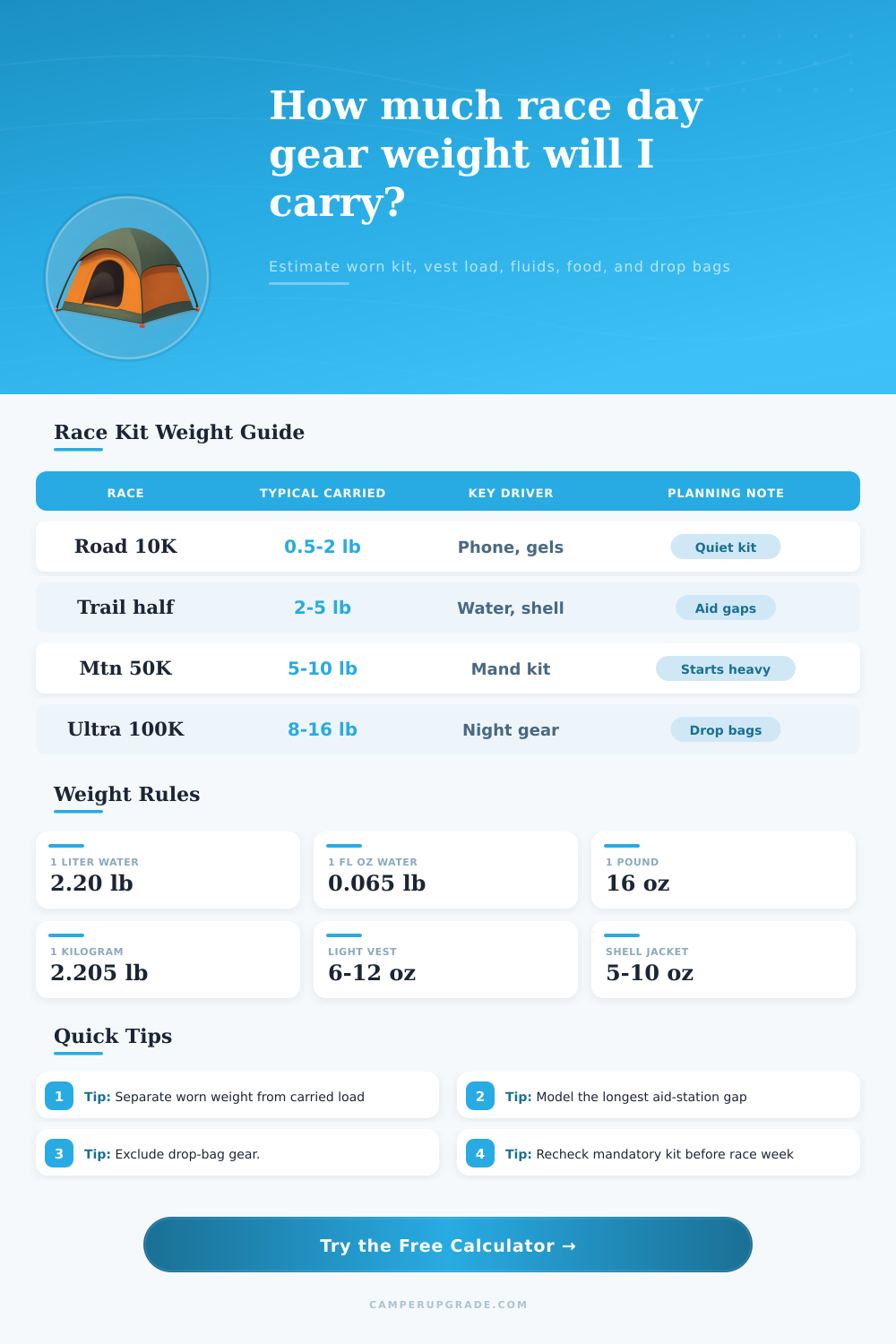
Race Day Gear Weight Calculator
Estimate the real weight of your race-day system: worn kit, vest load, fluids, fuel, mandatory gear, poles, drop bags, crew handoffs, and how the load changes between aid stations.
1.Race presets
2.Race profile
3.Worn gear and race kit
4.Carried gear
5.Fuel and fluids
6.Staging and extras
Race day weight estimate
7.Weight reference grid
8.Race load bands
| Start carried load | Band | Common race type | What to check |
|---|---|---|---|
| Under 2 lb / 0.9 kg | Light | Road 5K to half marathon, crewed events | Secure phone, gels, bib belt, and keys so nothing bounces. |
| 2-6 lb / 0.9-2.7 kg | Moderate | Trail half, marathon, short ultra | Fluid capacity and shell choice usually matter most. |
| 6-12 lb / 2.7-5.4 kg | Heavy | Mountain 50K, remote trail race, hot course | Practice the fully loaded vest on downhills and climbs. |
| Over 12 lb / 5.4 kg | Very heavy | Overnight ultra, severe kit list, fastpack stage | Use drop bags, staged poles, and aid refills to avoid overpacking. |
9.Typical item weights
| Item | Light | Typical | Heavy or cold-weather | Calculator field |
|---|---|---|---|---|
| Pair of race shoes | 14-18 oz | 18-24 oz | 24-32 oz | Shoes, pair |
| Running vest, empty | 5-8 oz | 8-14 oz | 14-22 oz | Empty vest or waist pack |
| Two soft flasks, empty | 2.5-3.5 oz | 3.5-5 oz | 5-8 oz | Empty bottles/flasks/bladder |
| Waterproof shell | 4-6 oz | 6-10 oz | 10-16 oz | Rain shell or wind shell |
| Warm layer and gloves | 4-7 oz | 7-13 oz | 13-24 oz | Insulation, gloves, buff, warm layer |
| Headlamp plus spare power | 3-5 oz | 5-9 oz | 9-16 oz | Safety kit or electronics |
| Compact poles, pair | 9-11 oz | 11-16 oz | 16-22 oz | Trekking/running poles |
| Food for one hour | 1.5-2.2 oz | 2.2-3.5 oz | 3.5-5 oz | Food and gels per hour |
10.Race-day packing checks
The thing about packing gear out is this: You don’t bring it out with the same weight you packed at home. It’s on you all the time. Your shoes and clothes stays on your body the whole way. Fluids and food change as you drink them, eat them and fill your bottles again. That vest alone move around as you fill and empty packs. Ounces here and there can mean the difference between a manageable beginning of the run and a difficult mile 18. Those ounces also alter what settles in your shoulders, how steady your breath remains and how much more every uphill is going to cost.
Simply input what you plan on carrying/gear, total body weight, length of your race, and longest aid gap and let the calculator do the work. It splits your load into carried vs. Worn items have different impacts. A shoe’s weight will impact running economy. A shoe’s weight won’t tug or bounce at your shoulders the way a loaded vest does.
Why Gear Weight Matters
This is why it matters when deciding if I can trust the forecast. Do I throw on an extra layer? Because water is heavy (and you can’t carry less of it), fluids makes up the bulk of calculations. Two pounds per liter, and that weight is at its highest right after you leave an aid station with full bottles. The “heaviest” section tend to be the one with the greatest distance between refills. This is why the calculator requests that figure different than the average time between stops. When your estimated capacity are less than expected for the next long run, the alert notifies you before race morning in case you need to tweak something.
The same is true for mandatory gear. Once you are out there, following weather and race rules no longer feels optional. What feels like a lightweight on a balmy day might be closer to a pound. But when you must meet full alpine requirements in a remote location including nights, it can push the overall weight up significantlly. Your choices make the tool pile on those layers automatically, so you aren’t underestimating what will have to go in your pack to ensure your safety.
This is why we have crew handoffs and drop bags. It’s because they allow you to stage extra calories, heavier layer or anything else that you know you’ll really want when you get there rather than carrying it all the way in. And by keeping the staged ounces out of the starting load it allows you to see the true difference between what you take off the line versus what you add on later. It also shows you just how little you might carry if you trust your plan.
After plugging in the numbers, most runners realize they’re carrying a moderate to heavy load. You can enter a target weight into the goal field and determine if it’s doable for the distance and conditions. The alert recommends concrete changes like eliminating duplicate layers or moving some food to the next aid station. It’s hard to make those adjustments on the side of the trail but much easier on a screen.
This will tell you what the load is as a percentage of your body weight. For most runners, the effort felt on uphill or downhill sections begins to be considered high at more than eight percent, particulary if the ground gets steep. It’s not a rigid guideline, just a convenient crosscheck on the body weight that you keyed in.
But here’s what will be more helpful in practice: Weigh your entire start setup, all bottles full of water and the rest of the gear (real batteries, real wrappers) when you’re ready to go. All those little things adds up to some weight once everything is put together. You should of checked this before. Run that loaded pack one time on a day where the biggest gap you model in the calculator occurs, and see if the numbers on the screen correlate to how hard you think it’ll be to run.