Quilt vs Bag Warmth Calculator
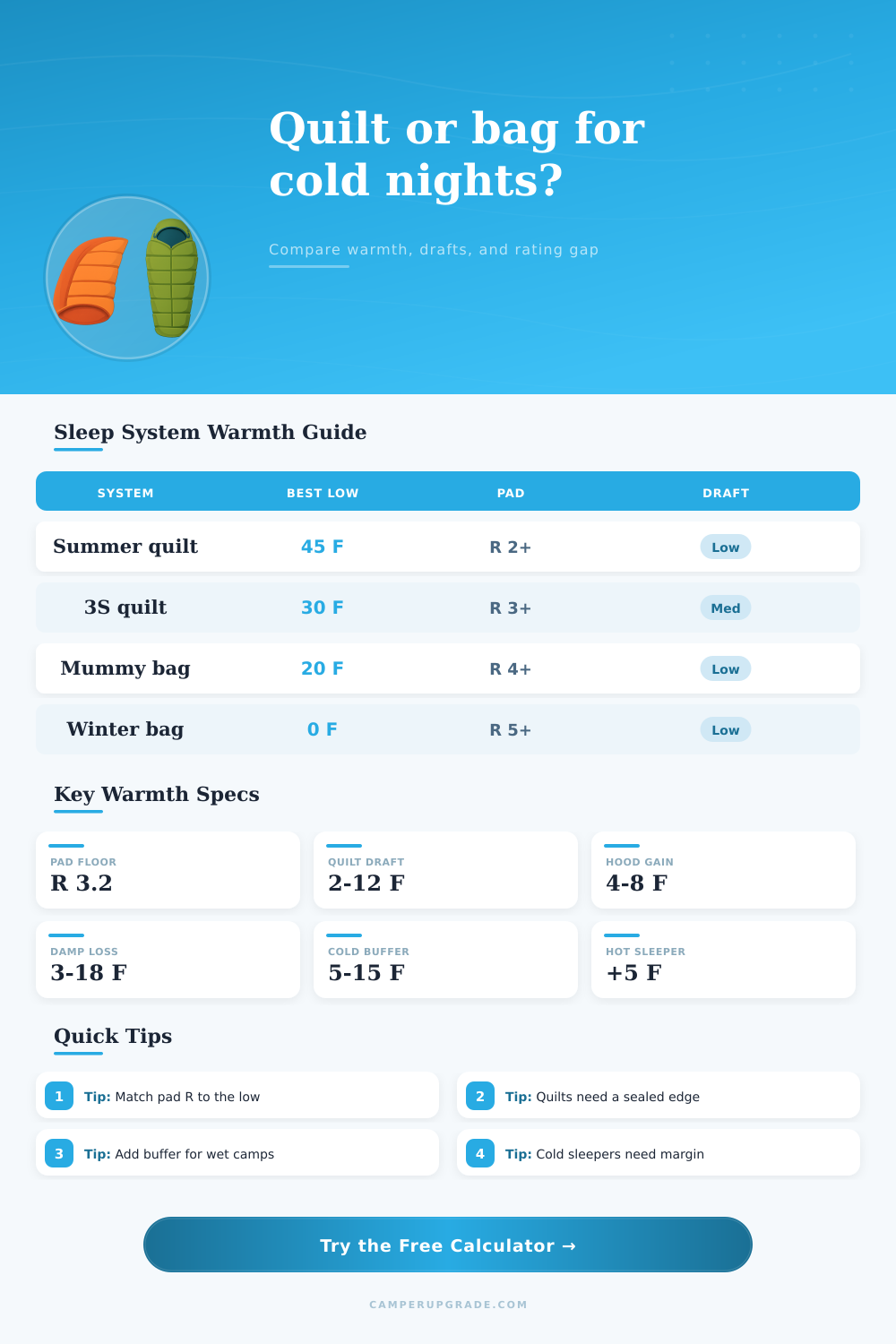
Compare a backpacking quilt and sleeping bag after pad R-value, drafts, hood coverage, clothing, dampness, sleeper metabolism, and safety buffer are included.
🏕Quilt and Bag Trip Presets
⚙Night, Pad, Quilt, and Bag Inputs
The model estimates a campsite warmth requirement, then adjusts the quilt and bag ratings separately for pad shortfall, drafts, hood coverage, fit, damp loft, clothing, metabolism, fatigue, and buffer.
📊Warmth Modifier Spec Grid
📑Reference Tables
| Rating term | What it means | Use in calculator | Watch point |
|---|---|---|---|
| Comfort rating | Most useful comparison number | Best input for both quilt and bag | Many quilts use maker-specific testing. |
| Limit rating | Lower, less comfortable survival-leaning number | Add extra buffer if used | Cold sleepers may miss by 10 F or more. |
| Extreme rating | Emergency-only marketing number | Do not use as comfort input | Not a trip-planning warmth target. |
| User-tested rating | Your field result in similar conditions | Often the most honest input | Only valid with a similar pad and shelter. |
| Expected low | Minimum R | Better target | Why it matters |
|---|---|---|---|
| 50 F / 10 C | R 1.5 | R 2.0 | Warm ground usually needs modest insulation. |
| 35 F / 2 C | R 2.5 | R 3.2 | Three-season lows punish thin pads. |
| 20 F / -7 C | R 3.8 | R 4.5 | Cold ground can overpower warm top loft. |
| 0 F / -18 C | R 5.0 | R 6.0+ | Winter systems need serious bottom insulation. |
| Feature | Quilt effect | Bag effect | Calculator lever |
|---|---|---|---|
| Side drafts | Main risk near rating | Usually lower unless zipper leaks | Width, straps, toss-turn leakage |
| Head warmth | Requires hat or hood | Built-in hood can seal heat | Headwear and hood quality |
| Dead air | Less compressed underside fabric | Fit can be trim or roomy | Bag cut and quilt width |
| Moisture | Open edges can vent or leak heat | Closed shell holds warmth but can trap dampness | Dampness and loft condition |
| Scenario | Likely better | Needed check | Main risk |
|---|---|---|---|
| Warm summer backpacking | Quilt | Pad still adequate | Unexpected cold valley camp |
| Wet shoulder-season tent | Close call | Loft and head warmth | Damp insulation and fatigue |
| Windy tarp below freezing | Bag | Draft collar and pad R | Side leaks or exposed ground |
| Hammock top insulation | Quilt | Underquilt or pad R | Wind stripping heat below |
💡Warm Sleep Planning Tips
This calculator is a planning estimate, not a lab rating. Use conservative margins for hypothermia risk, remote trips, wet insulation, medical concerns, or unfamiliar sleep systems.
When choosing between a quilt and a sleeping bag for camping, you have to make that decision based off how much heat you can manage in your sleeping environment. Many peoples look at the temperature rating of the sleeping bag or quilt to determine how warm it will keep you while you are sleeping. However, the temperature rating of the sleeping bag or quilt isnt the only factor that will affect the warmth of the sleeping system that you have chosen for camping.
One of the main factor to consider is the R-value of the sleeping pad that you will be using for camping. Regardless of how warm the sleeping bag or sleeping quilt is rated to be, if the sleeping pad does not effectively limit the amount of heat that is lost from your body to the ground while sleeping, you will feel cold while sleeping. For instance, using a sleeping bag that is rated to 20 degree may cause you to feel cold if the sleeping pad does not retain your body heat.
How to Choose a Sleeping Bag or Quilt to Stay Warm
Heat loss occurs underneath the sleeping bag or sleeping quilt while sleeping. Additionally, the exposure level to the wind while sleeping is another of the main factor to consider. The sleeping bag or sleeping quilt may retain heat for you while sleeping in a tent, but will not retain that heat effective if you are sleeping under a tarp that allows the wind to come into contact with your sleeping system.
Another factor to consider is the way that sleeping bags and quilts interacts with heat and air within their system due to their physical shapes. Sleeping bags are a closed system that can retain heat, but may also lead to condensation within the sleeping bag under the sleeping bags insulation. Quilts are an open system due to the edges of the quilt not being seal.
Therefore, heat can escape from the sleeping quilt if the sleeping person move in their sleep or pushes against the quilt away from the sleeping pad. Additionally, sleeping bags often come with a hood to cover the sleeping persons head while sleeping, but quilts do not include a hood. Thus, a person using a sleeping quilt must use a separate sleeping hat to cover their head when sleeping.
Another factor to consider is the level of dampness of the sleeping bag or sleeping quilt and the loft of the insulation within the sleeping system. If the sleeping bag or sleeping quilt becomes damp, the loft of the insulation can collapse, especially if the insulation uses synthetic fill or down fill instead of down alternative material. If the loft of the sleeping bag or quilt insulation do collapse, the sleeping system will not be able to retain as many warm air for the sleeping person.
Additionally, if the sleeping bag or sleeping quilt contains old or dirty insulation, that insulation will not be able to retain as much heat as if the sleeping bag or sleeping quilt were clean and new. Thus, the condition of the sleeping bag or sleeping quilts insulation is a factor to consider when sleeping. Finally, your bodys own temperature and sleeping habits may affect the warmth that you feel from your sleeping bag or sleeping quilt.
For instance, some people naturaly feel warmer while sleeping then others. If you tend to feel cold when sleeping, you may have different sleeping habits than people that feel warm while sleeping. For instance, you may sleep in more layers of clothing or eat meals that contains warm ingredients to feel as warm while sleeping as others who have different sleeping habits.
Your goal should of be to find a sleeping bag or sleeping quilt that allows you to maintain a reliable margin of warmth during your camping trip. Therefore, choose the sleeping system that provide for you the largest margin of warmth above the temperature that you will need to feel warm while sleeping. This margin of warmth is important in case the temperatures while sleeping are even colder than those indicated on the weather forecast.
Thus, do not select a sleeping bag or sleeping quilt based solely upon its temperature rating. Instead, select a sleeping bag or sleeping quilt based upon its sleeping pad, its exposure to the wind, its dampness, and your own sleeping need.