Quilt Baffle Size Calculator
Estimate chamber spacing, baffle strip cut width, net loft, down fill weight, and per-chamber fill amounts for camping quilts, top quilts, and hammock underquilts.
| Preset | Finished size | Loft target | Typical build note |
|---|---|---|---|
| 50F summer top quilt | 72 x 50 in | 1.2 in | Wide spacing and light overstuff for warm nights |
| 30F backpacking quilt | 78 x 54 in | 2.0 in | Balanced three-season spacing with 850 fp down |
| 20F wide quilt | 78 x 58 in | 2.4 in | More shoulder width and moderate taper |
| 10F winter quilt | 80 x 56 in | 3.0 in | Narrower chambers and higher overstuff |
| 0F expedition quilt | 82 x 60 in | 3.5 in | Tall baffles with 900 fp down and 35% overstuff |
| Hammock underquilt | 76 x 45 in | 2.5 in | Differential cut protects loft under suspension |
| Double camping quilt | 82 x 82 in | 2.3 in | Extra width and broader drape volume |
| Kids camp quilt | 60 x 42 in | 1.6 in | Short pattern with smaller chamber count |
| Edge-to-edge summer | 70 x 48 in | 0.8 in | Low loft sewn-through or very short baffle strip |
| Temperature class | Single-side loft | Suggested spacing | Overstuff cue |
|---|---|---|---|
| 50F / 10C summer | 0.8-1.3 in | 5.5-6.5 in | 8-15% keeps fill mobile but controlled |
| 40F / 4C mild shoulder | 1.4-1.7 in | 5.0-6.0 in | 12-18% works for light three-season quilts |
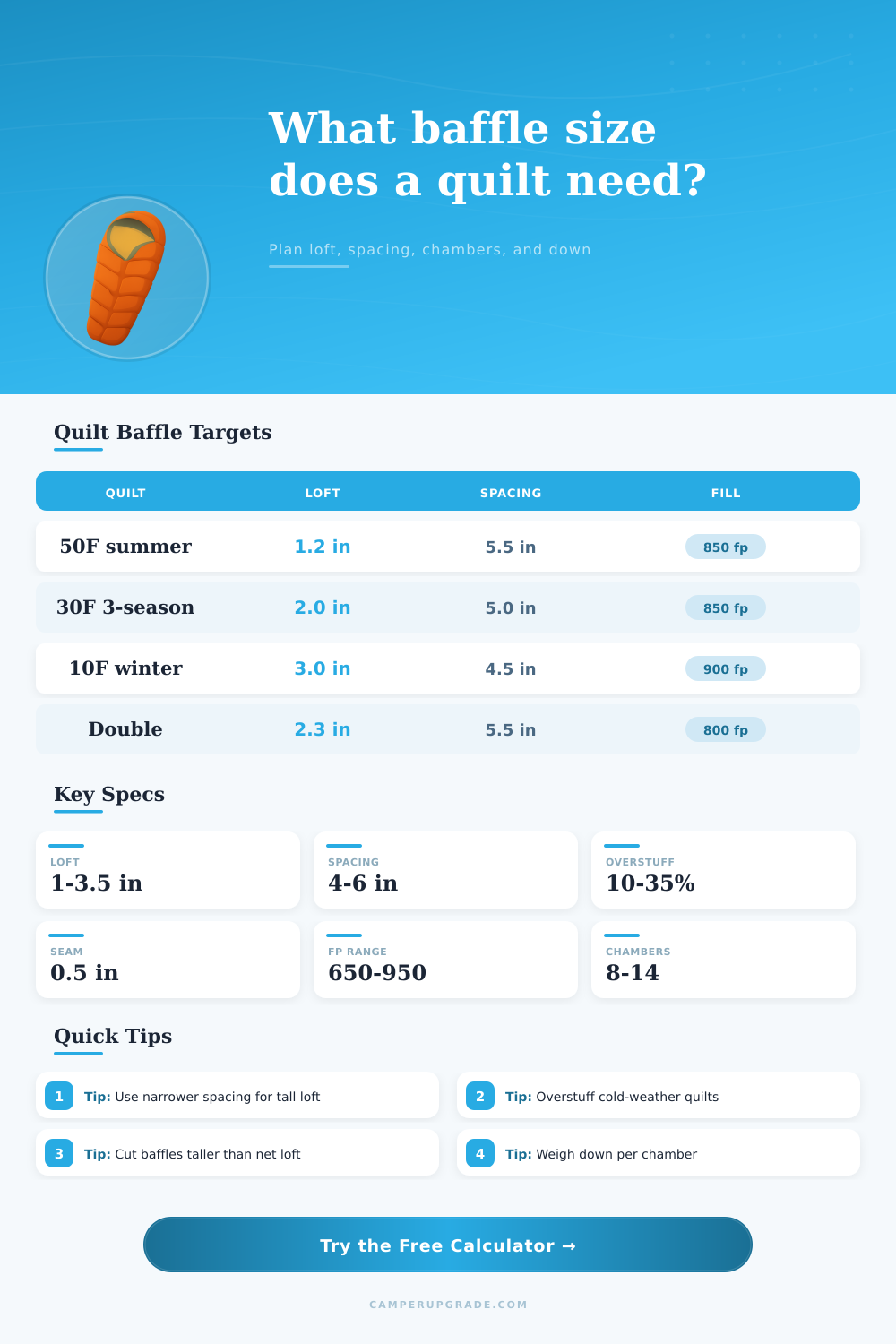
| 30F / -1C three-season | 1.8-2.1 in | 4.8-5.5 in | 15-25% is common for backpacking use |
| 20F / -7C cold | 2.3-2.6 in | 4.5-5.2 in | 20-30% helps limit cold spots |
| 10F / -12C winter | 2.8-3.2 in | 4.2-4.8 in | 25-35% favors stability over minimum weight |
| 0F / -18C deep winter | 3.3-3.8 in | 4.0-4.6 in | 30-40% for tall chambers and harsh use |
| Fill power | Volume per ounce | Down per 1000 cu in | Where it fits |
|---|---|---|---|
| 650 fp | 650 cu in/oz | 1.54 oz | Durable budget or car-camping quilts |
| 700 fp | 700 cu in/oz | 1.43 oz | General DIY builds with forgiving handling |
| 750 fp | 750 cu in/oz | 1.33 oz | Moderate weight backpacking quilts |
| 800 fp | 800 cu in/oz | 1.25 oz | Common premium outdoor quilt fill |
| 850 fp | 850 cu in/oz | 1.18 oz | Light three-season and winter builds |
| 900 fp | 900 cu in/oz | 1.11 oz | High-end backpacking quilts |
| 950 fp | 950 cu in/oz | 1.05 oz | Ultralight builds with careful down handling |
| Construction choice | Math setting | Best use | Watch point |
|---|---|---|---|
| Sewn-through rows | 0.20 baffle factor | Very warm-weather quilts | Stitch lines create cold strips |
| Low mesh baffle | 0.85 baffle factor | Summer or mild shoulder-season quilts | Do not over-compress tall loft |
| Balanced box baffle | 0.95-1.00 factor | Most top quilts and underquilts | Keep chamber fill weights consistent |
| Tall box baffle | 1.10 baffle factor | Winter quilts with high loft | Requires careful differential sizing |
| Differential underquilt | 8-15% outer width | Hammock quilts under body tension | Inner shell should not sag loose |
| Double quilt drape | 1.12 volume factor | Wide two-person quilts | Down migration needs enough chambers |
When you build a down quilt, you must make a decision about the size of the chambers that will contain the down. The size of these chambers will determine how much the down can move within the quilt, how thick the loft of the down will remain during the night, and how much the down will weigh altogether. The most important measurement to establish when building chambers is the distance between each of the baffle walls.
If the distance between each baffle wall are too large for the amount of down that you’re going to use within the quilt, the down will collapse onto itself into the lowest point of the quilt, creating cold spots on the body within the quilt. If the distance between the baffle walls is too small, though, then the baffle walls will add to the weight of the down quilt and make it feel stiff and difficultly to move when sleeping on. Many individuals likes to choose a distance between the baffle walls of between four and six inches; this distance ensures that the down cannot travel too far between each chamber, yet allows the shell of the quilt to drape around the shoulders and hips of the sleeping individual.
Choosing baffle size and loft for a down quilt
The target loft of the down quilt will influence the geometry of the quilt. Summer down quilts may have a loft of only one and a quarter inch of down. Winter down quilts, in comparison, may require three inches of loft.
Because the baffle strips will need to allow for the down to reach the target loft, the baffle strips has to be tall enough to allow for that many inches of loft. In calculating how wide the strips of down should be cut, though, allowance has to be made for the finished height of the baffles and for the seam allowance that you will use when sewing the quilt together; calculating these variables incorrectly will result in a down quilt that is under-lofted. The temperature that the down quilt will handle will influence the size of the baffles.
Quilt temperatures that are lower will allow for the baffles to be narrower so that the down has more loft; the greater loft require more support so that it does not dissapears within the down quilt altogether. Milder temperatures will allow for the baffles to be spaced further apart from one another. The same concept can be applied to quilts that have different shapes than rectangular quilts; for instance, a quilt that tapers along its length will require that the average width of each of the chambers be calculate so that the down will distribute evenly along the body.
Another variable in building down quilts is the overstuff percentage of the down. While this may seem like an overlooked variable, you can add extra down to the quilt beyond the calculated volume of the down. The extra down will allow for forgiveness in the event that the chambers becomes compressed when you sew the quilt, and when the individual sleeps within the quilt.
For summer down quilts, ten percent extra down may be all that is needed; for cold weather, though, thirty percent extra down is recommended. This extra down will help to prevent the loft of the down from flattening against the body; the negative effect of this extra down is the increase in the total weight of the quilt. Fill power will change the weight of the down that is used in the quilt, but will not change the dimension of the quilt.
If the down that is used has a higher fill power, it will contain more volume per ounce; hence, you can reduce the total weight of the down while still maintaining the target loft of the quilt. With the same target loft, then, the baffle strips will be of the same height; the total weight of the down will decrease with higher fill power. Using higher fill power to build the down quilt is beneficial in that it reduces the weight of the down that is used; however, it is also more expensive and more difficult to handle than low fill power down.
Another consideration for quilts is the edge allowance and the outer shell differential for the quilt. The edge allowance allow for the down to remain in the quilt at the edges of the quilt where it will be less likely to recieve a full fill from the body; the outer shell differential allows for the outer shell of the quilt to curve around the sleeping individual without flattening the down within the quilt. These two variable are essential to the construction of the quilt; they will prevent the calculated loft from dissapearing within the down quilt when the sleeping individual moves during the night.
The last step in constructing the quilt is to test the strips of down baffle that you will use for the quilt along a cutting mat. Ensuring that the calculations of the width of the baffle strips will result in the down reaching the target loft will ensure the success of the rest of the construction of the down quilt. If the strips are too short, or if the distance between the baffles is likely to lead to the down not being able to reach the target loft, the down quilt will not perform correct.
Thus, prior to cutting any fabric, the individual must decide the temperatures that the down quilt will be able to handle.