Pulk Drag Calculator
Estimate how much force a winter sled takes to pull from load weight, sled shell weight, snow friction, runner style, slope grade, harness efficiency, wind exposure, and travel distance.
🛷Pulk Trip Presets
⚙Load, Snow, Slope, and Friction Inputs
This calculator estimates steady pulling force for planning. Actual effort changes with snow temperature, packing, terrain breaks, skiing technique, and fatigue.
📐Four Drag Formula Cards
Total Mass
cargo + sledThe pulk shell, traces, poles, and packed gear all contribute to normal force on the snow.
Flat Drag
W x mu x cos(theta)Snow friction coefficient times the slope-adjusted normal force gives the sliding component.
Grade Drag
W x sin(theta)Uphill slope adds a gravity component. Downhill slope can reduce pull or create braking need.
Harness Pull
drag / efficiencyHarness and pole angle losses increase the force the traveler feels at the waist or hips.
❄Snow and Sled Specification Grid
📊Pulk Drag Force Tables
| Total Weight | Packed Snow | Cold Powder | Wet Snow |
|---|---|---|---|
| 50 lb | 3 lbf | 6 lbf | 9 lbf |
| 75 lb | 5 lbf | 8 lbf | 14 lbf |
| 100 lb | 6 lbf | 11 lbf | 18 lbf |
| 125 lb | 8 lbf | 14 lbf | 23 lbf |
| 150 lb | 9 lbf | 17 lbf | 27 lbf |
| Grade | 100 lb Packed | 100 lb Powder | 100 lb Wet |
|---|---|---|---|
| 0% | 6 lbf | 11 lbf | 18 lbf |
| 2% | 8 lbf | 13 lbf | 20 lbf |
| 4% | 10 lbf | 15 lbf | 22 lbf |
| 6% | 12 lbf | 17 lbf | 24 lbf |
| 10% | 16 lbf | 21 lbf | 28 lbf |
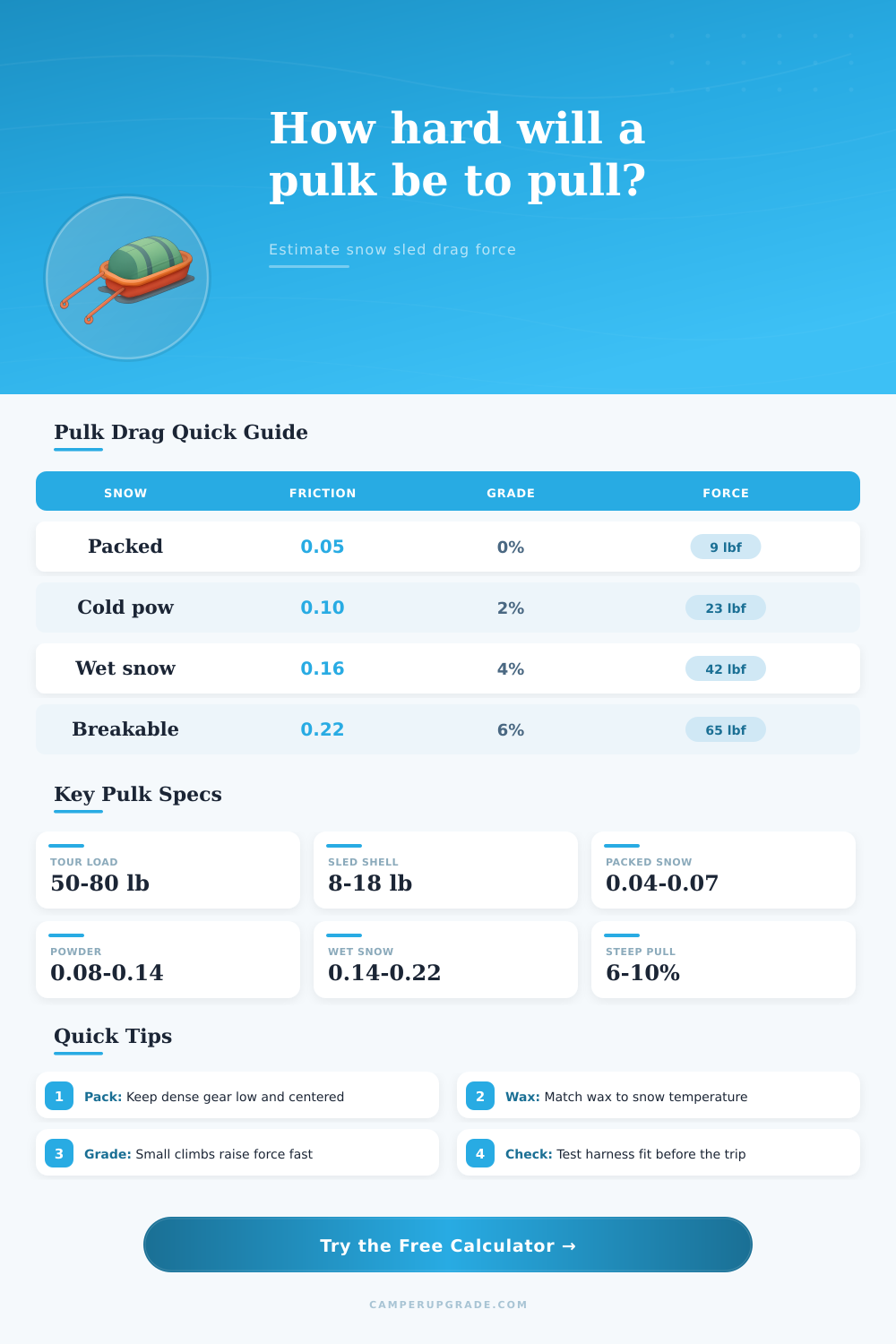
| Snow Surface | Coefficient | Best Estimate | Use When |
|---|---|---|---|
| Glare ice | 0.02-0.04 | 0.03 | hard crust |
| Packed trail | 0.04-0.07 | 0.06 | firm track |
| Cold powder | 0.08-0.14 | 0.11 | dry snow |
| Wet snow | 0.14-0.22 | 0.18 | sticky snow |
| Breakable crust | 0.18-0.30 | 0.24 | punchy crust |
| Runner Setup | Multiplier | Effect | Typical Use |
|---|---|---|---|
| Waxed ski | 0.88x | lowest | cold tours |
| UHMW runner | 1.00x | baseline | most pulks |
| Plastic tub | 1.12x | moderate | utility sled |
| Wide tub | 1.18x | higher | soft snow |
| Scratched base | 1.28x | highest | dirty base |
💡Pulk Drag Planning Tips
The pulk drag calculator are a tool that calculates the force that is required to pull a sled on snow. There are various field within the calculator in which you can enter data about your trip, such as the weight of your cargo, the weight of your sled, the snow condition, your runner type, slope grade, harness efficiency, and the distance that you will travel on your sled. The calculator will allow you to view the effect that each of these variable will have upon the total force that you will have to exert while on your trip.
Furthermore, because the snow conditions may change during the trip, the calculator allow you to estimate how each of these variables will have an effect upon your trip. The total weight that you will apply to the snow will include both the weight of your cargo and the weight of your sled. The total weight of your sled will include the shell of the sled, the poles, traces, and your harness.
How the pulk drag calculator works
Your cargo will include the items that you have within your sled. The heavier of your total weight will lead to an increase in the force of friction between your sled and the snow. An increase in the force of friction will lead to an increase of the force that you have to use to pull your sled.
The pulk drag calculator separates the weight of the cargo from the sled because the weight of your cargo is a variable that you can change, but the weight of your sled will remain constant. The friction that your runners will experience with the snow will change according to the type of snow that you will encounter. If you encounter packed snow, there will be less friction between your runners and the snow.
Less friction will make it so that you dont have to use as much force in order to pull your sled. If the snow that you encounter is fresh powder and crusty snow, there will be high friction between your runners and the snow. High friction will require that you use more force in order to pull the sled.
These types of snow can be selected in the calculator to indicate the type of friction that will be experienced. Furthermore, if the temperature change throughout the day, the type of snow may change as well. The type of runners that you use will also change the friction that is experienced by your sled.
If the runners are waxed, there will be less friction between the runners and the snow. Furthermore, if the snow that you are traveling on is packed, you may want to opt for a set ski track that allows your sled to remain on a prepared path rather than traveling through deep snow or traveling on a sidehill to which you will have to steer your sled. These factors will impact the total effort that you use to pull your sled.
The grade of the slope on which you will be traveling will impact the total force that you must use. On flat ground, you will only have to overcome the friction between your sled and the snow. On an uphill slope, however, in addition to the friction force you will have to overcome, you will also have to utilize the force necessary to lift the total weight of your sled and its cargo.
The calculator accounts for uphill and downhill slopes differently because uphill slopes will require that you use more force to pull your sled, while downhill slopes may require that you utilize braking force. The slope grade that you select will allow you to indicate the total gravitational force that will act upon your total load of cargo and sled. Your harness system and the rest that you will take during your trip will also impact the total effort that you will use to pull your sled.
The efficiency of the harness system will impact how much energy from your body is transferred to your sled. If your harness system is rigid, more of your energy can be transferred to the sled. If your harness system is less efficient, such as if it is more loose than a rigid system, then more of your energy will be lost to swaying and bouncing of the sled.
An inefficient harness system will require you to exert more effort to pull your sled. The rest that you will take during your trip will account for the stops that you will take to turn your sled. When you are taking rests, the pull force on your sled can be averaged over the entire trip.
The result of the pulk drag calculator will provide a variety of measurements of the force that you will use to pull your sled. One measurement will be of the total pull force that you will feel at your waist or your hips. Additionally, there will be measurements that indicate the effort and the work that you will perform in relation to the distance that you will travel.
Furthermore, there will be a drag ratio that indicates the relationship between the total pull force that you will use and the total weight of your sled and cargo. Finally, there will be a breakdown of the force that was used to calculate your total effort, indicating how much of the force was required to overcome friction between your sled and snow, the slope grade that you traveled, and any extras with the terrain upon which you traveled. The pulk drag calculator allows you to select various trip scenario that you would like to test out.
For example, you could use the calculator to determine the effect that changing the type of runners that you use will have upon the total effort that you must use to pull your sled. Additionally, you could use the calculator to determine the effect that reducing your total cargo will have upon your total effort for the trip. Additionally, it is important to run the calculator for different types of snow conditions because the difference between packed snow and powder snow could have a larger impact upon your trip than the difference between a light load of cargo and a heavy load.
Thus, by using this calculator, you can anticipate the impact of each of these variable on your trip prior to setting out on your journey. You should of checked the weather first. Its actualy helpful to know the conditions.
You’ll find that the weight matter alot when your pulling a heavy load.