Prusik Cord Length Calculator
Estimate cord cut length, finished folded loop length, wrap consumption, cord-to-rope diameter ratio, and compatibility notes for prusik loops, autoblock backups, glacier travel, rescue kits, and hauling hitches.
🧵Prusik Cord Presets
⚙Calculator Inputs
Planning only: a friction hitch must be tested with the exact rope, cord, wraps, loading direction, carabiner, gloves, and conditions. Follow current manufacturer instructions and qualified climbing or rescue training.
📊Cord Spec Grid
📋Prusik Preset Table
| Preset | Main rope | Cord | Loop target and wraps |
|---|---|---|---|
| Rappel backup | 9.8 mm single rope | 5.5 mm sewn or cord loop | 45 cm folded loop, 3 wraps |
| Classic 6 mm loop | 9.8 to 10.2 mm rope | 6 mm accessory cord | 55 cm folded loop, double fisherman's |
| Skinny single rope | 8.9 to 9.2 mm rope | 5 mm to 5.5 mm cord | 48 cm folded loop, 3 wraps |
| Glacier travel | 8.0 to 9.0 mm rope | 5 mm to 6 mm cord | 60 cm folded loop, 3 wraps |
| Crevasse kit long loop | 8.5 to 10 mm rope | 6 mm cord | 100 cm folded loop, 3 wraps |
| Progress capture | 10 to 11 mm rope | 7 mm cord | 70 cm folded loop, 4 wraps |
| Rescue 7 mm loop | 10.5 to 11 mm rope | 7 mm cord | 80 cm folded loop, 4 wraps |
| Static 11 mm rope | 11 mm low-stretch rope | 7 mm to 8 mm cord | 75 cm folded loop, 4 wraps |
| Wet rope extra grip | 9.5 to 10.5 mm rope | 6 mm cord | 62 cm folded loop, 4 wraps |
| Short reach loop | 9.5 to 10 mm rope | 6 mm cord | 38 cm folded loop, 3 wraps |
| Ratio band | Meaning | Likely behavior | Action |
|---|---|---|---|
| Below 50% | Very thin cord | May bite hard and be difficult to release | Use only with expert judgment |
| 50% to 55% | Thin but common | Strong grab, more jamming risk | Test carefully |
| 55% to 72% | Preferred planning band | Balanced grab and release | Good starting point |
| 72% to 80% | Thick cord | May slide before grabbing | Add wraps or downsize cord |
| Above 80% | Too close to rope size | Often poor prusik bite | Choose smaller cord |
| Knot type | Allowance model | Use note | Tail note |
|---|---|---|---|
| Double fisherman's | 16 x cord diameter | Common cord loop bend | Dress and inspect tails |
| Triple fisherman's | 20 x cord diameter | Often used for slick cord | Bulkier and harder to untie |
| Offset overhand bend | 14 x cord diameter | Compact but requires care | Use generous tails |
| Water knot or tape knot | 18 x cord diameter | More common in webbing | Tails can creep |
| Sewn prusik loop | Manufacturer length | Use labeled finished length | Do not retie stitching |
🧮Wrap and Reach Reference
| Wrap count | Typical use | Length consumed | Handling note |
|---|---|---|---|
| 2 wraps | Autoblock-style backup or larger cord | Lowest wrap consumption | May slide more easily |
| 3 wraps | General prusik loop starting point | Moderate consumption | Common balance of grab and release |
| 4 wraps | Slick, wet, thin, or rescue loads | Higher consumption | Grabs harder and may bind |
| 5 wraps | Special cases only | High consumption | Can be hard to dress and release |
📏Accessory Cord Reference
| Cord diameter | Common rope match | Typical role | Planning caution |
|---|---|---|---|
| 4 mm | Small utility cord only | Gear tie, tag line tasks | Usually too thin for life-safety prusik use |
| 5 mm | 8 to 9.5 mm ropes | Light glacier or backup loops | Can bite hard and wear faster |
| 5.5 mm | 8.5 to 10 mm ropes | Sewn prusik or supple cord loop | Check heat and sheath compatibility |
| 6 mm | 9 to 10.5 mm ropes | All-around prusik loop | Popular balance for many climbing ropes |
| 7 mm | 10 to 11.5 mm ropes | Hauling, rescue, larger static lines | May be too thick on skinny ropes |
| 8 mm | 11 mm and larger lines | Rescue or rope access context | Often poor bite on common climbing singles |
💡Prusik Length Tips
This calculator estimates cordage dimensions only. It does not certify any knot, hitch, rope system, rescue setup, or climbing technique.
A Prusik knot is an type of loop that is used in a variety of climbing and rescue situations. The length of the Prusik knot is a critical factor in the function of the knot; if the length of the knot is too short, it may slip on the rope that it is meant to hold, but if the length of the knot is too long, it may become too grippily with the rope that it is tied to such that it cant be released when needed. The amount of cord that is used to create the knot determines the length of the knot; thus, to create a knot of a specific length, you must calculate the amount of cord that is necessary to create that length.
The amount of cord that is necessary for creating a Prusik knot of a specific length can be calculated using the calculator that is provided on this page. The calculator perform its calculations based off the specific inputs of the diameter of the rope upon which the knot will sit, the diameter of the cord that will form the knot, the length of the knot that is desired, the number of wraps that will be made around the rope, and the type of knot that will be created. Each of these variable impacts the length of the knot; for instance, the diameter of the rope will impact the amount of friction that the knot creates with the rope, the diameter of the cord will impact the friction between the knot and the rope, the number of wraps will impact the length of the cord that is consumed by the knot, and the type of knot will impact the length of the cord that is consumed by the knot itself.
How to Find Cord Length for a Prusik Knot
In addition to these variables, many who is learning to create a Prusik knot often overlook the length of the cord that is consumed by the wraps of the knot; for instance, if a knot is to have three wraps made around a rope of a ten-millimeter diameter, those three wraps will use some of the cord that is provided, thus shortening the length of the knot. If, additionally, a fourth wrap is to be made due to the conditions of the climbing or rescue operation being wet or icy, the addition of that fourth wrap will again shorten the length of the knot. Thus, the calculator is another means of determining the length of the knot that will remain after the cord is consumed by the wraps of the knot.
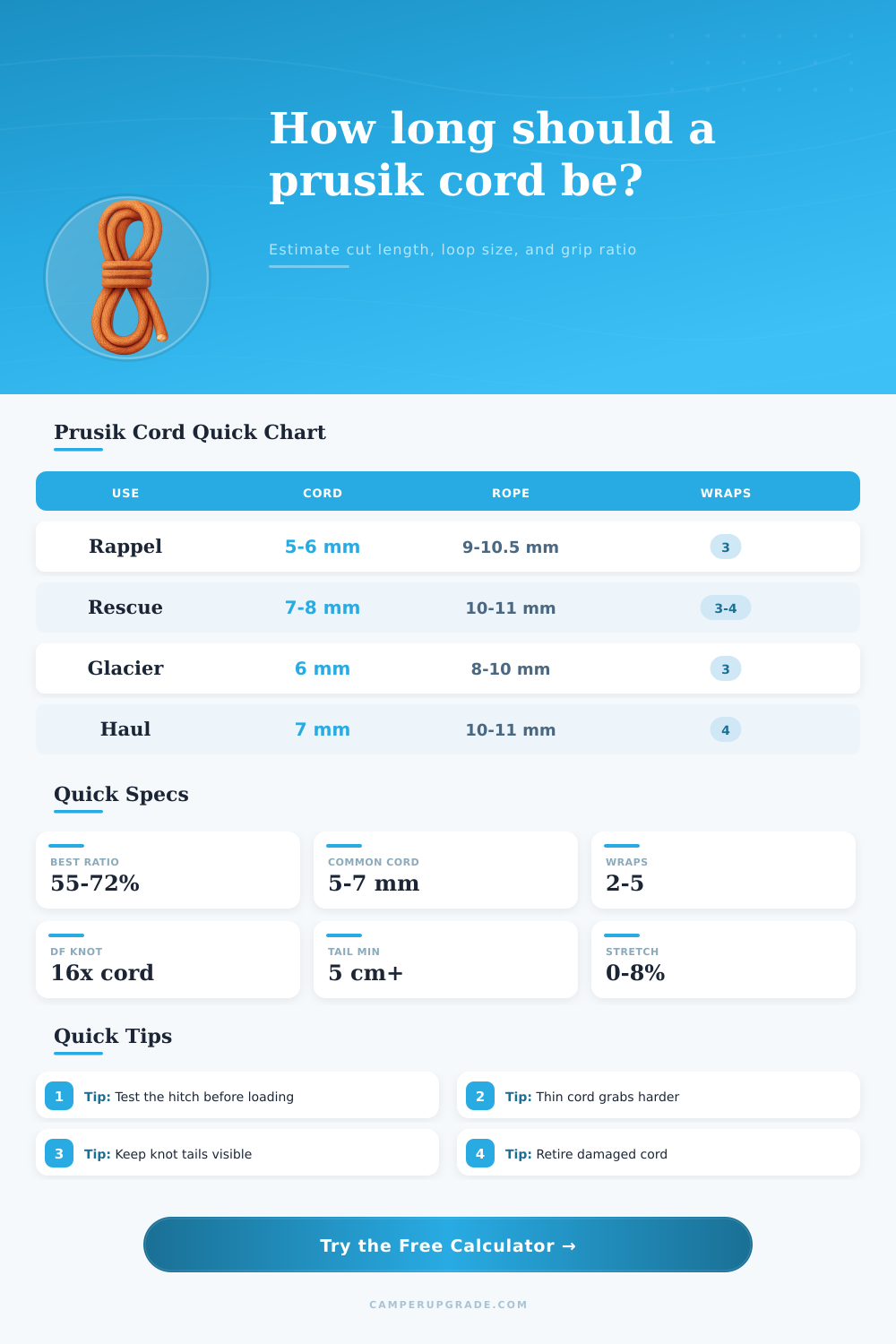
Additionally, the calculator calculates the ratio of the diameter of the cord to the diameter of the rope. Often, an ideal ratio between these two measurements is between fifty-five and seventy-two percent; ratios lower than fifty-five percent will cause the knot to bite too hard into the rope, potentially creating heat with the rope due to the friction between the two components, but ratios higher than seventy-two percent may result in the knot not being able to secure hold the rope. Thus, the calculator indicates the ratio of the cord to the rope, as well as suggesting a starting number of wraps for the knot such that these percentages can be met.
Finally, there are a variety of additional variables to the function of a knot such as the weight of the load that will be attached to the knot, the age of the rope, the type of rope, the type of gloves that will be worn during the operation, the carabiner that will be used, and the type of friction that is desired between the knot and the rope. Each of these variables may impact the function of the knot; thus, the calculator includes a field for users to input there preferences for these variables. While the setting of such a field does not eliminate the need for individuals to manually test the knot when tied to the ground, it does help to ensure that the created knot will exhibit the type of friction that is desired in those specific conditions.
In addition to the fields that relate to the rope, the cord, the wrap count, and the type of knot, the tails of the knot are another critical component of the knot. For instance, short tails may slide back into the knot, especially if its an offset overhand knot or a water knot. Thus, the calculator also indicates the length of the knot’s tails that should be created.
Additionally, there are tables that display various cords and ropes that are often used in different types of tasks; for instance, one table details the types of cord and rope that is used in glacier travel, and another in rescue operations. These tables provide an indication of the types of cords and ropes that are often used, but they are not rules that cannot be changed. For instance, six-millimeter cord on a nine point eight-millimeter rope with three wraps and a double fisherman’s bend is one that is often used; if any of the variable to that example are altered, the length of the knot will change.
Thus, the calculator provides an indication of the length of cord that should of been cut to form the knot, as well as the way in which the knot will sit upon the rope. The calculator is a means of assisting the individuals in performing the calculations necessary to form the knot, but it does not replace the mathematical and physical knowledge of the knot that each individual possess. Additionally, individuals are required to form the knot and to test it when near the ground to ensure that it will successfully both grab the rope, and also allow for the knot to be released.