Propane Vapor Withdrawal Rate Calculator
Estimate whether an RV propane cylinder bank or ASME tank can vaporize enough fuel for furnace, water heater, generator, and cooking loads at the selected temperature and fill level.
Vapor Withdrawal Result
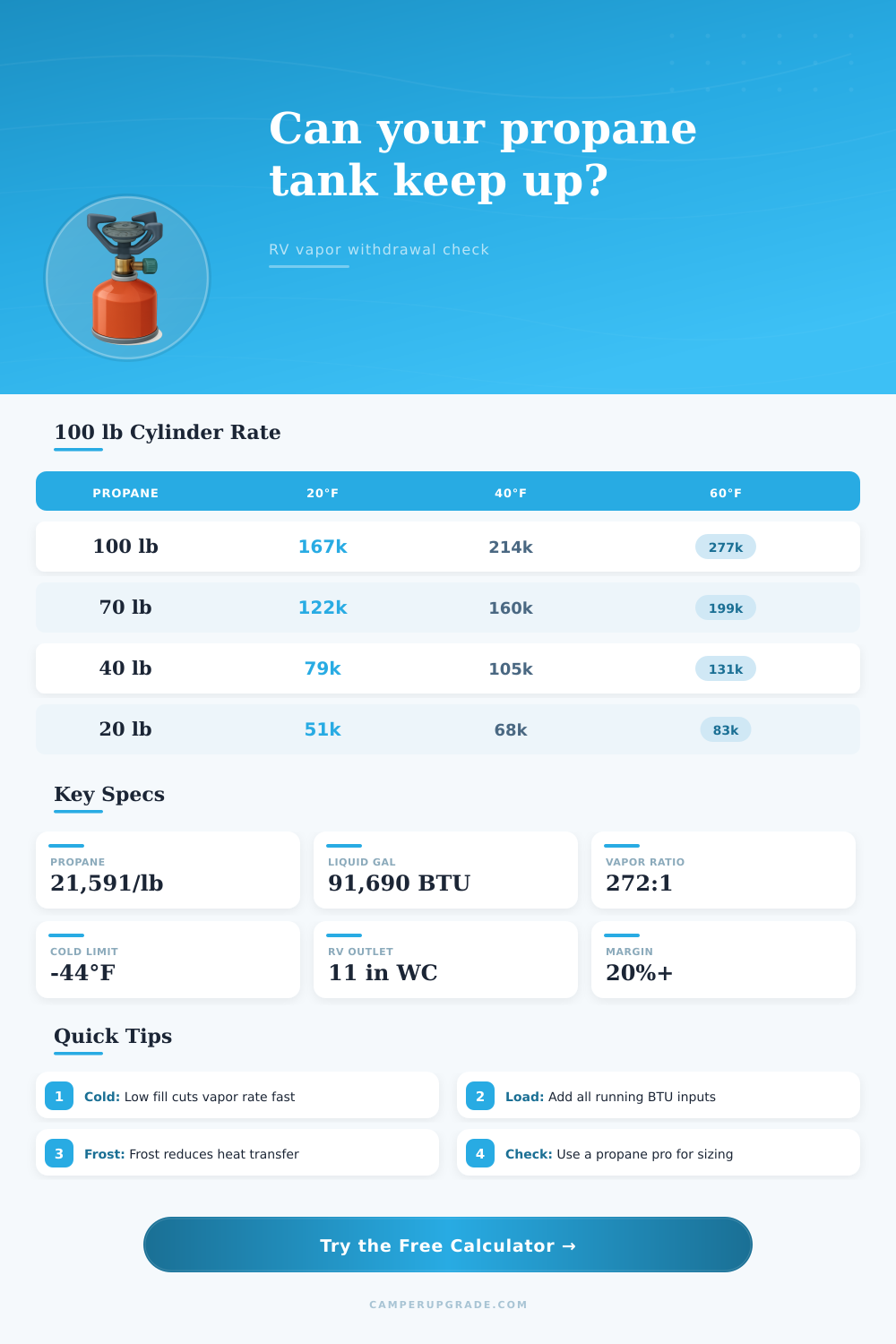
| Propane in 100 lb Cylinder | 0°F | 20°F | 40°F | 60°F | 70°F |
|---|---|---|---|---|---|
| 100 lb liquid | 113,000 | 167,000 | 214,000 | 277,000 | 300,000 |
| 80 lb liquid | 94,000 | 137,000 | 180,000 | 214,000 | 236,000 |
| 60 lb liquid | 75,000 | 109,000 | 140,000 | 176,000 | 192,000 |
| 40 lb liquid | 55,000 | 79,000 | 105,000 | 131,000 | 141,000 |
| 20 lb liquid | 36,000 | 51,000 | 68,000 | 83,000 | 92,000 |
| 10 lb liquid | 28,000 | 38,000 | 49,000 | 60,000 | 66,000 |
| Common RV Appliance | Typical Input | kW Equivalent | Planning Note |
|---|---|---|---|
| RV furnace, mid-size | 25,000 to 35,000 BTU/hr | 7.3 to 10.3 kW | High winter cycling load |
| RV water heater burner | 8,800 to 12,000 BTU/hr | 2.6 to 3.5 kW | Often overlaps furnace |
| Two-burner cooktop | 13,000 to 18,000 BTU/hr | 3.8 to 5.3 kW | Short duration load |
| Absorption refrigerator | 1,500 to 3,000 BTU/hr | 0.4 to 0.9 kW | Small steady demand |
| LP generator, small RV | 55,000 to 85,000 BTU/hr | 16.1 to 24.9 kW | Can dominate vapor sizing |
| ASME Tank Size | 20°F Intermittent | 0°F Intermittent | Continuous Estimate | Assumption |
|---|---|---|---|---|
| 150 gal aboveground | 161,800 BTU/hr | 134,700 BTU/hr | 25% of table | Half full, no frost |
| 250 gal aboveground | 216,800 BTU/hr | 180,600 BTU/hr | 25% of table | Half full, no frost |
| 500 gal aboveground | 360,400 BTU/hr | 300,100 BTU/hr | 25% of table | Half full, no frost |
| 1000 gal aboveground | 641,900 BTU/hr | 534,500 BTU/hr | 25% of table | Half full, no frost |
| Cold-Weather Project | Peak Load | Typical Container | Key Vapor Risk | Calculator Check |
|---|---|---|---|---|
| Weekend trailer heat | 30,000 to 45,000 BTU/hr | Dual 30 lb cylinders | Low fill below freezing | Use 20% margin |
| LP generator support | 60,000 to 110,000 BTU/hr | Four cylinders or ASME | Long continuous draw | Set load continuous |
| Food trailer cooking | 100,000+ BTU/hr | Paired 100 lb cylinders | Manifold imbalance | Use lowest fill |
| Park model winter stay | 45,000 to 90,000 BTU/hr | 150 to 500 gal ASME | Frost and low temperature | Compare to margin |
When you turn on the valve of your RV’s cylinder containing propane, all that propane will be sitting there as a liquid. It has to turn itself into a gas, or vapor, so that it can flow through the tube and up to the burner. But to do this, it needs some heat. If air temperature is warm, then surrounding air soaks into the metal tank and provides heat for this transition.
If it is freezing outside, however, the tank steals the heat from the propane itself (the liquid), which then cools down. This process eventually causes the fluid to become too cold to boil efficienty. The result? The vapor pressure falls below level required by your appliances to remain alight.
Why Propane Fails in Cold Weather
The number one assumption most people make about an RV is that if there is something liquid showing in their tank, they are going to have heat. So they crank up their thermostat, wait for a minute and then cuss at the furnace which shuts down after another minute. Usually it’s not the furnace or the regulator; it is nearly always the vapor withdrawal rate.
Once you know what type of container(s) you have and what your low temperature expectations will be, the rest is left to the calculator (above). You won’t have to guess how many 30 pound cylinders you will need to heat the rig while running the water heater too. Do you really want to try to figure out the thermodynamic laws of latent heat? Nope, just don’t mess with the fill level input…
Most folks simply set it at 100 percent because they always have, and more is better right? Well, that is not always true in vapor withdrawal terms. You’ll find you have less exposed metal surface area touching air when your tank is full than when it’s half full. The wetted surface area is what transfers the heat.
For example, if you’re only down to twenty percent liquid and your tank is buried under snow, or maybe the tank is sitting in the shade, the available vapor capacity can actualy plummet by nearly half. And this is compared to higher fill levels or warmer weather.
The other thing folks don’t consider (until it’s too late) is the demand added by appliances. Let’s say your water heater is 10,000 BTU per hour and your furnace is 30,000. That doesn’t mean both will ever be running at full bore simultaneously… But in the dead of winter, if a heatwave of cold air suddenly cycles them both on together, the spike of demand would be instantaneous huge.
With this tool you can set a duty cycle based off how realistically you use things. Instead of looking at the appliance nameplate rating, which really isn’t accurate, you get a better picture of reality. Furnaces modulate, and water heaters turns off after the tank gets hot.
Keep in mind that if you are using a propane generator, especially during the winter, make sure to follow your margin settings more closely. Generators require consistent flow. They don’t take a break. On paper it may appear nice having a bank of four 20-pound cylinders, but those has a finite amount of combined surface area. In the cold weather when combined with inadequate wind protection or solar exposure, they simply won’t be able to sustain a large electric load.
Frost is another factor to consider. Yes, the ice on your cylinder valves isn’t just for decoration; it’s a thermal blanket choking off heat transfer between the exterior air and the tank. Think of it this way: You’re putting your fuel source inside a thermos. Removing the frost is one thing, but it will reappear again when the withdrawal rate exceeds the ambient temperature’s ability to support it.
That’s where the safety margin comes into play. Don’t think of it as paranoia. Think of it as understanding that theoretical maxes don’t take into account real world conditions (i.e., tank shading, wind chill, and cloud cover). In the tool, the reference tables spell out just how rapidly the rate drops between 60 degrees and 20 degrees. What’s comfortable in early fall turns into a liability come mid-December.
And no, we’re not suggesting never running propane in winter. We’re saying: size your system such that you don’t have to battle physics at the moment you want some comfort. That applies whether you’ve got a big ASME tank set up for stationary use or a pair of cylinders for towing a small trailer. The rules apply equally.
Vapor is created proportional to surface area. Speed depends on temperature. Geometry of heat absorption depends on fill level. Modify your equipment or modify your expectations to align with reality If you’re using your heaters most in winter, leave them out in the open under as much warm air and daylight as practical. Connect your lines properly to keep empty cylinders from pulling the full cylinder pressure down. And be aware that when it gets cold, liquid propane holds stored energy and needs a little help to turn into heat.
Respect that potential and you probably won’t have to wrestle with your heater at midnight. The cold doesn’t give a crap how full your tank appears. It just gives a crap about how quickly you want it to boil.