Propane Tank Size Calculator
Estimate the propane cylinder size for an RV, camper, camp kitchen, hunting cabin, ice shelter, or overland trailer using appliance BTU ratings, runtime, duty cycle, reserve, and cold-weather vapor margin.
🏕RV and Camping Presets
⚙Trip, Reserve, Temperature, and Tank Inputs
🔥Appliance BTU, Runtime, and Duty-Cycle Inputs
| Appliance | BTU/hr | Qty | Hours | Use type | Duty % | Efficiency |
|---|---|---|---|---|---|---|
Appliance ratings are estimates. Check each appliance data plate, keep cylinders upright and secured, and follow all RV, cylinder, regulator, hose, and ventilation instructions.
📋Propane Tank Spec Grid
📊Propane Tank Size Tables
| Tank | Propane | BTU capacity | Best fit |
|---|---|---|---|
| 1 lb bottle | 1 lb | 21,600 | Lantern or small stove |
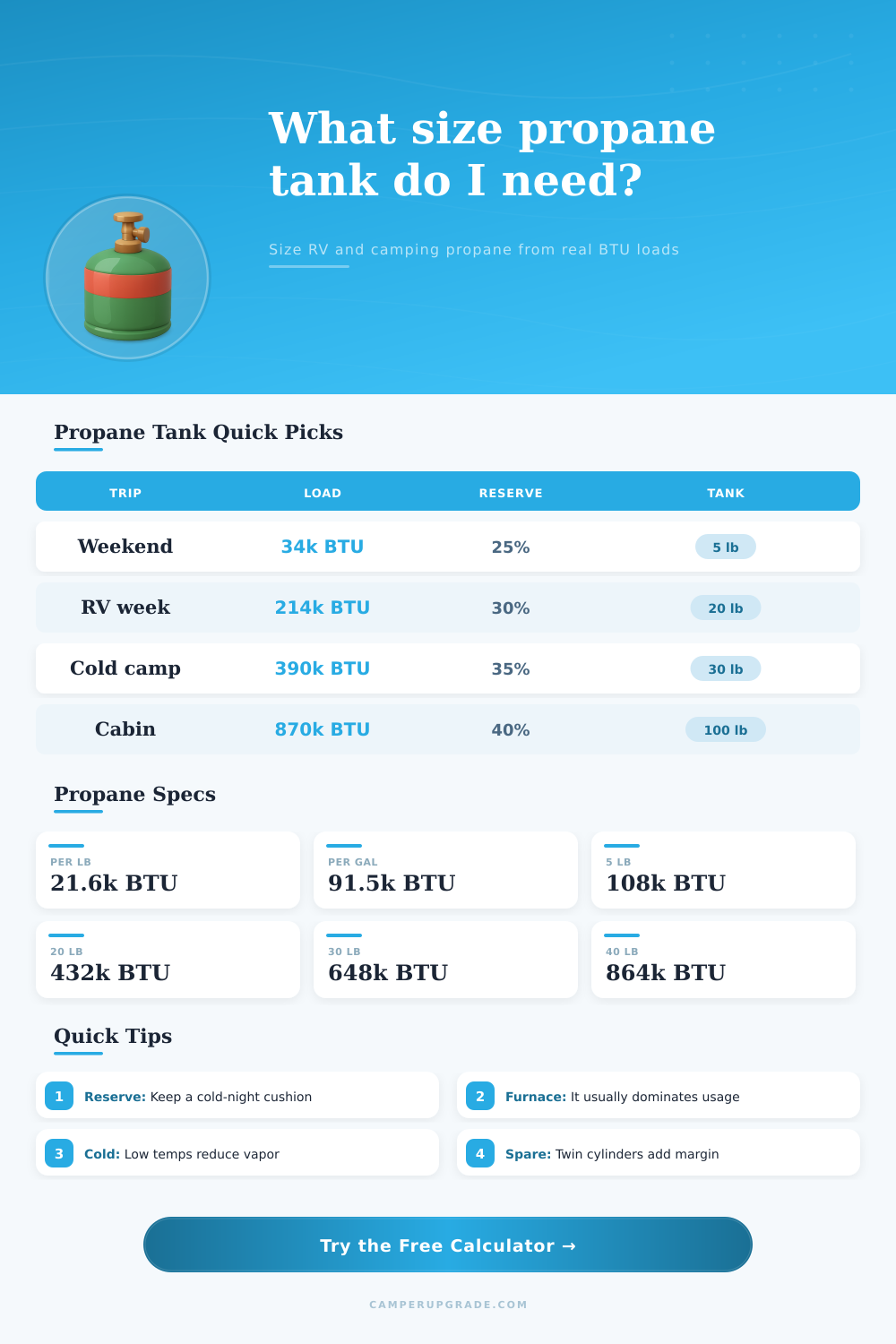
| 5 lb cylinder | 5 lb | 108,000 | Weekend kitchen |
| 11 lb cylinder | 11 lb | 237,500 | Compact overland rig |
| 20 lb cylinder | 20 lb | 431,800 | Grill, camper, light RV |
| 30 lb cylinder | 30 lb | 647,700 | Travel trailer |
| 40 lb cylinder | 40 lb | 863,600 | Longer RV stay |
| 100 lb cylinder | 100 lb | 2,159,100 | Cabin or basecamp |
| Appliance | Typical BTU/hr | Duty note | Propane use |
|---|---|---|---|
| RV furnace | 20k-35k | Cycles often | High |
| Water heater | 8k-12k | Short burns | Medium |
| 3-way fridge | 1.2k-2.2k | All day | Medium |
| Camp stove burner | 6k-10k | Meal bursts | Low-medium |
| Portable heater | 4k-18k | Weather driven | High |
| Lantern | 1k-3k | Evening use | Low |
| Temperature | Planning factor | What changes | Practical move |
|---|---|---|---|
| Above 40°F | 1.00 | Normal vapor | Standard reserve |
| 25-40°F | 0.92 | Lower pressure | Keep tank fuller |
| 10-25°F | 0.82 | Weak vapor on small tanks | Use larger cylinder |
| 0-10°F | 0.70 | High draw may starve | Twin tanks help |
| Below 0°F | 0.58 | Severe vapor limit | Oversize capacity |
| Setup | Usable lb at 15% | BTU at 15% | Common use |
|---|---|---|---|
| Single 20 lb | 17.0 lb | 367k | Short RV stay |
| Two 20 lb | 34.0 lb | 734k | Small trailer |
| Two 30 lb | 51.0 lb | 1.10M | Travel trailer |
| Two 40 lb | 68.0 lb | 1.47M | Cold boondocking |
| One 100 lb | 85.0 lb | 1.84M | Basecamp cabin |
💡Propane Sizing Tips
When choosing a propane tank for your RV or camping trips, you must consider several variable. You have to decide on how many appliance you are using, for how long they will be on, and what the temperature will be during those trips. Furthermore, you have to decide on how much propane you would like to reserve in your tanks so that you will not run out of fuel during your camping trips.
The calculator included on this page will make the mathematical calculations for you after you enter the length of your trips, the low temperatures that you will experience during those trips, the condition of your regulator, and the BTU rating of the appliances that you will use while camping. Using this propane calculator will prevent you from having to guess as to how much fuel your furnace will use when it is burning for cold nights, or how much of your propane’s vapor pressure you will lose when the temperatures drop below freezing. Many camping trips starts with calculating the needs for propane for appliances like a cooktop and a refrigerator, as you use these appliances every day while camping.
How to Choose a Propane Tank for Your RV
However, the propane needed for a furnace is often more than the propane needed for a cooktop or refrigerator. A furnace may run for many hour each day during the winter months when the temperatures are cold. However, during the summer months when the temperatures are high, a furnace may only run for a few hour each day.
Furthermore, you can adjust the duty cycle percentage within this calculator to reflect how often your RV furnace will run. As the temperature drops, the amount of propane in liquid form that can be utilized as vapor decreases. A 20-pound propane tank may be able to handle extreme temperature in October, but may not provide enough propane fuel for your furnace in January during the cold winter months.
Furthermore, you must decide on a percentage reserve for your propane tanks. If you plan on refilling your propane tanks while camping often, a 10% reserve will be enough. However, if you plan on camping or traveling far from propane station, you may want to use a 40% reserve for your tanks.
The propane calculator will add the reserve margin to the total load of your appliances to calculate your total propane capacity. Furthermore, the total propane capacity is not the same as the nominal or rated propane tank size. Propane tanks are never filled to their maximum capacity, so be sure to refill your propane tanks before the propane gauge on your RV reaches zero.
The reference tables located on this page will help to tell you the weight of the liquid propane in your tanks of various sizes, as well as the total BTU content of those propane tanks. Furthermore, there are tables that list the different appliances that are commonly used on RVs and campers, as well as the temperatures at which vaporization of the propane will become an issue. These tables offer a quick overview of propane requirements, but you should use the propane calculator to determine the total BTU requirements of your appliances and the propane tanks needed based on your areas’ weather conditions.
For instance, changing to an older regulator will require more propane for heating to perform at the same rate as with a newer, clean regulator. Furthermore, increasing the percentage of propane tanks to be refilled will also require more propane for your RV to use. It is also possible for a small propane tank to contain enough liquid propane to last the camping trip, but it may not be able to supply enough vapor pressure for the appliances to run at full capacity.
If the liquid propane levels in a propane tank are too low, there is not enough surface area for enough propane vapor to be created. To avoid this scenario, many RV owners use a pair of propane tanks of the same size. Using two propane tanks will increase the surface area of the liquid propane, which increases the amount of propane that can be vaporized and supplied to the RV’s appliances.
During severe cold weather, having more propane surface area will allow the propane furnace to remain lit and not turn off or fail while in use. While the propane calculator will not know the specifics of how you will use your RV, you can use the duty cycle inputs for the various appliances to adjust for your specific camping habits. For instance, if you plan on camping with four people who will cook three meal each day, you will use more propane than if you were to go on a camping trip with one person who will cook one meal each day.
Furthermore, if you keep a log of how many hour your furnace and water heater will run during the camping trip, you can use that information to fine-tune your propane tank size and propane needs. You can adjust the numbers within the calculator to determine how many propane tanks of what size will be needed, and to decide if you would like to include extra propane tanks to provide more propane capacity. Furthermore, while the propane calculator will tell you how big of a propane tank you need, your local refill stations may not be able to fill that size of propane tank.
Some propane dealers may not accept small propane tanks and only fill 40-pound propane tanks, for instance. Therefore, you may want to ensure that you can refill your propane tanks at the locations where you plan to go camping. The calculator will indicate the size of the smallest propane tanks that will meet your needs, but it does not account for whether or not your local propane station will be able to fill that tank.
By calculating your propane tank size and needs ahead of time, you can eliminate the uncertainty of not having enough propane fuel for your camping trip. When you run the numbers for propane needs, you will know how much propane to expect each day, how much reserve to use, and the effect that the camping trip temperatures will have on your propane tanks’ vapor performance. Furthermore, you can plan your camping trip accordingly.
The calculator will not replace your experience using propane tanks and appliances while camping, but it will help to avoid the experience of running out of propane during your camping trip.