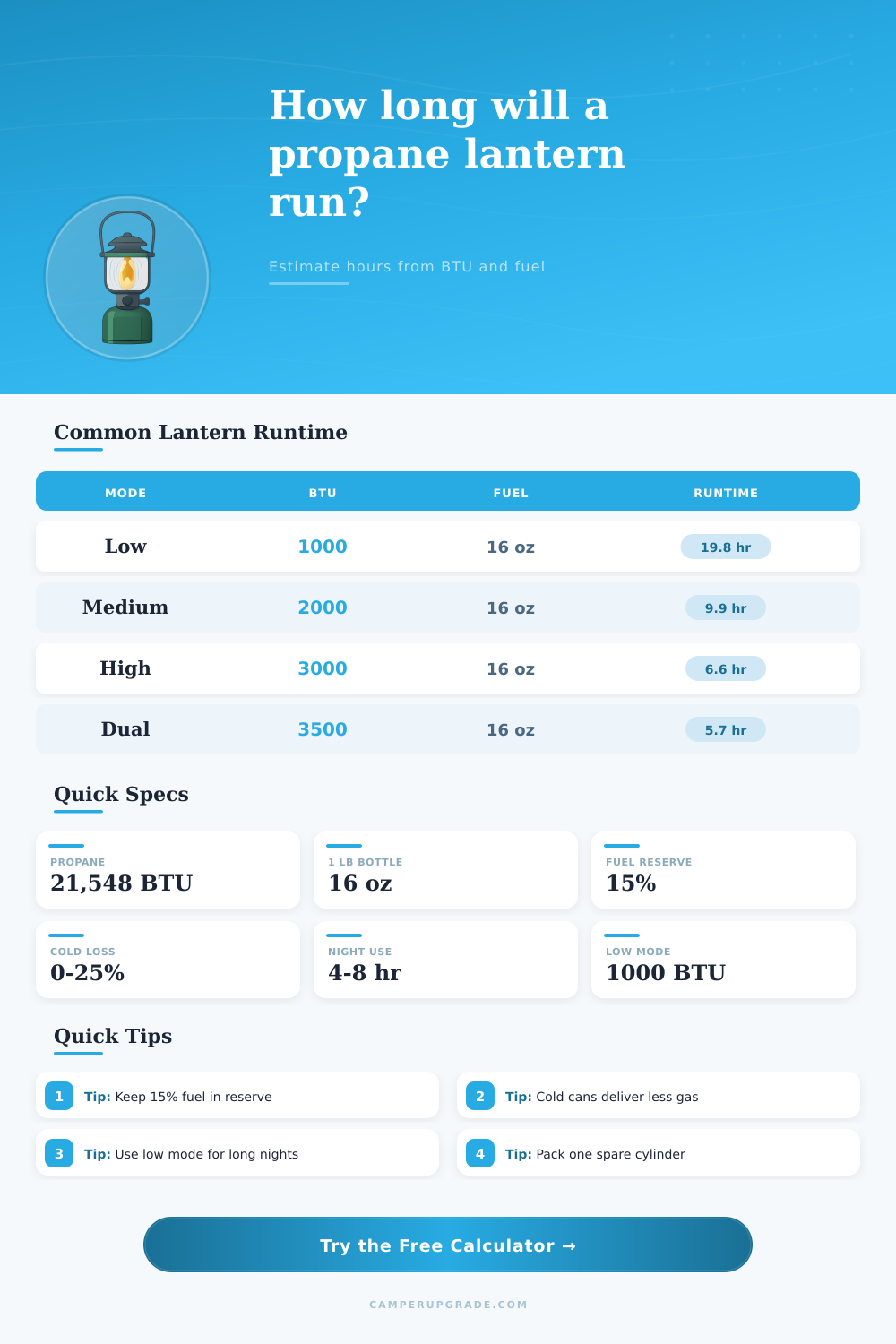
Propane Lantern Runtime Calculator
Estimate how many hours a propane lantern will run from BTU draw, cylinder size, fuel level, ambient temperature, and nightly burn schedule.
Lantern Runtime Estimate
| Lantern setting | BTU per hour | Runtime at full bottle | Runtime with 15% reserve |
|---|---|---|---|
| Very low glow | 800 BTU/hr | 27.6 hours | 23.5 hours |
| Low single mantle | 1,000 BTU/hr | 22.1 hours | 18.8 hours |
| Medium single mantle | 1,600 BTU/hr | 13.8 hours | 11.7 hours |
| Medium dual mantle | 2,200 BTU/hr | 10.0 hours | 8.5 hours |
| High dual mantle | 3,000 BTU/hr | 7.4 hours | 6.3 hours |
| Very bright camp area | 3,500 BTU/hr | 6.3 hours | 5.4 hours |
| Ambient temperature | Runtime factor | Planning effect | Use case |
|---|---|---|---|
| 70°F and warmer | 100% | Normal delivery | Summer campsite |
| 50–69°F | 96% | Small allowance | Cool evening |
| 32–49°F | 90% | Noticeable reserve needed | Shoulder season |
| 20–31°F | 82% | Cold vapor drop | Frosty morning |
| Below 20°F | 75% | Conservative estimate | Winter camp |
| Fuel container | Propane capacity | At 2,200 BTU/hr | At 3,000 BTU/hr |
|---|---|---|---|
| 8 oz partial bottle | 0.50 lb | 4.9 hours | 3.6 hours |
| 16 oz camp bottle | 1.00 lb | 9.8 hours | 7.2 hours |
| 16.4 oz camp bottle | 1.03 lb | 10.0 hours | 7.4 hours |
| 5 lb refillable tank | 5.00 lb | 49.0 hours | 35.9 hours |
| 11 lb small RV tank | 11.00 lb | 107.7 hours | 79.0 hours |
| 20 lb grill tank | 20.00 lb | 195.9 hours | 143.7 hours |
| Lighting plan | Burn schedule | Lantern draw | 16 oz bottles needed |
|---|---|---|---|
| Quick dinner light | 2 hr for 1 night | 1,600 BTU/hr | 1 bottle with large reserve |
| Weekend low light | 4 hr for 2 nights | 1,000 BTU/hr | 1 bottle |
| Weekend medium camp | 5 hr for 2 nights | 2,200 BTU/hr | 2 bottles |
| Bright group site | 6 hr for 2 nights | 3,000 BTU/hr | 2 bottles plus reserve |
| Three-night base camp | 5 hr for 3 nights | 2,200 BTU/hr | 2 bottles, 3 safer |
| Cold shoulder trip | 5 hr for 2 nights | 2,200 BTU/hr | 2 bottles minimum |
Propane consumption are a critical factor for campers to understand. The propane consumption of a camping lantern will determine how much lights the lantern will provide before the propane within a cylinder is depleted. Many campers has experienced their propane lantern slowly dim until the propane within the cylinder is completely depleted.
One of the reason for this depleted propane is the camper did not account for the amount of propane that the lantern burn at a specific rate. Two factors determine the consumption of propane. First, the amount of propane that is contain within the cylinder.
How Much Propane a Camping Lantern Uses
Second, the speed at which the lantern consumes the propane. The type of lantern that are used will change the rate at which the propane is consumed. For example, using a high-output dual mantle lantern will consume the propane three times more fast than a low glow single mantle lantern.
A calculator can be used to determine the propane need of the camper. The calculator will convert the number of pounds of propane into BTU. The BTU rating for the camping lantern indicate the appetite of the camping lantern.
The higher the BTU rating, the brighter the light that the camping lantern will emit. However, the higher the BTU setting, the faster that the camping lantern will consume the propane that is contained within its tank. The setting that the camper select for the camping lantern is one of the first factors that must be consider when using propane lanterns.
For example, running the camping lantern on the high setting for two hours will use more propane then if the camping lantern was on the medium or low setting. Should the camping lantern be set to the medium or low setting instead, the runtime of the camping lantern may be double. Many people sets their camping lanterns to the high setting to obtain an intense light, but this will result in the camping lantern not providing enough light prior to the camping trip being over.
The propane that is store within the camping lantern is in the form of a liquid. The propane must be vaporized into gas to be supply to the camping lantern. The rate at which the propane is vaporized will change based off the weather conditions outside of the camping lantern.
The colder the temperature outside of the camping lantern, the more slower that the propane will vaporize. If the propane does not vaporize at an adequate rate, the pressure within the propane tank will drop. The drop in the propane pressure will prevent the propane from being push to the mantle of the camping lantern, even though there is propane in the tank in liquid form.
The calculator will account for the outside temperature to calculate the amount of usable propane within the tank. The condition of the camping lantern and the environment in which it is being used will affect the consumption rate of the propane. For example, if the camping lantern and its generator is not in good condition, or if they are old, it will waste propane.
The generator may leak heat, or it may be “running rich.” Additionally, if there is wind in the camping environment, the camping lantern may strip heat away from the generator. The camping lantern will have to work harder to maintain the flame, using up the propane at a faster rate. It is a recommendation for campers to maintain a fuel reserve.
For instance, maintaining a fifteen percent fuel reserve will protect the camper in the case of an extra hour of use of the camping lantern or if the camping lantern was underfill with propane when it was to be use. It is better for the propane to remain within the lantern after the camping trip than to run out of propane while camping. However, if larger system are to be used, such as camping lantern trees, or multi-head camping lantern systems, the propane consumption will be more complex.
Lastly, moving from small disposable green bottles of propane to five pound propane tanks will change propane consumption within camping lanterns. The five pound tanks will last much longer than disposable green bottle.