Propane Cylinder Cold Output Calculator
Estimate whether your RV propane cylinders can vaporize enough BTU per hour in cold weather, then compare runtime, pressure margin, and parallel-cylinder needs.
Cold Propane Output Estimate
| Propane temperature | Approx. vapor pressure | Pressure note | Cold-output effect |
|---|---|---|---|
| 60°F / 16°C | 92 psig | Normal mild-weather pressure | High vapor reserve |
| 40°F / 4°C | 63 psig | Comfortable regulator margin | Good cylinder output |
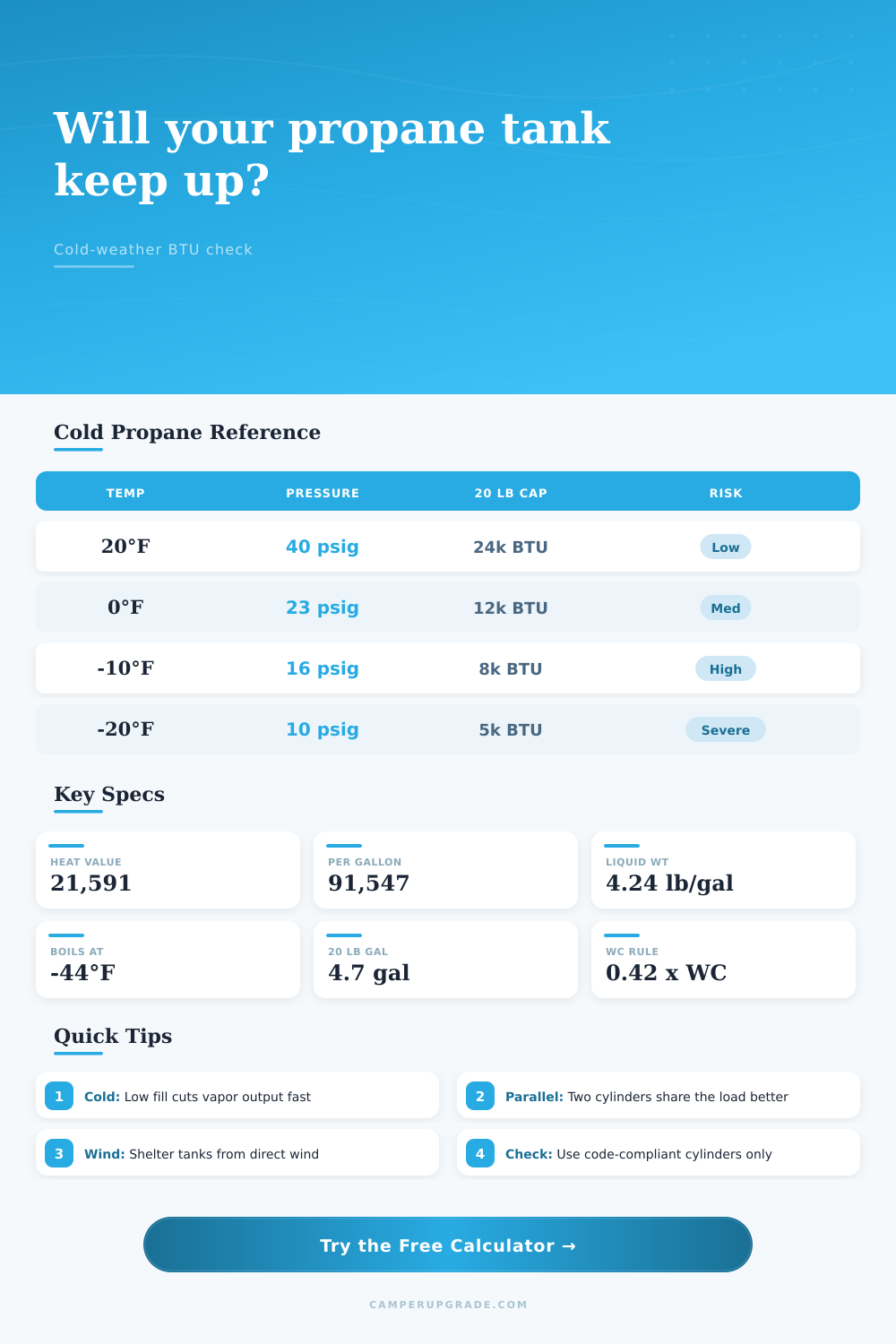
| 20°F / -7°C | 40 psig | Cold but usable for many RV loads | Watch high BTU appliances |
| 0°F / -18°C | 23 psig | Demand and fill level matter | Parallel cylinders often help |
| -10°F / -23°C | 16 psig | Little regulator headroom | Single small cylinders struggle |
| -20°F / -29°C | 10 psig | Severe cold margin | Use conservative load planning |
| -40°F / -40°C | 1 psig | Near practical vapor limit | Propane flow can become unstable |
| -44°F / -42°C | 0 psig | Atmospheric boiling point | No useful natural vapor pressure |
| Temperature | 20 lb cylinder at 40% fill | 30 lb cylinder at 40% fill | 100 lb cylinder at 40% fill |
|---|---|---|---|
| 40°F | 40,000 BTU/hr | 50,000 BTU/hr | 97,000 BTU/hr |
| 20°F | 24,000 BTU/hr | 30,000 BTU/hr | 58,000 BTU/hr |
| 0°F | 12,000 BTU/hr | 15,000 BTU/hr | 29,000 BTU/hr |
| -10°F | 8,000 BTU/hr | 10,000 BTU/hr | 19,000 BTU/hr |
| -20°F | 5,000 BTU/hr | 6,300 BTU/hr | 12,000 BTU/hr |
| Common RV propane load | Typical input range | Propane draw at high end | Cold-output planning note |
|---|---|---|---|
| RV furnace | 20,000–40,000 BTU/hr | 1.85 lb/hr | Usually the largest winter draw |
| Six-gallon water heater | 8,800–12,000 BTU/hr | 0.56 lb/hr | Add only when firing at the same time |
| Absorption refrigerator | 1,200–2,200 BTU/hr | 0.10 lb/hr | Small but continuous |
| Cooktop burner | 6,500–9,000 BTU/hr | 0.42 lb/hr | Count each active burner |
| LP generator | 16,000–40,000 BTU/hr | 1.85 lb/hr | Can exceed a cold single 20 lb cylinder |
| Portable radiant heater | 3,000–18,000 BTU/hr | 0.83 lb/hr | Small cylinders frost quickly |
| Fill level | Vaporization multiplier | Reason | RV takeaway |
|---|---|---|---|
| 80–100% | 1.05–1.10 | More liquid wets cylinder wall | Best cold reserve |
| 60% | 1.00 | Calculator reference point | Good planning baseline |
| 40% | 0.82 | Less heat-transfer surface | Start watching furnace cycling |
| 20% | 0.55 | Small wetted area remains | Cold high draw may fail early |
| 10% | 0.35 | Vapor space dominates | Treat as emergency reserve |
During winter, an RV furnace will suddeny stop firing for no apparent reason. No error code, no smoke, nothing obviously wrong at first glance; you simply notice it getting colder. The cause is that outside, your propane cylinder has lost enough vapor pressure to continue to feed the flame. That’s known as the cold output problem. It’s the number one cause of winter camping trips ending up being towed home.
It is caused by the laws of physics working against you when it’s cold. The simple rule is this: Liquid propane won’t become a gas without absorbing heat from its environment. In other words, when liquid within the cylinder have a higher temperature then the surrounding air, the pressure inside will plummet. The same thing will happen when the appliance draw more gas than the liquid can vaporize. Why? Because the regulator detect the pressure drop, then cuts off flow to protect the appliance itself.
Why Your RV Furnace Stops in Winter
By plugging in your load and temperature, the calculator above do all of this for you; saving you the trouble of figuring out conversions and coefficients. But knowing why that’s important is what keeps you warm.
A full tank is a full tank… or so most folks believe. In the winter, a tank that is half full is effectively much smaller. Why? This happens because surface area exposed to evaporation becomes smaller. Here’s how it works. Liquid propane wets inside of the steel cylinder wall, then the metal (heat exchanger) absorbs some of the warm air from outside and boils the liquid. As you drop below 60% full, the wetted surface area decrease a lot. Yes, you still have plenty of liquid but now you’re missing the engine that converts it to gas. Most folks never make this connection. They look at their gauge and see gas but don’t notice that there is no way for heat to move.
The other silent killer is wind. It takes away the thin layer of warm air still clinging to shell of the cylinder and replaces it with new cold air. That speeds up the rate at which metal cools and in turn lowers the rate at which the propane vaporize. Protecting your tanks isn’t only for comfort. It’s about maintaining that temperature difference that makes boiling the propane possible. An insulated cover or wind break could of been the difference between a burner that won’t stay lit and one that does.
Another factor that trips up owners is simultaneous load. At 20 degrees outside, you might be able to run a 30,000 BTU furnace just fine on one 20-pound cylinder. That’s until the water heater click on too. Now you’re asking for more than 40,000 BTUs. In cold air, there’s no way a single small cylinder will vaporize that much gas fast enough. Pressure drops, the regulator closes and the heat goes dark. Know your peak draw, not your average draw. The reference table on this page shows how capacity drop with lower temperatures.
There are two reasons why using multiple cylinders in parallel help. Yes, they add fuel capacity. But more importantly, they add surface area. Twice as much steel wall contact provide double the heat exchange with the air. They share the thermal load. One starts to struggle and frost up? The other pick up the slack. That’s a practical mitigation strategy that can cost less than shore power hookup or generator.
Don’t go trying to learn where all those pressure points are. Learn about how demand affects fill level, which affects temperature. Don’t be afraid of propane in the cold. It doesn’t vanish into thin air. It simply ceases to flow. Make sure your tanks is filled enough. Ensure they are protected from the weather. Plan for the worst-case scenario at the same time. The heat will stay on and the peace will remain silent while the vapor continues to flow.