Propane Burn Time Calculator
Estimate how long an RV, van, tent heater, stove, grill, or camp kitchen propane tank will run after fill level, load, temperature, and reserve are included.
⛽Trip Presets
⚙Calculator Inputs
Propane runtime snapshot
Enter a tank and BTU load to estimate burn time.
📋Appliance and Tank Spec Grid
📊Burn Time Tables
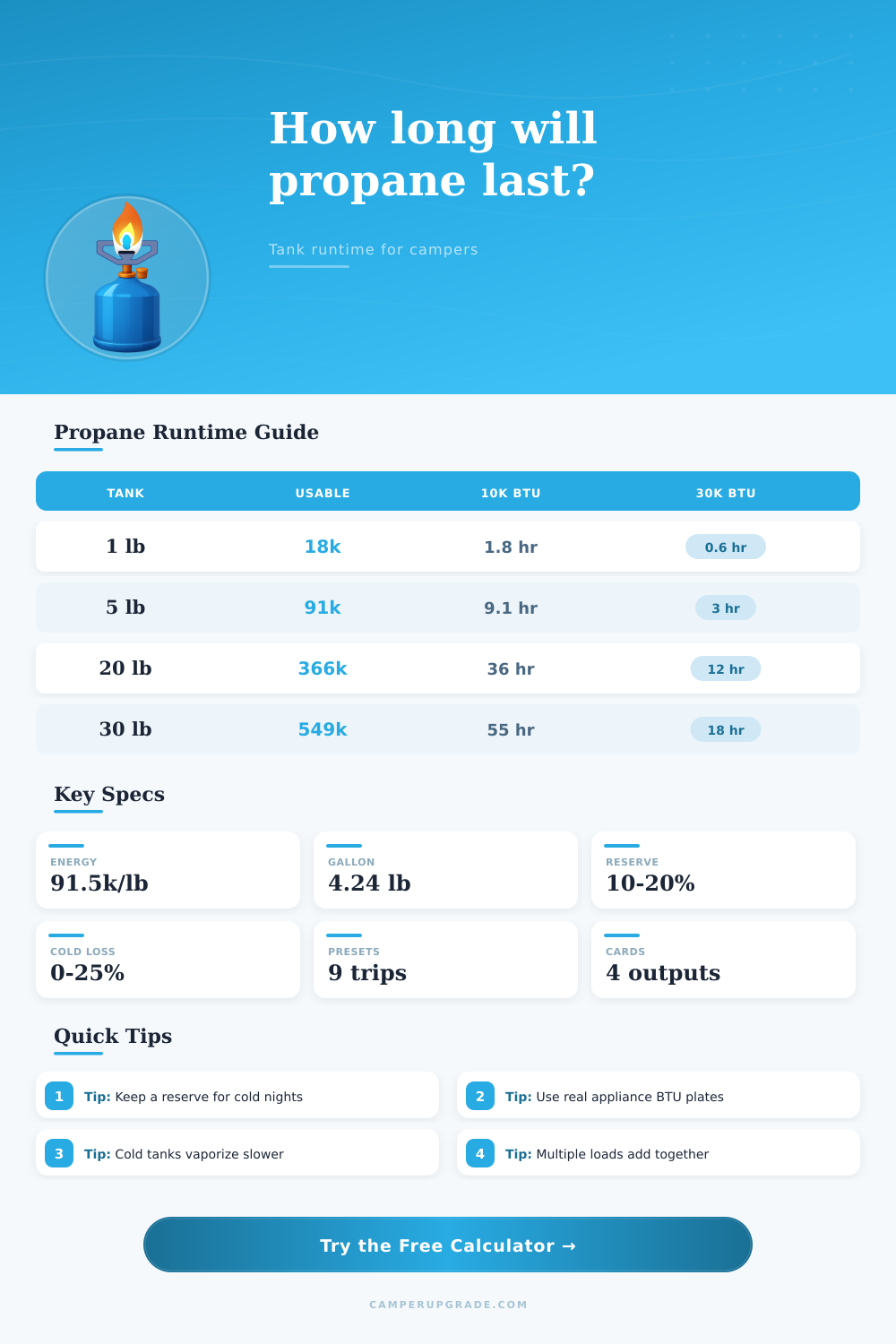
| Tank fuel amount | Full energy | Usable at 80% fill, 15% reserve | Best use |
|---|---|---|---|
| 1 lb bottle | 91,500 BTU | 59,292 BTU | Stove, lantern, small heater |
| 5 lb cylinder | 457,500 BTU | 296,460 BTU | Weekend kitchen or compact van |
| 11 lb cylinder | 1,006,500 BTU | 652,212 BTU | Small trailer or extended stove use |
| 20 lb cylinder | 1,830,000 BTU | 1,185,840 BTU | Grill, RV furnace, mixed camp loads |
| 30 lb cylinder | 2,745,000 BTU | 1,778,760 BTU | Travel trailer furnace and water heat |
| 40 lb cylinder | 3,660,000 BTU | 2,371,680 BTU | Longer RV stays |
| Appliance load | BTU/hr | 20 lb tank at 80% fill | 30 lb tank at 80% fill |
|---|---|---|---|
| Absorption fridge | 1,500 | 691 hr with 15% reserve | 1,037 hr with 15% reserve |
| Portable heater low | 4,000 | 259 hr with 15% reserve | 389 hr with 15% reserve |
| Portable heater high | 9,000 | 115 hr with 15% reserve | 173 hr with 15% reserve |
| Two-burner stove | 16,000 | 65 hr with 15% reserve | 97 hr with 15% reserve |
| RV furnace full fire | 30,000 | 35 hr with 15% reserve | 52 hr with 15% reserve |
| Large griddle | 60,000 | 17 hr with 15% reserve | 26 hr with 15% reserve |
| Duty cycle | 30k furnace average | 20 lb tank runtime | Trip nights at 8 hr/night |
|---|---|---|---|
| 20% | 6,000 BTU/hr | 173 hr | 21.6 nights |
| 35% | 10,500 BTU/hr | 99 hr | 12.3 nights |
| 50% | 15,000 BTU/hr | 69 hr | 8.6 nights |
| 70% | 21,000 BTU/hr | 49 hr | 6.2 nights |
| 100% | 30,000 BTU/hr | 35 hr | 4.3 nights |
| Tank temperature | Planning factor | Why it matters | Calculator effect |
|---|---|---|---|
| 60°F and warmer | 100% | Normal vapor pressure for most loads | No cold reduction |
| 40°F to 59°F | 94% | Cool tank, modest vapor margin | 6% runtime reduction |
| 20°F to 39°F | 86% | Furnace demand may pull pressure down | 14% runtime reduction |
| 0°F to 19°F | 75% | Small cylinders struggle with high loads | 25% runtime reduction |
| Below 0°F | 65% | Use larger or multiple cylinders | 35% runtime reduction |
💡Planning Tips
When planning a camping trip that uses propane, one must consider the lengths that the propane in the tank will last during the camping trip. The length that the propane will last is something to consider in relation to the various appliance that one may use during the camping trip. Camping trips often includes appliances like heaters, stoves, and refrigerators, each of which will impact how quickly the propane is used up.
Thus, the size of the propane tank is not the only consideration that is needed to determine the length that the propane will last during such a trip. When considering the length that the propane will last during the camping trip, it is also necessary to consider that the amount of propane that is usable within the tank may be less than the total amount of the tank’s capacities. New propane cylinder are not often filled to maximum levels with propane, and the gauges on older propane tanks may not be accurate in reflecting the level of propane within the tank.
How Long Will Your Propane Last on a Camping Trip
Additionally, some propane tanks include a safety reserve of propane that must be accounted for. The amount of propane that is consumed within such a reserve reduce the total amount of propane that can be used by the camping trips appliances. The amount of propane that is consumed may also be impacted by the temperature of the surrounding area; the lower the temperature, the less propane can be vaporize and delivered to the camping appliances.
For example, a propane cylinder may be able to effectively deliver propane to the appliances at temperatures of 60 degrees, but be unable to effectively deliver much propane at temperatures within the twenties. In order to calculate the length that the propane will last during a camping trip, one may utilize a calculator that considers factors like the size and fill percentage of the propane tank, the temperature around the propane tank, the rating of the appliances that will be used, and the duty cycle of those appliance. For example, appliances like furnaces may only operate at a certain duty cycle for a given time period, rather than continuously running at full strength.
The average load of those appliances that is consumed by the propane will impact the length of time that the propane will last, so it is necessary to enter that duty cycle into the calculator to obtain an accurate estimate of propane usage. Such estimates can be created for each appliance that is to be used during the camping trip, and each appliance’s BTU draw and duty cycle can be entered into the calculator to determine the total amount of propane that will be used. In addition to these factors, the length that the propane will last can also be impacted by the temperature at which the propane tanks; as discussed, lower temperatures will impact the vapor pressure within the tanks.
Thus, larger propane tanks may be better suited for camping trips during cold weather seasons; the additional surface area and thermal mass of the larger tanks allow for better maintenance of the propane cylinder’s pressure during cold weather nights. Additionally, camping trip planner can use the calculator to determine how each appliance’s duty cycles may impact the length that the propane will last. For instance, an appliance with a 30% duty cycle will use propane more slow than an appliance with a 100% duty cycle; a 30% duty cycle will allow a 20-pound propane cylinder to last nearly three times as long as a 100% duty cycle.
Each appliance’s BTU draw and duty cycle may be entered into the calculator to determine the total length that the propane will last during the camping trip. In addition to the individual propane tanks for each appliance, it is also necessary to consider the possibility of using more than one appliance; camping trips may include appliances like furnaces, stoves, and refrigerators. In this case, it is necessary to calculate the total length that the propane will last by considering the propane that will be consumed by each appliance.
For instance, the camping trip may include using a furnace, a stove, and a fridge throughout the trip; each appliance will use some of the total propane that is included within the camping trips propane tanks. These individual propane consumptions can be entered into the calculator so that the calculator calculates the total propane that will be used during the camping trip. This total propane calculation will lead to the determination of how many day of propane use will be included in the camping trip before the propane reserve must be utilized.
A propane reserve within the tank is often established for use in emergency situation. Typical reserves may include 10 to 15 percent of the total propane that is stored in the tanks. The propane reserve is necessary to account for potential drops in the surrounding temperatures, which may lead to an increased runtime of appliances like furnaces.
Additionally, the risk of a freezing regulator may lead to the reduction of the propane that is able to be released from the tanks. Thus, before calculating the length of time that the camping’s appliances will use the propane, the calculator will subtract the percentage of the reserve of propane; this will result in the calculation of the length of time that the propane will last during the camping trip without having to utilize the reserve. The position of the propane tanks may also have an impact upon the propane tanks’ propane consumption.
For instance, propane tanks that are located horizontally may expose less of the liquid propane to the vapor space within the tank than those that are in vertical position. These difference in propane exposure may have an impact upon the consumption of propane when the temperatures are low. Thus, the propane tanks can be shaded from the sun during the summer to prevent the tanks from becoming too hot, and may be positioned in a sheltered spot from the weather during the winter.
The tables included within the propane calculator may provide an indication of the length of time that the propane tanks will last when using certain appliances like refrigerators, furnaces, and griddles. However, the most accurate plans for the camping trip can be made by entering specific information about each of the camping’s appliances into the calculator; the calculator can account for each of the camping trip’s specific variable. Thus, understanding these factors will allow individuals to make a workable schedule for the propane tanks’ propane consumption during the camping trip.
You should of checked your tanks before you go. It would of been better to have a lot more propane. Dont forget the extra tanks.
It’s actualy better to have more than you think you need.