Power Bank Phone Recharge Calculator
Estimate usable watt hours, full phone recharges, camping runtime, and reserve after USB conversion losses.
⚡Trip Presets
🔋Battery And Trip Inputs
Profiles fill battery size and nominal phone voltage.
Most bank ratings use 3.7V internal cells.
Boost conversion from internal cells to USB output.
Lower this for long, thin, or fast-charge cables.
One cycle means the same percent span as start-to-target.
Add earbuds, smartwatch, hotspot, or headlamp charging.
Recharge Estimate
📊Power Bank Spec Comparison
📘Reference Tables
| Power Bank Rating | Nominal Energy | Usable At 85% + 10% Reserve | Typical Phone Charges |
|---|---|---|---|
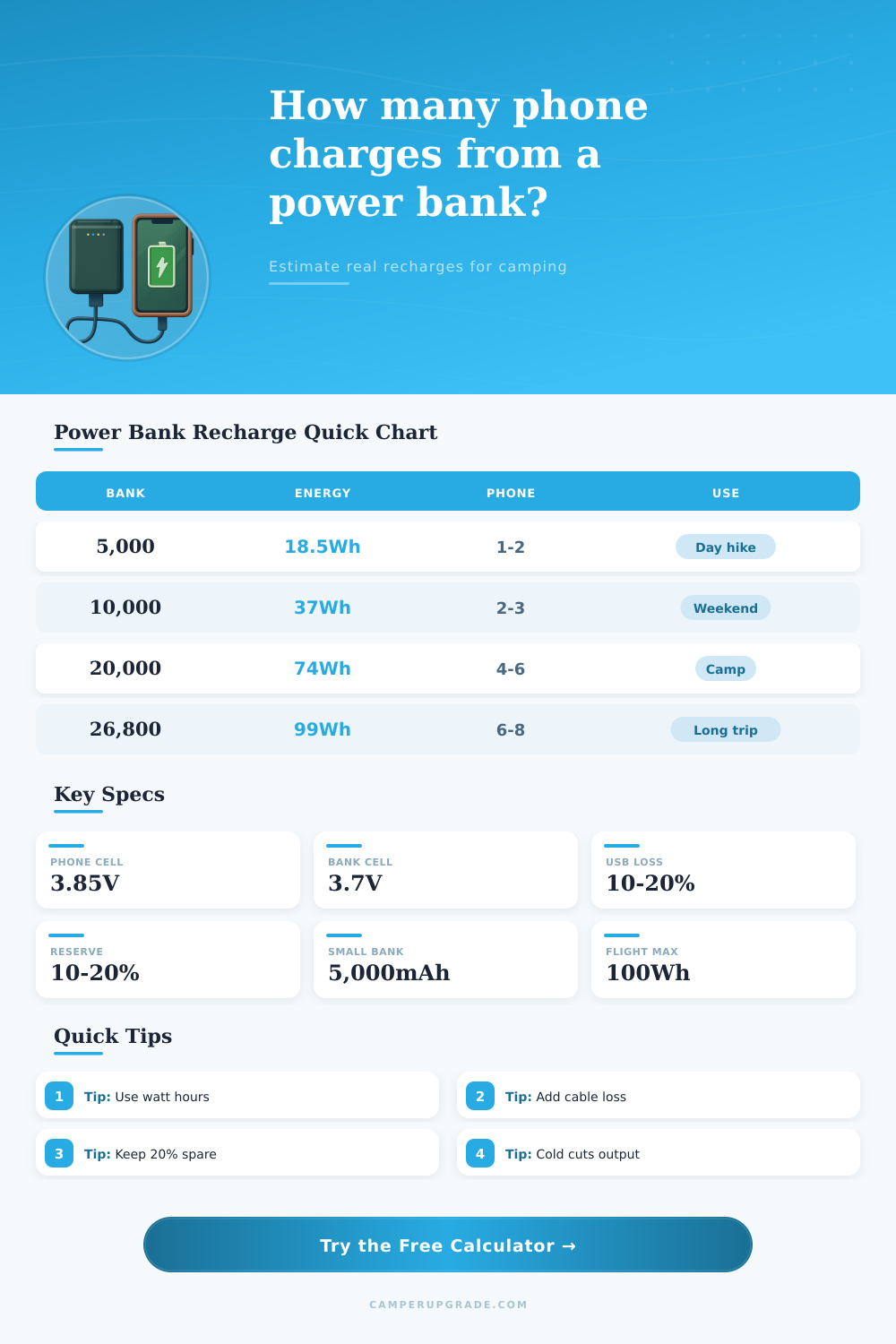
| 5,000 mAh at 3.7V | 18.5 Wh | 14.2 Wh | About 0.8 to 1.1 full charges |
| 10,000 mAh at 3.7V | 37.0 Wh | 28.3 Wh | About 1.6 to 2.2 full charges |
| 20,000 mAh at 3.7V | 74.0 Wh | 56.6 Wh | About 3.3 to 4.5 full charges |
| 26,800 mAh at 3.7V | 99.2 Wh | 75.9 Wh | About 4.5 to 6.0 full charges |
| Phone Battery | Nominal Energy | 20% To 90% Top-Up | Notes For Camping Use |
|---|---|---|---|
| 3,200 mAh compact phone | 12.3 Wh | 8.6 Wh | Good for lightweight day trips |
| 4,000 mAh standard phone | 15.4 Wh | 10.8 Wh | Common mainstream Android size |
| 4,500 mAh large phone | 17.3 Wh | 12.1 Wh | Typical newer large-screen phone |
| 5,000 mAh heavy-use phone | 19.3 Wh | 13.5 Wh | Plan more bank capacity for photos and GPS |
| Loss Or Reserve Setting | Conservative Value | Why It Matters | When To Increase It |
|---|---|---|---|
| USB conversion | 80% to 90% | Internal cells must boost to USB voltage | Older banks or high-output charging |
| Cable and heat | 90% to 98% | Thin cables and warmth waste output | Long cables, fast charge, hot sun |
| Battery health | 80% to 100% | Capacity falls as the bank ages | Frequently used or stored hot |
| Trip reserve | 10% to 30% | Leaves power for navigation or contact | Cold weather or remote camping |
| Camping Scenario | Daily USB Demand | Suggested Bank Class | Planning Note |
|---|---|---|---|
| One phone, light photos | 8 to 12 Wh/day | 5,000 to 10,000 mAh | Enough for a day hike or overnight |
| One phone, maps and camera | 14 to 22 Wh/day | 10,000 to 20,000 mAh | Use a reserve if GPS is important |
| Two phones at camp | 24 to 40 Wh/day | 20,000 to 26,800 mAh | Bank may need topping up after one night |
| Family phones plus small USB gear | 50 to 90 Wh/day | Multiple banks or power station | Split loads so one bank stays reserved |
✅Camping Calculation Tips
When that phone is dead while out in the wilderness away from charging, a fun weekend adventure suddenly becomes a logistical nightmare. Bring a power bank. But be aware of number of charges it’ll actualy deliver. The charge listed on the case is usually higher than what makes its way to your phone. With all the losses and voltage differences, this become important on longer hikes and for multi day treks.
That’s the voltage difference. Power bank cells is rated for about 3.7 volts, phone batteries around 3.85. The bank has to juices them up to five volts, which is what USB requires. Each conversion step waste a couple percent of efficiency. Fast-charging heats things up; you lose more. Long cables and skinny ones can saps another ten or fifteen percent off your delivery. Plug those numbers in the calculator to remove the need to guess.
Why You Need a Power Bank Calculator
You should of also have a reserve of power. Having 10 or 20 percent left over doesn’t seem efficient, but it becomes critical if a cold snap hit, or if the signal gets weak. Both can happens simultaneously. If you have a reserve in place, you’re insulated from that surprise. You can designate how large that reserve is. Then your plan stay viable regardless of changing conditions.
Different phones has different power requirements based off their size. For example, a big screen phone will consume nineteen watt hours to be fully charged, whereas a smaller phone might only take in twelve. If you’re sharing a single bank among multiple people then this add up fast. In addition, how much you use it matters, constant GPS usage and lots of photos will drive consumption past the baseline. Think about that extra load and adjust to match it with the daily top-up option instead of using a “one-size-fits-all” setting. Do not assume all day are the same.
Realistic phone counts is displayed alongside typical bank sizes in reference tables. You can easily determine if small unit is enough for a day hike, or whether the whole gang will need something on the order of the flight-safe ninety-nine watt hour mark. The output fields then convert those inputs into days of coverage, partial top-up, or full charge. It is a single number to compare against your trip duration.
People make one big mistake: They think they can take the printed mAh number at face value. After accounting for every loss and adding a buffer, almost everything go down. That’s not the fault of the battery, that’s physics. Running the math beforehand makes your best-case scenario a workable plan. A viable strategy ensures the phone doesn’t die on the trail if the trail turns out longer then planned.