Power Bank Capacity Calculator
Convert device battery needs into Wh, advertised mAh, USB equivalent capacity, and recharge time with realistic loss factors.
💾Scenario Presets
⚙Device Load Inputs
🔌Output And Recharge Inputs
📊Cell And Pack Spec Grid
📘Reference Tables
| Capacity Basis | mAh | Wh | Notes |
|---|---|---|---|
| 3.7V cell | 10000 | 37.0 | Common power bank math |
| 3.85V cell | 20000 | 77.0 | Phone-class battery basis |
| 5V output | 10000 | 50.0 | USB-side comparison only |
| 12V pack | 10000 | 120.0 | Higher-voltage travel bank |
| Device | Battery Size | Approx Wh | Typical Full Charges |
|---|---|---|---|
| Smartphone | 4000-5000 mAh | 15-20 Wh | 1-4x |
| Tablet | 7000-10000 mAh | 27-38 Wh | 0.5-2x |
| Action camera | 1200-2000 mAh | 5-8 Wh | 4-8x |
| Laptop | 45000-70000 mAh | 50-80 Wh | 0.3-1.2x |
| Output Standard | Voltage | Power Band | Best Use |
|---|---|---|---|
| USB-A | 5V | 5-12W | Phones and accessories |
| USB-C basic | 5-9V | 12-30W | Tablets and small laptops |
| USB-C PD | 15-20V | 45-100W | Laptops and fast charging |
| 12V DC | 12V | 24-60W | Routers and mini gear |
| Recharge Source | Input W | Time for 50 Wh | Time for 100 Wh |
|---|---|---|---|
| USB-C wall charger | 20W | ~2.7 h | ~5.4 h |
| Fast PD charger | 65W | ~0.8 h | ~1.6 h |
| Car USB adapter | 18W | ~3.0 h | ~6.0 h |
| Small solar input | 10W | ~5.4 h | ~10.8 h |
A power bank is a device that provide extra electricity to electronic devices. The energy that a power bank contains may not always be the amount that the device manufacturer advertise for that power bank. Even though the milliampere-hour (mAh) measurement for the power bank indicates the total energy that the power bank contains, this measurement is based on the internal voltage of the power bank cells.
As the power bank has to change the voltage from its internal voltage to the voltage needed by the device that is being charge, there will be some loss of energy during this process. Thus, it is important for individuals to understand how to calculate the energy requirement of the devices that they wish to charge in order to ensure that the power bank will contain enough power to supply those device. The watt-hour measurement for a power bank indicates the total amount of energy that the power bank will contain, taking into consideration both the voltage and the capacity of the device.
How to Calculate and Choose the Right Power Bank
In order to calculate the watt-hours that a power bank will contain, you can multiply the milliampere-hours of the power bank by the voltage of the power bank cells and divide by 1000. For example, if a power bank contains 10,000 mAh of energy and its cells has an internal voltage of 3.7 volts, the power bank will contain 37 watt-hours of energy. Smartphones typically require between 15 and 20 watt-hours to fully charge the devices battery.
Thus, another way of determining the amount of devices that a power bank will be able to charge is to compare the watt-hours that the power bank contains with the watt-hours that the devices require. This unit of measurement also allows for the energy requirement of multiple devices to be summed together before purchasing a power bank that can fully supply those devices. When using a power bank, energy will always be lost due to the need to convert the internal voltage of the cells within the power bank to the 5-volt output that is required to charge electronic devices through USB cables.
The energy that is lost due to heat and voltage conversion can range from 15 to 20% of the total capacity of the power bank. In addition to these energy loss, using a power bank in cold temperatures will also lead to a reduction of the power bank’s capacity. At cold temperature, the efficiency of the power bank’s lithium battery cells will decrease which will lead to a reduction of the power bank’s capacity of 10 to 20%.
Thus, power bank manufacturers and consumers should always purchase a power bank that has a higher watt-hour rating than the total energy requirement of the devices that will be charged from that power bank. When manufacturers manufacture power banks, they use the voltage levels of the internal cells of the power bank to label the device’s mAh capacity. The voltage that the power bank outputs, however, is often higher than the internal voltage of the cells within the device.
For instance, a power bank that is labeled as having a 10,000 mAh capacity may only have an output capacity of 6,000 to 7,000 mAh if the power bank is outputting electricity at 5 volts. Thus, individuals who are purchasing power banks and who only consider the mAh ratings of those devices may purchase a power bank that does not have enough energy to power their device. In addition to the device’s mAh ratings, the peak wattage of the device that will be charged should also be considered.
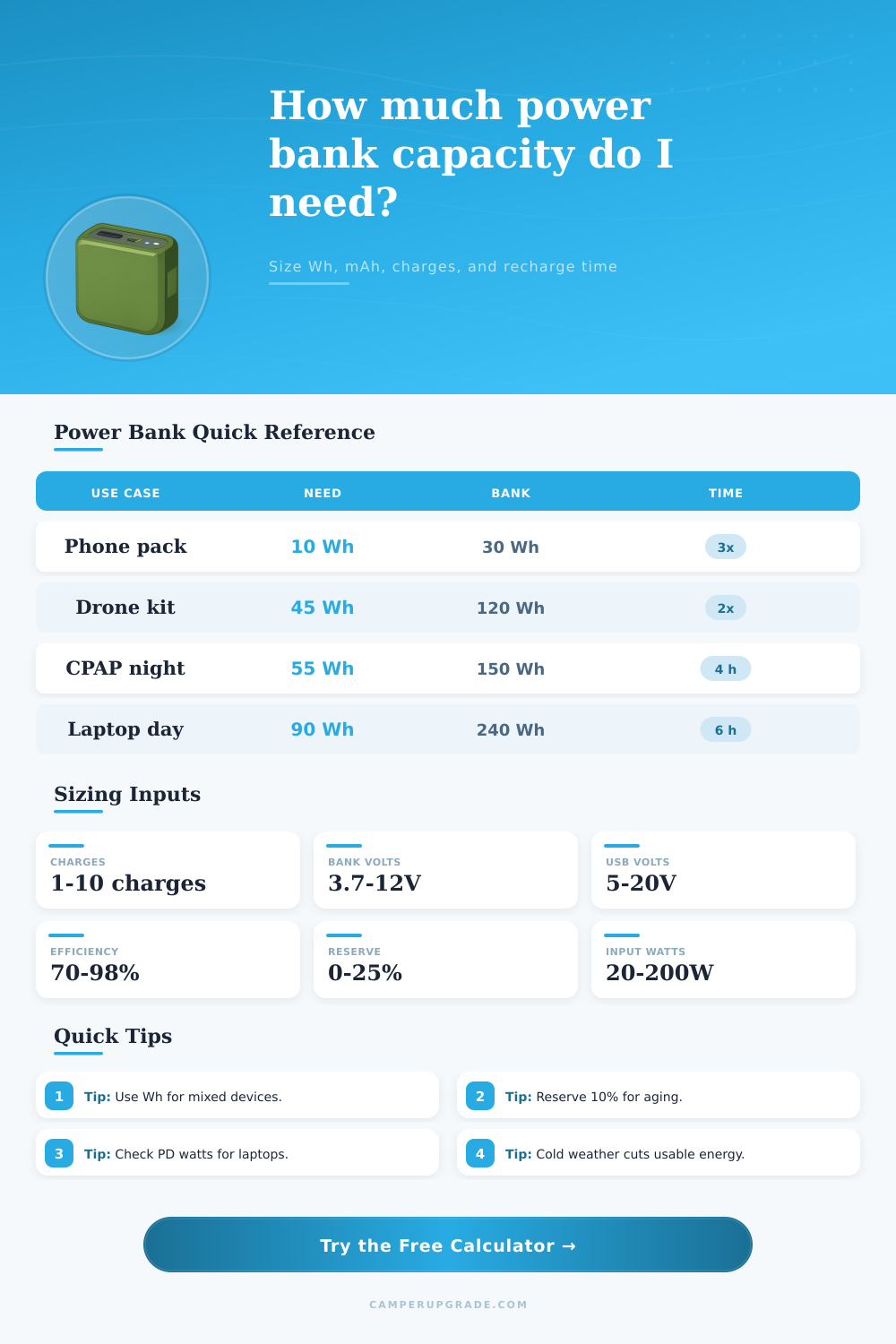
For instance, laptops require more watts than devices like smartphones. A laptop that requires 90 watts of power, for example, will require a power bank that is capable of delivering 90 watts of power through the USB Power Delivery specification. Another factor to consider when purchasing a power bank is the time that it will take for the power bank to fully recharge its batteries.
A power bank with a 50 watt-hour capacity will take less time to recharge if the individual utilizes a 65 watt charger as opposed to a 20 watt charger. Solar chargers and car adapters will often take longer to charge a power bank than will a wall charger. Thus, when individuals are planning to travel with their devices, the charging rates of those devices should be considered.
Furthermore, the number of times that the devices should be charged can simply not be calculated as the product of the number of charge required by the device multiplied by the capacity of that device. Additional capacity must be provided for the power bank to account for the energy that will be lost during the charging of the devices. Different devices require different amounts of capacity from the power bank that is providing energy to those devices.
For instance, an individual that pilots drones will require a power bank with a high watt-hour rating as the batteries for drones require alot of energy. An individual who utilizes a CPAP machine during the sleeping hours of the day will require a power bank with the ability to provide steady energy to that device over long period of time. An individual who utilizes a laptop will require both a power bank with high levels of wattage output as well as a high rate of the ability of that power bank to recharge their devices.
Finally, a family that utilizes many tablets may require a higher capacity of the power bank than individuals that utilize fewer tablet devices. Individuals can avoid common mistakes when purchasing a power bank by using the unit of watt-hours to describe the energy that the power bank will contain. For example, many individuals may make mistakes when purchasing a power bank if they only consider the mAh ratings of the devices.
Another common mistake is to forget to account for the effect that temperature can have on the power bank as well as the way in which the battery cells within the power bank may age over time. Thus, in order to select the appropriate power bank for an individual’s devices, it is important for the individual to calculate the watt-hours that are required by the devices that will be charged from the power bank, to add some extra capacity to account for energy losses from the power bank, and to then purchase a power bank that meets those requirements. Following these steps will ensure that the power bank will supply the energy that is required by the devices of the individual.