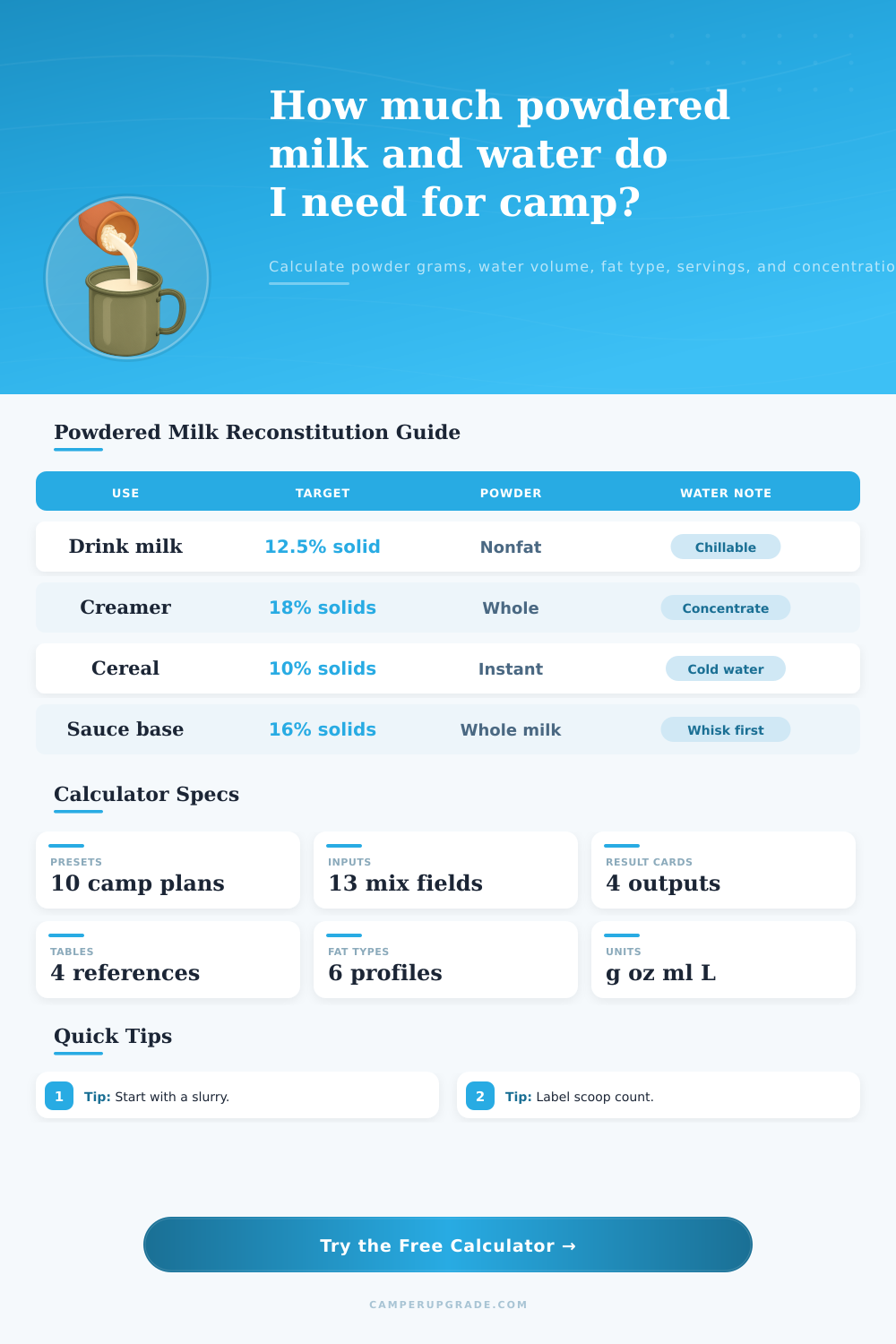
Powdered Milk Reconstitution Calculator
Plan camp milk by powder type, fat style, target concentration, serving size, water loss, scoop weight, kettle capacity, batch count, and trip buffer.
⛺Camp Milk Presets
🥛Reconstitution Inputs
Formula: milk solids grams = final milk ml x 1.03 x target solids %. Powder grams = milk solids grams / powder usable solids %. Water to measure = final milk ml minus powder displacement, then plus water-loss allowance.
📊Spec Grid
📘Reference Tables
| Powder type | Solids | Fat | Best camp use |
|---|---|---|---|
| Instant nonfat | 95 to 97% | 0 to 1% | Breakfast, cereal, baking, light packs |
| Whole milk | 95 to 97% | 24 to 28% | Drinking milk, cocoa, rich oatmeal |
| Buttermilk | 94 to 96% | 4 to 8% | Pancakes, biscuits, tangy sauces |
| Goat milk | 94 to 96% | 24 to 30% | Small sensitive-stomach batches |
| Coconut milk | 88 to 94% | 45 to 65% | Dairy-free coffee and curry base |
| Target use | Solids target | Texture | Mix cue |
|---|---|---|---|
| Light cereal milk | 8 to 10% | Thin | Good cold if shaken hard |
| Drinking milk | 12 to 13% | Standard | Rest 5 to 10 minutes |
| Creamer | 17 to 22% | Concentrated | Make slurry first |
| Sauce base | 14 to 18% | Rich | Whisk before heat |
| High calorie drink | 16 to 24% | Heavy | Use warm water or blender bottle |
| Batch size | Finished milk | Typical powder | Field note |
|---|---|---|---|
| Solo cup | 240 ml | 30 to 34 g | One shaker bottle serving |
| Two mugs | 500 ml | 62 to 70 g | Good breakfast pair batch |
| Quart | 946 ml | 118 to 132 g | Common pantry reconstitution |
| Group liter | 1000 ml | 125 to 140 g | Fits many camp bottles |
| Cooking pot | 1500 ml | 190 to 245 g | Split if kettle is small |
| Problem | Likely cause | Fix | Pack choice |
|---|---|---|---|
| Clumps | Powder added to too much hot water | Make a paste with cool water first | Instant powder |
| Thin flavor | Low solids or high water loss | Raise concentration 1 to 3 points | Whole milk powder |
| Oily layer | High-fat powder and cold water | Use warm water and shake longer | Coconut or whole |
| Scorching | Powder heated before dissolved | Dissolve off heat, then warm gently | Nonfat or buttermilk |
| Sour note | Buttermilk powder selected | Use nonfat or whole for neutral milk | Nonfat |
💡Camp Mixing Tips
When you prepare milk on a camping trip or an backpacking trip, you have to use the correct amount of milk powder to the amount of water. If you use to little milk powder, the milk will be thin. If you use too much milk powder the texture will be chalky and most people will not finish the milk.
Understanding the ratio of milk powder to water will allow you to create milk that taste good and has the correct thickness. The type of milk powder you use will change the outcomes of adding the powder to the water. Nonfat dry milk will dissolve easy in water and weighs very little so it is a good powder to use when you are trying to minimize your weight on the trip.
Making Milk from Powder on a Camping Trip
Whole milk powder will contain more fat and calories, so it is better for people who want a richer taste to there drinks or breakfast foods like oatmeal. Buttermilk powder will give your drink a tangy taste that is good for baking but may not be a good option for individuals who only want to drink the buttermilk powder. Goat milk powder and coconut milk powder are an option for small groups and only if individuals has specific reasons for using either of these alternatives.
Because each type of milk powder will have a different amount of usable solids in the powder, the weight of each type of powder will have to be vary. You must also decide on the concentration of the milk. If you are preparing the milk for drinks it should be twelve to thirteen percent solids which will provide the more similar taste to fresh milk.
For breakfast cereals, you may use a lighter milk powder. For coffee, you can prepare a thicker milk powder concentrate because less liquid are needed to do the job. Higher concentration milk powder will provide more calories per serving but may be a better choice for those cold camping trips or hikes.
Another element that you should plan for is how much water you will need. Since the milk powder will take up space in your container and some of the water will be lost to evaporation and rinsing of your drinking cup, you must add some extra water to your plan. The powder will dissolve in cold water but it is more difficult to dissolve the higher fat milks in cold water so using some warm water to create a slurry will make it easier to blend in the powder with the remaining water.
When preparing enough milk powder for several days you should include some extra milk powder in your pack. This extra milk powder will allow for spills to occur and some individuals will have more higher appetites than others. Having extra milk powder will ensure that you dont run out of milk powder while on your trip.
You will also want to plan for how you are going to divide the water you will carry because your water container may not be large enough to use to prepare a batch of milk. Another important aspect of the plan is the ability to adjust the recipe. Depending on the weather you may want to increase the amount of solids in the milk for individuals who would like a richer taste of there drinks.
If you will use the milk for cooking a sauce the serving size can be reduce. These types of adjustments can be made because the best milk reconstitution plan is one that can be adjusted according to the situation so that the plan is a practical one rather than a more rigid one. The most common mistake is to treat the milk powder as if the ratio of milk powder to water is set and will work in any situation.
Each of the element of the milk powder recipe has an impact on the other element of the recipe so before you prepare the milk you should ask questions of how many individuals will need a serving of milk, how those individuals will use the milk, and how much space does each individual have in their containers. Considering these questions will allow you and your traveling companions to rely on the milk powder you brought for the entire trip.