Pour Over Camp Ratio Calculator
Plan a field-friendly pour over recipe with coffee grams, total brew water, bloom, pulse weights, brew time, final cup yield, filter loss, altitude adjustment, and kettle reserve.
☕Camp Brew Presets
📏Pour Over Inputs
⚙Camp Brew Spec Grid
📋Pour Over Reference Tables
| Preset | Yield | Ratio | Coffee |
|---|---|---|---|
| Solo bright | 300 ml | 1:17 | 20 g |
| Solo strong | 280 ml | 1:14 | 24 g |
| Two campers | 600 ml | 1:16 | 43 g |
| RV carafe | 960 ml | 1:15.5 | 70 g |
| Group cone | 1500 ml | 1:15 | 113 g |
| Filter | Loss | Pulse style | Use |
|---|---|---|---|
| Paper cone | 8 g | 4 pulses | Clean cup |
| Flat paper | 7 g | 3 pulses | Even bed |
| Thick paper | 12 g | 5 pulses | Camp cone |
| Metal mesh | 3 g | 3 pulses | Low waste |
| Cloth | 10 g | 4 pulses | Full body |
| Altitude | Boil feel | Time add | Move |
|---|---|---|---|
| Below 3000 ft | Full boil | 0 sec | Normal grind |
| 3000-7000 ft | Lower boil | 10 sec | Slight finer |
| 7000-10000 ft | Fast cooling | 25 sec | Preheat mug |
| Above 10000 ft | Very low boil | 40 sec | Slow pour |
| Dose | Scoops | Water 1:16 | Yield |
|---|---|---|---|
| 15 g | 2.5 tbsp | 240 g | 202 ml |
| 20 g | 3.3 tbsp | 320 g | 272 ml |
| 30 g | 5 tbsp | 480 g | 412 ml |
| 45 g | 7.5 tbsp | 720 g | 622 ml |
| 60 g | 10 tbsp | 960 g | 832 ml |
💡Camp Brewing Tips
Making coffee at camp involves several different variables that make the process challenging compared to brewing coffee at home in the kitchen. Many people who brew coffee know that factors such as wind, temperature, and altitude all play a role in how coffee tastes. These variables has to be accounted for before brewing coffee at camp to ensure the brewed coffee tastes correctly.
The coffee brewing process is essentially a ratio game. The coffee brewing process relies on the relationship between the amount of coffee grounds that is to be use in the brew and the amount of water that will be used to brew the coffee grounds. The first step in brewing coffee at camp is to decide on the target size of the cup that will be used for brewing the coffee.
How to Make Good Coffee at Camp
The size of the mug that you use to drink the brewed coffee will determine the volume of water that will be used to brew the coffee grounds. Due to the fact that most mugs used at camp have different volumes to those that are used at home, it is necessary to measure the volume that will be used for brewing coffee at camp. Once you have measured the target volume, the next step is to determine the strength of the coffee that is to be brewed.
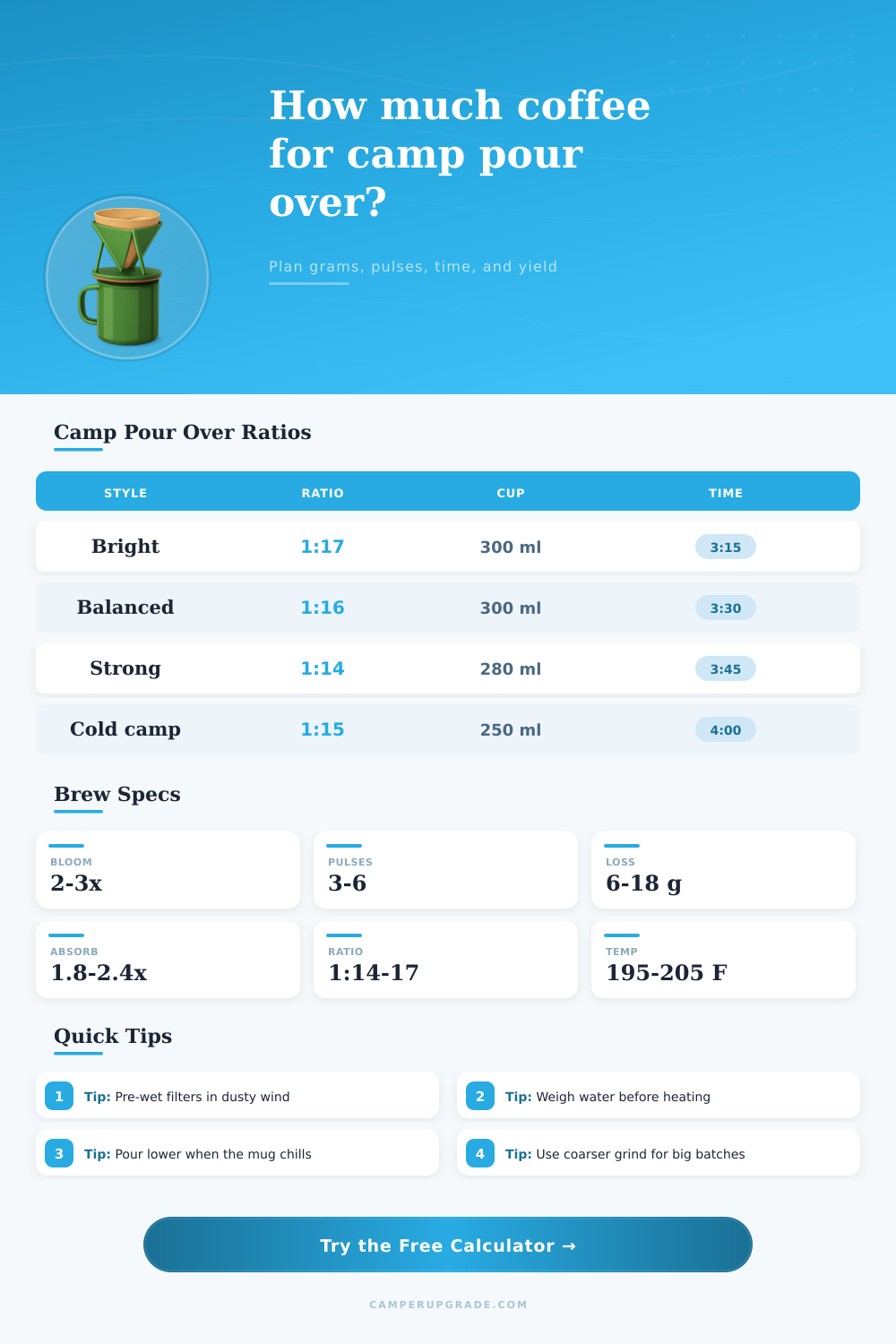
The ratio of coffee to water will determine the strength of the brewed coffee. A coffee to water ratio of 1:16 is considered to be a balanced strength coffee, but a coffee-to-water ratio of 1:14 will result in brew coffee that is more stronger than coffee brewed to a 1:16 ratio. This ratio will dictate how much water you will use for brewing coffee with a specific amount of coffee grounds.
Once you have measured the coffee grounds and programmed the brew variables into the calculator, the next step in the coffee brewing process is to perform the bloom. The bloom is a step that is performed to allow the coffee grounds to release the trapped gas that is within the grounds. To perform the bloom, pour a small multiple of the weight of the coffee grounds in water.
If you do not perform the bloom when brewing coffee, your brewed coffee will taste flatly. Additionally, if you do not use enough water during the bloom step, your brewed coffee will not properly extract the coffee flavors. The bloom process uses a specific amount of water, so it is necessary to account for this amount when brewing coffee so that you do not run out of water during the brewing process.
Another factor to consider during brewing is the pulse count. The pulse count is the number of times that you will pour water into the coffee filter. Using more pulses allows for the brewing of large batches of coffee.
However, each pulse will expose the coffee to air, which will eventually cool the coffee. To avoid this drop in coffee temperature, use a specific pulse schedule when brewing coffee so that the water level remains low and the temperature of the coffee grounds is maintained. Altitude and ambient temperature are two variables that affect the brewing process.
At high altitudes, the boiling point of water is lower. Additionally, the water will cool down at a higher rate at high altitudes. Due to these factors, you will have to use a finer grind of coffee beans at high altitudes, or the brewing process will take longer to brew coffee with proper extractability.
At high altitudes, preheat the mug that will be used to drink the brewed coffee. Additionally, always keep the lid on the kettle to keep the water hot. The type of filter that you use will change the brewing process of the coffee.
A metal mesh filter allows for the passage of small coffee particles and water through the filter. A paper filter retains more liquid than a metal mesh filter. Due to this property, a paper filter will result in the brew of coffee having a lower yield.
When brewing coffee at camp, decide whether you want the clear taste of brewed coffee that passes through a paper filter or the speed of a metal mesh filter. If using a paper filter, remember that it will absorb some of the water that is brewed. It is also important to account for reserve water when brewing coffee at camp.
Reserve water is used to rinse the filter, preheat the coffee mug, and replace the water that may be lost during the brewing process. If you do not account for reserve water in the brewing process, you may find yourself out of water before you finish brewing your coffee. The calculator provides three specific pieces of information that will assist you in brewing coffee.
The first of these pieces of information is the coffee dose. The coffee dose will allow you to know how much coffee to weigh in order to brew your coffee. The second piece of information is the pulse weights and timing.
This will allow you to know when to pour the water during the brewing process. The third piece of information is the final yield of brewed coffee. This will allow you to know how much liquid coffee will be brewed and will be contained in your mug after the coffee grounds has absorbed some of the brewed water.
These three pieces of information will help to remove the guesswork involved in brewing coffee at camp.