Portable Wind Turbine Output Calculator
Estimate net charging watts, daily watt-hours, battery amp-hours, and charging time from rotor size, wind speed, cut-in speed, rated speed, efficiency, and controller loss.
Wind turbine charging estimate
| Turbine preset | Rated power | Rotor diameter | Typical cut-in | Rated wind |
|---|---|---|---|---|
| Primus Air 40 | 400 W | 1.17 m / 3.84 ft | 7 mph | 28 mph |
| Silentwind Pro 400+ | 420 W | 1.15 m / 3.77 ft | 5.6 mph | 29 mph |
| Superwind 350-II | 350 W | 1.25 m / 4.10 ft | 7.8 mph | 27 mph |
| Rutland 1200 | 500 W | 1.22 m / 4.00 ft | 7 mph | 29 mph |
| Rutland 914i | 280 W | 0.91 m / 2.99 ft | 6 mph | 24 mph |
| ECO-WORTHY 400W | 400 W | 1.30 m / 4.27 ft | 5.6 mph | 27 mph |
| Automaxx 400W | 400 W | 1.20 m / 3.94 ft | 6.7 mph | 28 mph |
| Pikasola 400W | 400 W | 1.40 m / 4.59 ft | 5.6 mph | 29 mph |
| Eclectic D400 | 400 W | 1.10 m / 3.61 ft | 5.5 mph | 28 mph |
| Nature Power 400W | 400 W | 1.17 m / 3.84 ft | 7 mph | 28 mph |
| Average wind | Power vs 10 mph | What it means | Calculator note |
|---|---|---|---|
| 6 mph / 2.7 m/s | 0.22x | Often near cut-in only | Expect little battery return |
| 8 mph / 3.6 m/s | 0.51x | Low but useful overnight | Cut-in setting matters |
| 10 mph / 4.5 m/s | 1.00x | Baseline light wind | Good for trickle charging |
| 12 mph / 5.4 m/s | 1.73x | Noticeably stronger | Small changes are large |
| 16 mph / 7.2 m/s | 4.10x | Strong campsite wind | Check tower and stays |
| 20 mph / 8.9 m/s | 8.00x | High output conditions | Watch furling behavior |
| Daily energy | 12 V bank | 24 V bank | 48 V bank |
|---|---|---|---|
| 250 Wh | 20.8 Ah | 10.4 Ah | 5.2 Ah |
| 500 Wh | 41.7 Ah | 20.8 Ah | 10.4 Ah |
| 750 Wh | 62.5 Ah | 31.3 Ah | 15.6 Ah |
| 1,000 Wh | 83.3 Ah | 41.7 Ah | 20.8 Ah |
| 1,500 Wh | 125 Ah | 62.5 Ah | 31.3 Ah |
| 2,000 Wh | 166.7 Ah | 83.3 Ah | 41.7 Ah |
| Input | Common range | Use in formula | Practical note |
|---|---|---|---|
| Power coefficient Cp | 0.18-0.35 | Rotor capture factor | Betz limit is 0.593, real portable units are lower |
| Alternator efficiency | 60-85% | Mechanical to electrical | Small alternators are less efficient at low speed |
| Controller and wire loss | 3-12% | Subtract from electrical watts | Long thin cable raises this loss |
| Turbulence derate | 0-30% | Subtract from net watts | Roof edges, trees, and vans disturb airflow |
| Air density | 1.00-1.225 | Scales raw wind watts | Higher elevation reduces available power |
| Usable hours | 4-16 hr/day | Daily Wh multiplier | Use conservative hours for variable campsites |
Portable wind turbines can provide electricity to the batteries of campers and boaters or anyone who might need electricity in places without power outlets. A portable wind turbine will only provide electricity to the battery if you know how much energy the portable wind turbine will produce in the specific wind conditions. You will have to use a calculator to determine how much energy the portable wind turbine will produce because the energy produced by a portable wind turbine do not increase in a straight line.
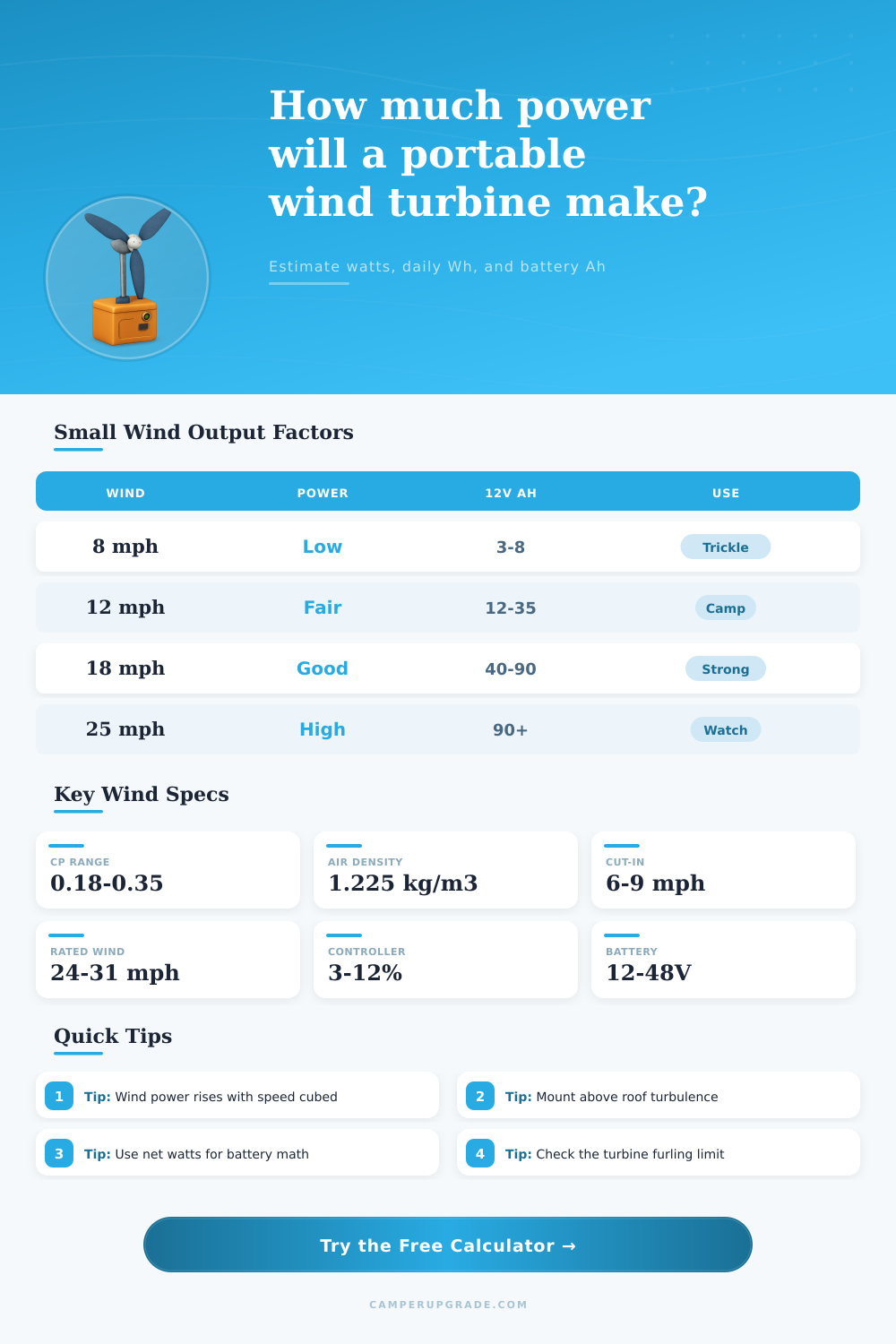
The energy produced by a portable wind turbine increases according to the cube of the speed of the wind. The speed of the wind at a site might be twelve miles per hour, which means the site will have almost twice the energy compared to another location with an average wind speed of ten miles per hour. A portable wind turbine calculator allow you to enter the diameter of the rotor, the average wind speed, the cut-in speed, and the rated speed of the portable wind turbine.
How to Calculate Energy from a Portable Wind Turbine
Additionally, the calculator also considers the power coefficient, the alternator efficiency, and the controller losses of the portable wind turbine. By entering these factors into the calculator, you will get the correct amount of energy that will reach the battery. If you dont enter these factors, you will end up overestimating the amount of energy that the portable wind turbine will produce by up to thirty percent or more.
The size of the rotor blades that a portable wind turbine use is another important factor to consider when determining the energy output of the device. The size of the rotor will determine the amount of air that the rotor blades will encounter. If the diameter of the rotor is increased from three feet to four feet, the area that the rotor sweeps will increase by nearly eighty percent.
The calculator calculates the energy output of the portable wind turbine from this swept area before the efficiency factors of the portable wind turbine are considered. Manufacturers of the portable wind turbines will want to make the rotor blades as long as possible to increase the area that is exposed to the wind. The larger the area that is exposed to the wind, the more electricity that the portable device can produce.
This will allow the portable wind turbine to reach its rated output at a lower wind speed. This is an advantage to those who live in areas where the wind speed is in the mid-teens instead of the twenties. Another important factor in the calculation is the cut-in speed for the portable wind turbine.
The cut-in speed for many small portable wind turbines is six or seven miles per hour. However, the wind speed at the height of the hub will be lower due to the movement of trees, cars, and buildings. The user will set the cut-in speed into the calculator as a parameter for the wind speed, and any value lower than the cut-in speed will be valued at zero in the calculation.
This ensures that people will not think that the portable wind turbine will provide power if there is a mere breeze in the area. Additionally, people can use the cut-in speed to calculate the amount of energy that is lost if the usable hours of the battery drops from eight hour to five hours. Other factors that must be considered in the calculation of the energy output of a portable wind turbine is the air density and the terrain derate.
Air density will vary with the altitude at which the portable wind turbine is positioned. If the air is thinner the higher that the device is above the ground, then the wind will have less power. The calculator will allow the user to set air density values for different altitudes.
This factor will be important if the user plans to run the portable wind turbine above four thousand feet. Additionally, the terrain derate accounts for the effect of rough terrain on the energy output of the portable device. These two variables ensure the accuracy of the energy output that the calculator calculates for the portable wind turbine.
Besides these variables, the portable wind turbine calculator will provide information on the voltage of the battery and the amount of amp-hours that the battery will recieve each day. The calculator will convert the net watts into amp-hours based off the voltage of the battery bank that is to be charged. This is important for providing a comparison between different types of battery banks.
The higher the voltage, the lower the amount of electrical current that will be used to carry the same amount of watts. Using less electrical current will reduce the amount of energy that is lost travelling through the wires from the portable wind turbine to the battery bank. The calculator can also estimate the number of hours of wind that will be required to return the battery to a specific amount of amp-hours.
This information will allow the user to determine if the portable device can fulfill there power needs. Inside the calculator are also reference tables that indicate the amount of energy that the portable wind turbine will produce at different wind speeds. If the wind speed is doubled, the energy output will be eight times greater.
This means that one day with strong winds can provide the same amount of energy as several days when the wind is at a calmer speed. These tables also show the amount of daily watt-hours and amp-hours that the portable wind turbine will produce at common battery voltages. This information will allow users to understand the information from the calculator in the same terms as your battery monitor or charge controller for the battery bank.
The variables of the mounting height and siting of the portable device will not be captured by the calculator. A portable wind turbine will produce little energy if it is situated in the lee of an RV, or if it is in the area of turbulence created by trees or other structures. To increase the energy output of the device, the user can raise the mast to ensure that the rotor blades are at least ten feet above any structures in the surrounding area.
This will often produce more energy than purchasing a larger portable wind turbine. Shortening the length of the wiring from the portable wind turbine to the battery bank will also increase the energy output because the current will travel through fewer wires to reach the battery. Finally, portable wind turbines work best as part of a mixed system along with solar power systems.
Portable wind turbines will charge the battery when there is no sunlight available for the solar panels. The solar panels will produce the charge when it is sunny outside and there is no wind movement for the portable device. The portable wind turbine calculator allows the user to size the device accordingly to produce the proper amount of energy without overwhelming the battery with too much energy at once.
When the user enters the parameters for the size of the rotor, the wind speed at the hub of the portable device, and the energy losses of the portable device into the calculator, the device will provide a reliable number for the user. By running the numbers for the portable device, users will be able to determine which factor will produce the most energy for the portable device. The best way to increase the energy output of a portable wind turbine is to increase the wind speed at which it is sited, or to increase the number of hours that the device is deployed in locations where the wind is likely to be at a marginal speed.
When the power output from the portable device matches the electrical loads that you’re to operate, the device will become a reliable power source for the off-grid location. This would of been easier with a moddern sensor, but calculations still works.