Portable Toilet Capacity by Uses Calculator
Estimate how many safe uses your cassette, camp, van, boat, or emergency portable toilet can handle before waste capacity or flush water becomes the limiting factor.
| Named portable toilet | Waste tank | Fresh tank | Planning note |
|---|---|---|---|
| Thetford Porta Potti 135 | 2.6 gal / 9.8 L | 3.0 gal / 11.4 L | Compact weekend unit |
| Thetford Porta Potti 345 | 3.2 gal / 12.1 L | 4.0 gal / 15.1 L | Medium RV and van size |
| Thetford Porta Potti 365 | 5.5 gal / 20.8 L | 4.0 gal / 15.1 L | Larger family holding tank |
| Dometic 972 | 2.6 gal / 9.8 L | 2.3 gal / 8.7 L | Short push-button toilet |
| Dometic 976 | 5.0 gal / 18.9 L | 2.3 gal / 8.7 L | Tall 970-series unit |
| Camco 41531 | 2.6 gal / 9.8 L | 2.5 gal / 9.5 L | Small travel toilet |
| Camco 41541 | 5.3 gal / 20.1 L | 2.5 gal / 9.5 L | Large detachable tank |
| Reliance Flush-N-Go 4822E | 5.8 gal / 22.0 L | 3.0 gal / 11.4 L | High-capacity flushing unit |
| Use pattern | Base waste | Paper allowance | Best use in calculator |
|---|---|---|---|
| Hydrated urine-only use | 14 to 18 fl oz | 1 to 2 fl oz | Raise urine volume |
| Average urine-only use | 10 to 14 fl oz | 1 to 3 fl oz | Use default values |
| Average solid use | 18 to 26 fl oz | 2 to 5 fl oz | Raise solid volume |
| Family or child use | 8 to 20 fl oz | 2 to 6 fl oz | Adjust both volumes |
| Emergency minimal flush | 8 to 16 fl oz | 0 to 2 fl oz | Lower paper and flush |
| Waste tank size | Usable at 10% reserve | Approx mixed uses | Approx two-person days |
|---|---|---|---|
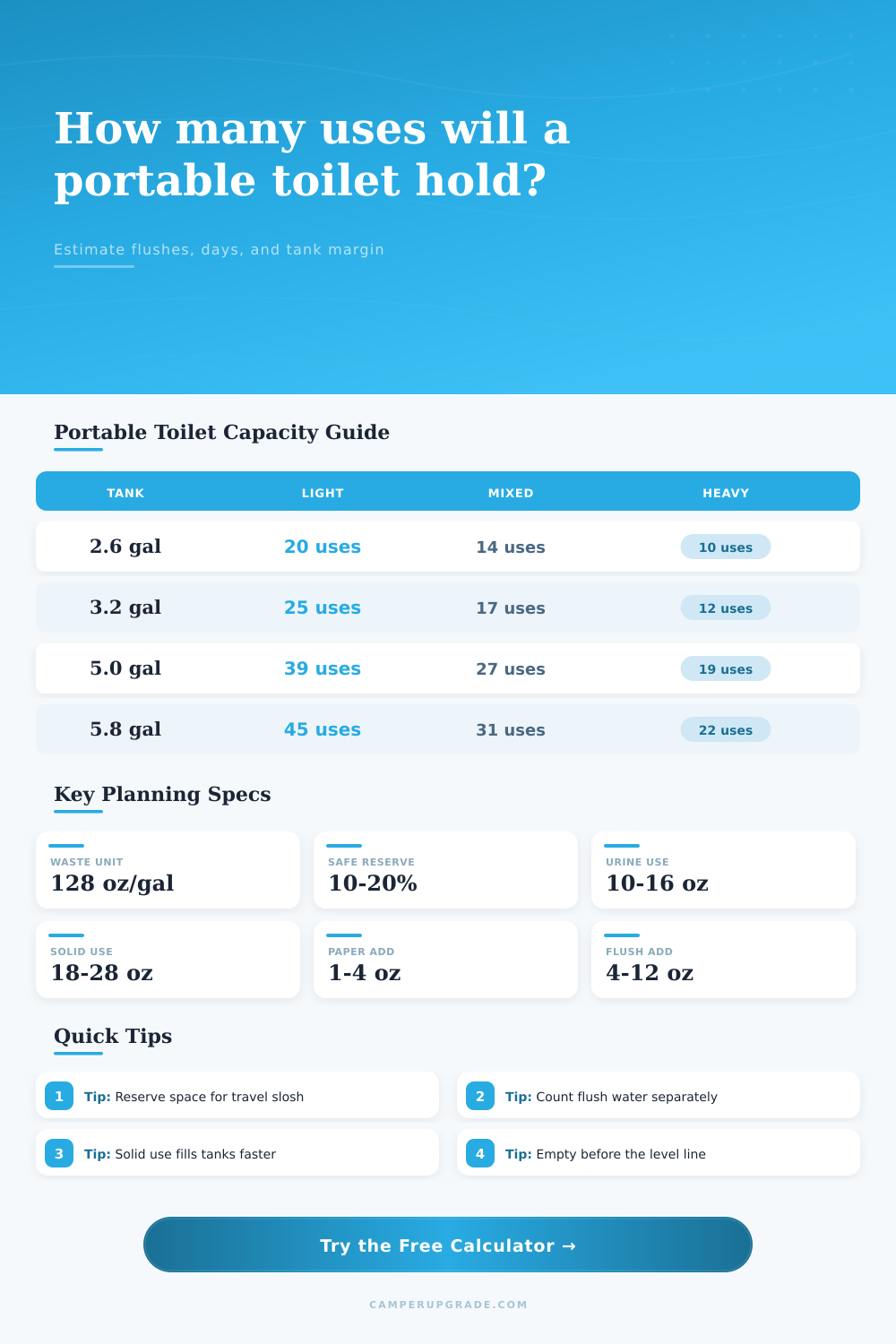
| 2.6 gal / 9.8 L | 299 fl oz | 14 to 20 uses | 1.4 to 2.0 days |
| 3.2 gal / 12.1 L | 369 fl oz | 17 to 25 uses | 1.7 to 2.5 days |
| 5.0 gal / 18.9 L | 576 fl oz | 27 to 39 uses | 2.7 to 3.9 days |
| 5.3 gal / 20.1 L | 611 fl oz | 29 to 41 uses | 2.9 to 4.1 days |
| 5.8 gal / 22.0 L | 668 fl oz | 31 to 45 uses | 3.1 to 4.5 days |
| Formula item | Calculator formula | Metric equivalent | Why it matters |
|---|---|---|---|
| Tank conversion | gallons x 128 = fl oz | gallons x 3.785 = L | All uses are summed as liquid volume |
| Usable waste space | capacity - start - reserve - treatment | oz x 0.02957 = L | Keeps space below the full line |
| Daily waste load | urine uses + solid uses + paper | daily oz x 0.02957 = L | Sets days before dump |
| Flush water limit | fresh oz / flush oz | fresh L / flush L | Fresh tank can run out first |
| Trip dump count | ceil(trip days / supported days) | same ratio | Plans required emptying cycles |
I checked the tire pressure and packed the van. The cooler is loaded. Plans are good. Wait. Did I forget to consider the portable toilet tank? Yes, the tank is a wildcard in any camping plan. Is it going to be a leisurely morning or will we frantically try to find a nearby dump station?
A lot of people don’t consider capacity when they is buying a portable toilet. They aren’t considering volume; they are thinking about number of times they can use it until nature calls again. Most people buy a toilet based off its total gallon rating. Most folks purchase a toilet by its total gallon rating and assume that a 2.5-gallon tank provide half as much comfort as a 5-gallon tank.
Why Your Portable Toilet Tank Matters
This isn’t true, since they fail to account for the reserve buffer required during travel. Liquid sloshes around inside the van when you hit a pothole. If the tank is filled all the way to the brim, then this movement will leak waste over the seal and/or spill into the bowl. To account for this, calculator allows you to set a reserve percentage which carves out dead space towards the top of the tank. A little thing, sure, but it makes a big difference. It keeps a full tank from ruining your day.
However, this isn’t the entire story on what’s going on in the bowl. While urine is fairly consistent, solid waste messes things up. For one thing, solids don’t easily compress or fit in a neat shape. They occupies more actual space per use. Then add toilet paper, and you’ve got a volume multiplier most camper miss: One solid deposit plus a couple sheets of paper will eat almost a quarter of a liter of holding capacity. This is where folks go wrong. They’re counting the number of uses instead of the volume.
The other non-waste-related limit is having flush water. You might be able to hold all the poop in the world, but what happens when your fresh water tank run out? You’ll still have a tank full of waste (technically) but without any water for flushing, it’s effectively useless. It’s a mis-match situation. This is why the tool breaks up those two tanks and lets you know which one is the problem. The fresh tank is the weak link for a lot of van lifers.
Another not-so-obvious variable is the type of paper. Using thick toilet paper will increase the amount of space your poo takes up in the tank by several inches. Think about how much more room it take up when wet. Thin, fast-dissolve paper use less space. That means fewer dumps too. It feels less luxurius, but you buy yourself some time.
And if you’re traveling with family, the volume consumption scales up quickly. Five gallons versus three can mean the difference between a single dump or two. Space is taken up by starter chemicals too. You don’t get those free blue/green liquids that dissolves the waste. They take up space that could of used. The more full your tank is with treatment prior to startup, the less room there will be for waste. It’s a matter of tradeoff: how much do you need for capacity versus odor control? This calculator can accounts for the amount of starter liquid you put into the tank, so it calculates the available space correctly.
And that brings us to the rhythm of dumping. What are you doing? How long of a trip are you on? Will a small tank be enough for a weekend trip or do you need something bigger so you can empty in the middle of your weeklong overland adventure? You’ll want to know how many days it’s been since your last dump. This will guide your route planning for rest areas and campgrounds without leaving you panicked.
At its core, this is all about expectation management. Physics won’t allow you to magically increase how much water fits in your tank. You can change what you do. Limit paper usage, stop filling up your tank until it’s actualy at max capacity, and know when to top-off vs add fresh water. Don’t push for every last drop of water in the tank. Instead, try not to fill your tank completely so you aren’t stuck on an incline with no room left for more water.