Polenta Camp Water Ratio Calculator
Size dry cornmeal, water, salt, pot headroom, cooking time, and finished yield for trail stoves, camp kitchens, and group pots.
🏕Named Camp Presets
⚙Polenta Ratio Inputs
Camp Polenta Batch Results
📊Polenta Grind Spec Comparison
🥘Texture Ratio Reference
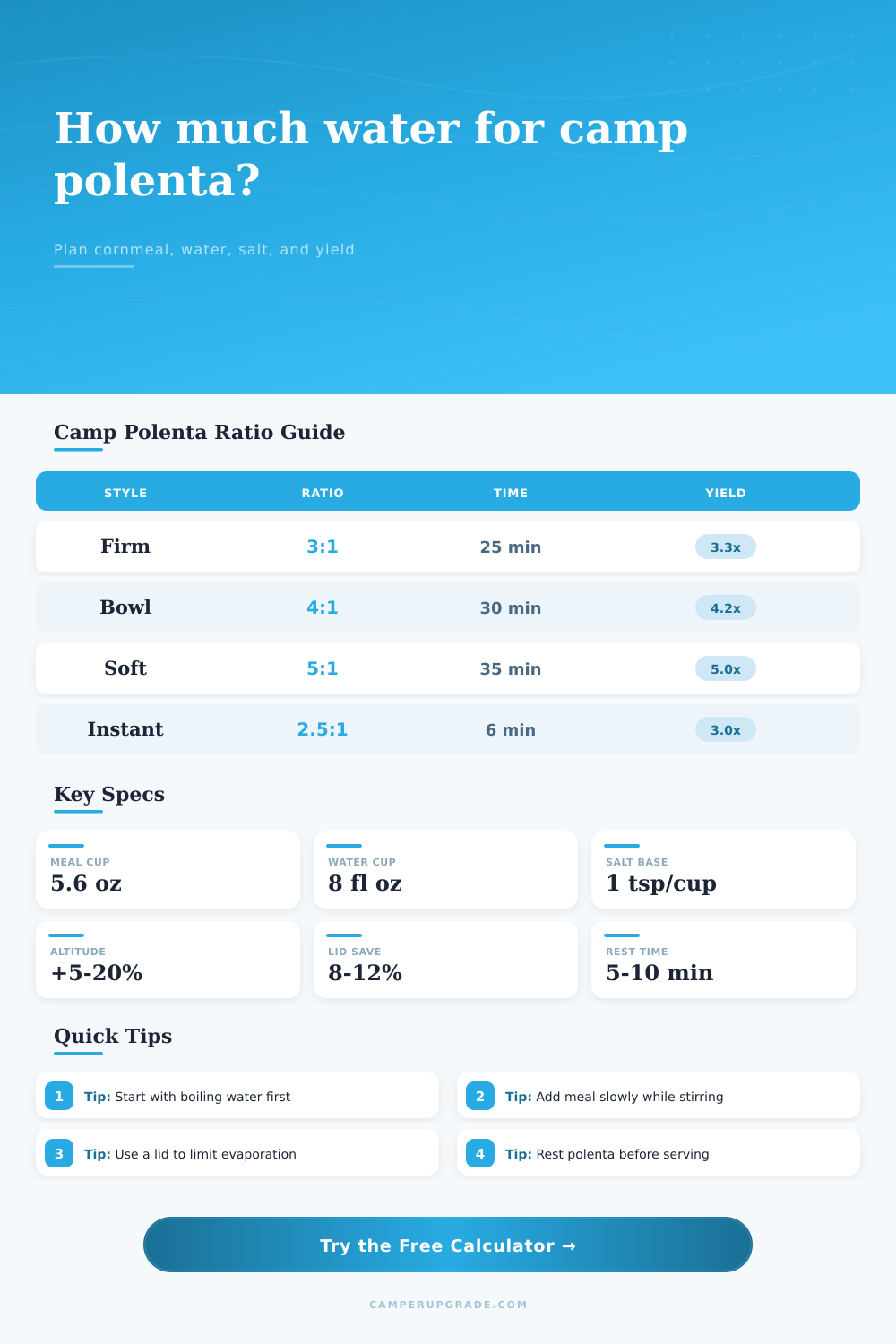
| Texture | Base ratio | Best camp use | Finished yield |
|---|---|---|---|
| Firm slices | 3 cups water per 1 cup meal | Cooling in a pan, frying later | About 3.3 cups per meal cup |
| Standard bowl | 4 cups water per 1 cup meal | Camp dinners and breakfast bowls | About 4.2 cups per meal cup |
| Soft creamy | 5 cups water per 1 cup meal | Dutch oven batches and shared pots | About 5 cups per meal cup |
| Loose grits-style | 5.5 cups water per 1 cup meal | Long simmer, soft spoonable bowls | About 5.4 cups per meal cup |
| Instant polenta | 2.5 cups water per 1 cup meal | Fast backpacking lunches | About 3 cups per meal cup |
🌡Altitude And Evaporation Adjustments
| Condition | Water add | Time add | Reason |
|---|---|---|---|
| Low camp below 2,000 ft | 0% | 0 min | Normal boiling and simmer behavior |
| 2,000 to 5,000 ft | 5% | 2 min | Softer boil and slower starch hydration |
| 5,000 to 8,000 ft | 10% | 4 min | Longer uncovered simmer loss |
| 8,000 to 10,000 ft | 15% | 6 min | Lower boiling temperature needs more time |
| Over 10,000 ft | 20% | 8 min | High camp cooking benefits from covered rest |
🍲Camp Batch Size Table
| Batch | Dry meal | Water at 4:1 | Pot headroom |
|---|---|---|---|
| Solo side bowl | 1/4 cup / 39 g | 1 cup / 237 ml | 1 quart pot minimum |
| Two person meal | 2/3 cup / 104 g | 2 2/3 cups / 631 ml | 1.5 quart pot minimum |
| Family dinner | 1 1/2 cups / 234 g | 6 cups / 1.42 L | 3 quart pot minimum |
| Basecamp group | 3 cups / 468 g | 12 cups / 2.84 L | 6 quart pot minimum |
| Firm slab pan | 2 cups / 312 g | 6 cups / 1.42 L | Half-sheet or 9 x 13 pan |
🧮Formula And Conversion Table
| Item | Formula | US result | Metric result |
|---|---|---|---|
| Dry meal weight | meal cups x 156 | 1 cup meal | 156 g |
| Water volume | meal cups x ratio x camp factor | 4 cups base water | 946 ml |
| Salt amount | meal cups x salt level | 1 tsp per cup meal | 5.7 g salt |
| Yield estimate | meal + water x absorption factor | 4.2 cups from 1 cup | 0.99 L from 156 g |
| Pot headroom | finished yield x 1.35 | 5.7 cup pot space | 1.35 L space |
💡Camp Cooking Ratio Tips
There’s a moment every time someone cooks polenta on a windswept ridge where they start to freak out. The liquid boils away, leaving a goopy cement-like lump adhered to the bottom of pan. Why? Cookbook in kitchens make assumptions about factors that camp cookouts leave changing. Open pots and wind change the physics of hydration. Altitude change how it behaves.
The math is complicated, but this will do the calculations for you so you can plan accordingly if the weather changes or something malfunctions with your stove. There’s just one problem: boiling the cornmeal hard makes it act one way; using lower heat for longer stretches make it behave another. Boiling it in fine meal cause it to absorb water rapidly, but burn quickly. Coarse grinds like stone ground cornmeal take longer to soften without burning.
How to Cook Polenta at Camp
A four-to-one water ratio sounds reasonable; which is why most people begin there. And, if you’re starting out on a calm sea-level morning with a covered pot, yeah, that four-to-one ratio will probably work out okay. But if you’re on a gusty afternoon up at seven thousand feet, you’ll find the same ratio is now a brick. That’s where the calculator comes in, it factors in all those variables you can’t see (like wind, altitude, etc.) and adds water to account for that evaporation before it’s too late.
Another thing overlooked in the haste to eat is salt. You can add a bit here and there at will when you are tasting along the way at home. When cooking over a camp stove there’s not much opportunity to fiddle with seasonings while trying to keep everything from lumping. So their recommendation is a salt base off every cup of meal to prevent bland carb. It seems small, but it is important. If your grains are hydrated in seasoned water they’re more flavorful than if they just get a sprinkling on top.
Altitude is less obvious than wind but just as dangerous. The higher you go the lower the boiling point of water. Starch also take longer to thicken. So simmer for a little longer, yes, but don’t overdo it. Just add a bit more water (the reference table on the page shows how much extra per band of elevation).
Don’t ignore the information: Burned-on-bottom, still-raw-in-the-middle polenta is the single most frequent cause of high-camp failure. The right ingredients and ratios aren’t the only thing that matters; the amount of space in your pot also affects how much water you need. Steam escapes quickly in an open, shallow pan like a skillet, requiring more water to stay creamy. By contrast, a tightly lidded Dutch oven (or even better: a thermos) will lock in moisture and heat and let you get away with far less.
As always, there’s no substitute for experience. Lots of home cooks top up their mixture every time it appears too thick. They don’t know they are simultaneously watering down the dish, this makes it harder to set properly. With the calculator, you’ll have a precise measurement of how much volume to expect. A lower ratio yields firmer slices for frying ahead; more water produce a soft, spoonable breakfast bowl.
So there’s the rub: you’re not simply mixing together some water and cornmeal; instead you’ve got to understand what you’re measuring and how heat transfer (or doesn’t) in your uncontrolled environment. Start with hot water. Slowly pour in the dry meal and stir to avoid lumps. Bring it back up to a boil, then reduce the heat and put a lid on the pan. If you let it sit for a few minutes before eating, the starch will continue to soak up water even without applying any further heat. Often people skip this last step and end up with what tastes like a dry polenta until it sets.
Control in chaos is camp polenta. Altitude is not your friend. Neither is wind; you can’t make it blow one way instead of another. But the ratios are something you can tweak based off your conditions, and that’s where the magic happens. Stop guessing and remove the variables. Use a tool to manage them for you. This lets you eat the food and savor it instead of wrestling with a hot pot.
Get it wrong and you’ll have a sticky regret. Do it right and it will be your comfort staple. You should of used this earlier.