PLB Battery Life Calculator
Estimate personal locator beacon transmit life after age, cold, GPS acquisition, self-tests, strobe drain, and emergency reserve are applied.
📍PLB Mission Presets
⚙Beacon, Battery, Cold, and Activation Inputs
Calculation Breakdown
📐Four PLB Battery Formulas
Derated Energy
Wh x factorsInstalled battery energy is multiplied by age, storage, and temperature retention.
Fixed Use Drain
GPS + testsGPS acquisition minutes and past self-tests are subtracted before transmit life is estimated.
Transmit Life
Wh / avg WRemaining watt-hours are divided by average beacon plus strobe power draw.
Reserve Life
hours x reserveThe selected emergency reserve is held back from the planning runtime.
🔋PLB Battery and Signal Specification Grid
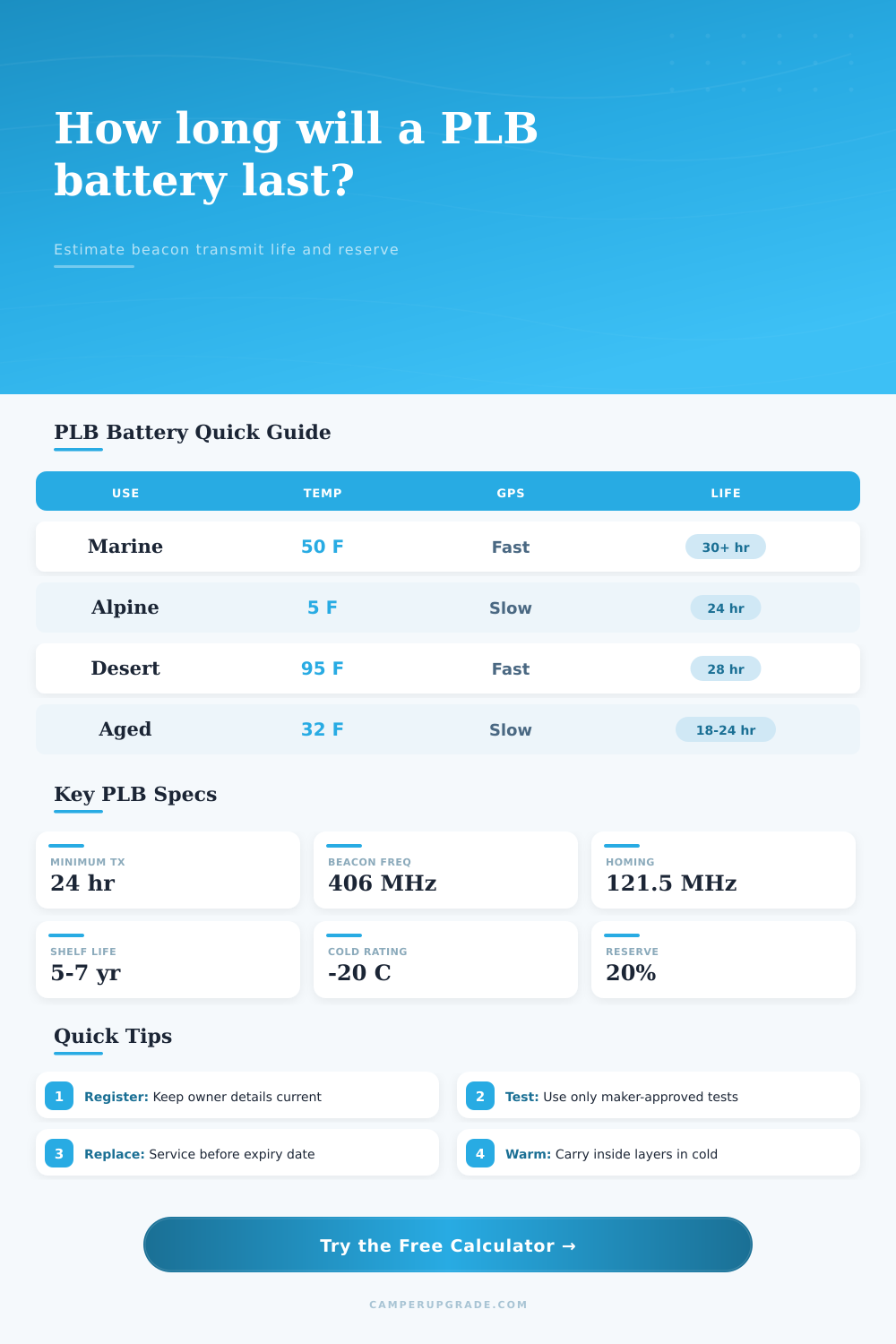
In-date beacons are commonly specified to keep transmitting through a full day.
The coded distress burst carries beacon identity and can include location data.
Used by responders for local direction finding once near the scene.
Actual service interval depends on the beacon label and manufacturer service rules.
Very cold cells lose voltage and usable capacity unless carried warm.
Open sky can be faster; cliffs, canopy, and cold starts can take longer.
A reserve guards against delayed discovery, weather, and antenna placement issues.
Actual draw varies by beacon, burst schedule, GNSS, strobe, and temperature.
📊PLB Reference Tables
| Beacon Profile | Rated Life | Battery Energy | Average Draw |
|---|---|---|---|
| Compact ultralight PLB | 24 hours | 8 to 10 Wh | 0.35 to 0.42 W |
| Standard modern PLB | 24 to 30 hours | 10 to 14 Wh | 0.38 to 0.48 W |
| Marine PLB with strobe | 24 hours | 11 to 16 Wh | 0.42 to 0.55 W |
| Older in-date PLB | 24 hours | 9 to 13 Wh | 0.45 to 0.60 W |
| Battery Temp | Planning Factor | Typical Effect | Field Action |
|---|---|---|---|
| 70°F / 21°C | 100% | Near lab capacity | Keep antenna clear and upright. |
| 32°F / 0°C | 90% | Moderate cold loss | Carry close to body before use. |
| 0°F / -18°C | 76% | Material capacity loss | Warm before activation if possible. |
| -20°F / -29°C | 62% | Severe cold loss | Use a higher reserve assumption. |
| Battery Age | Cool Storage | Vehicle Storage | Planning Note |
|---|---|---|---|
| 0 to 2 years | 96% to 100% | 90% to 96% | Usually strong if undamaged and registered. |
| 3 to 4 years | 90% to 96% | 80% to 90% | Check expiry date and self-test log. |
| 5 to 6 years | 82% to 90% | 70% to 82% | Plan service soon, especially before remote trips. |
| Past expiry | Unknown | Unknown | Replace battery; do not rely on estimates. |
| Scenario | GPS Fix | Reserve | Battery Planning Target |
|---|---|---|---|
| Open ocean or lake | 5 to 10 min | 20% | 24 hours plus visual strobe margin. |
| Timbered valley | 20 to 45 min | 25% | Carry beacon warm and expose antenna fully. |
| Winter alpine | 15 to 60 min | 30% to 40% | Cold derating can dominate the result. |
| Old stored beacon | Unknown | 40% | Service before relying on it for remote travel. |
✅PLB Battery Planning Tips
A PLB’s battery is never at 100 percent, nor is it ever at zero. Instead, it lives in the no man’s land of potentiality: a mixture of chemistry and guesswork. Temperature fluctuations and natural process of aging steal its charge over time. They also siphon off electrons each time you test your unit during pre-trip preparation.
Because emergency planning relies on knowing exactly how much runtime remains when the signal goes out, this common mistake are hazardous. Plug in some variables into the calculator above and let it do the work for you. Forget wondering if that old battery can last long enough through your twenty-four hour rescue window.
Why PLB Battery Life Changes
But here’s where it gets down to brass tacks: Manufacturers rate these units based off their best-case scenario, i.e., clean cells, ideal ambient temperature, unobstructed view of the heavens. In real life, however, your cells is chilled and you’re storing them in a moist compartment. Perhaps you’re in a rock-walled canyon and the GPS can’t seem to get a bead on a satellite. All these factors add up to a difference between theory (i.e., the specs) and practice (i.e., survival). And that’s where the device begins to take into account this difference.
First of all, it considers how old the battery is relative to its service interval. A lithium battery will lose capacity much quicker when stored in a hot trunk versus a cool, dry glove box. Why? Because heat breaks down the chemistry. Even though you might have another year before it expires, your usable juice will plummet well before that time. So, that’s why it is important to include cell-storage history in the calculation.
And then there is issue of cold weather. As it gets colder, the battery chemistry slow down. That means it has less usable voltage and in effect shrinks the overall battery capacity. So if you activate your beacon on a twenty degree F day, you’re not going to get the performance you would of had on a milder autumn day. To make up for that, the calculator adds a derating coefficient to reflect the loss. Cold weather does steals some hours off your transmit life, and yes, it’s a harsh reality of electrochemistry. You can help reduce this by keeping it close to your body before activation.
But even so, math has to account for the drain that occurs right after pressing the button. There’s also GPS acquisition time, which is another energy drain you won’t see. Today’s beacons must locate satellites and then transmit a detailed position along with the distress signal. If it has to search longer for a satellite to get a lock because it has a poor view of the sky, it will use more power. In open water, it may grab a fix within minutes. In heavy forest, it could take four times as long. Every extra 15 minutes spent searching for a satellite uses up 15 minutes of your transmission reserve. The device allows you to dial that estimate to match whatever environment you expect to operate in. It makes you consider the surrounding conditions, not only the technology itself.
Auxiliary displays and strobe lights may help someone visually locate you, which is nice, but they consume reserve energy quickly. Every watt is a watt that won’t keep the 406 MHz signal strong enough for satellites to pick up in case of an emergency. The calculator reduces this load from your overall estimate.
It also enables you to enter a reserve margin. Because you don’t know how long it will take for a rescue, this is critical. It could be two hours or it could be forty-eight. Twenty percent held back gives you some insurance against delay and prevents the beacon dying right when a helicopter flies overhead.
These variables make sense when viewed in context, which is where the page’s reference tables comes in. They illustrate the relative performance of beacons across profiles as well as the type and extent of degradation at each age. However, without understanding the trade-offs, the numbers aren’t meaningful. For example, while an ultralight beacon may be more compact and lighter, it may also have far less battery margin than its bulkier marine cousin. Similarly, a beacon with significant wear from lots of self tests likely has fewer hours remaining than one freshly removed from the box.
These nuances are boiled down by the calculator into a single estimated run time, abstract battery health reduced to tangible hours of coverage. So yes, it’s ultimately about managing risk. It’s not about getting super precise; it’s not about making sure that your beacon will last exactly twenty-four hours (though that’d be great!). But running those numbers beforehand clarifies things.
When it spits out something that says “this is nowhere near twenty-four hours”… with the derate and reserve included…it’s time to either replace/seriously service the beacon. Because, guess what? Don’t go by hope. Go by the data.
You want to make sure whatever battery life your beacon has can give off some kind of signal long enough for someone to find you, no matter how far you get from civilization or how nasty the weather turns. So keep your hopes realistic, your storage cool, and your batteries fresh.