Pillow Loft Calculator
Estimate loaded and uncompressed pillow loft from your sleep posture, body dimensions, mattress sink, and fill behavior so neck support stays aligned through the night.
🛏Preset Sleep Scenarios
⚙Pillow Fit Inputs
Outputs include target loaded loft, recommended uncompressed loft, and an adjustment window to tune pillow inserts over multiple nights.
🧵Fill Profile Grid
| Sleep Position | Support Factor | Typical Loaded Loft | Alignment Goal |
|---|---|---|---|
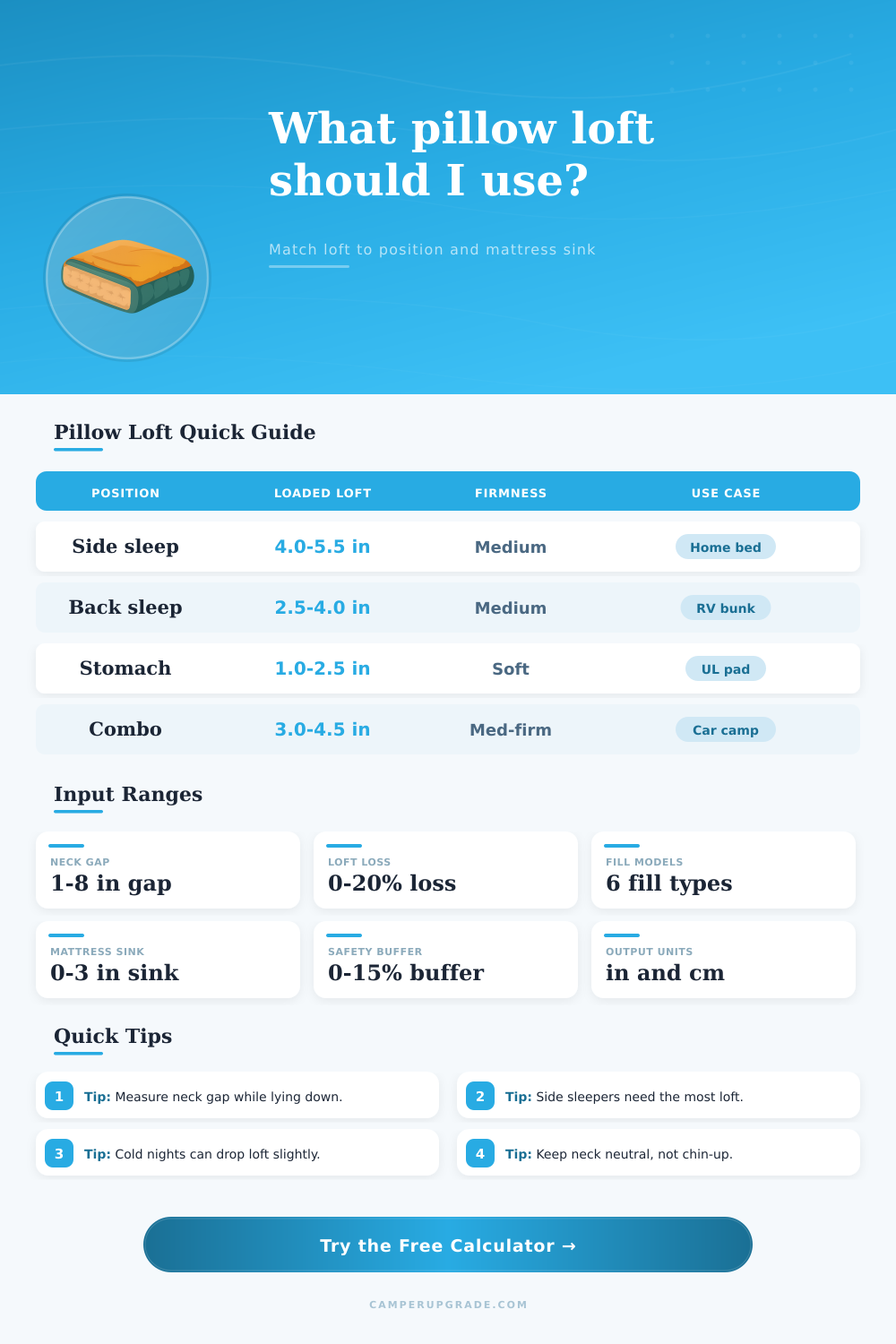
| Side sleeper | 1.00 | 4.0-5.5 in | Head level with sternum line |
| Back sleeper | 0.72 | 2.5-4.0 in | Neutral cervical curve support |
| Stomach sleeper | 0.42 | 1.0-2.5 in | Reduce neck extension demand |
| Combo sleeper | 0.82 | 3.0-4.5 in | Compromise across positions |
| Mattress Type | Default Sink | Sink Factor | Use Note |
|---|---|---|---|
| Soft top mattress | 1.4 in | 1.08 | Needs more pillow build |
| Medium mattress | 0.9 in | 1.00 | Baseline reference profile |
| Firm mattress | 0.5 in | 0.92 | Lower sink correction |
| RV foam cushion | 0.35 in | 0.90 | Often flatter shoulder sink |
| Fill Type | Recovery | Stability Base | Best Fit |
|---|---|---|---|
| Down cluster | 70% | 62/100 | Packable travel use |
| Shredded memory foam | 82% | 81/100 | Adjustable mixed sleepers |
| Solid memory foam | 88% | 88/100 | Consistent shape support |
| Latex core | 90% | 90/100 | Responsive side or combo use |
| Buckwheat hull | 95% | 94/100 | Maximum loft stability |
| Polyester fiber | 76% | 68/100 | Spare or lightweight setups |
| Use Case | Suggested Loft Window | Insert Step | Retest Cycle |
|---|---|---|---|
| Home main pillow | Midpoint +/-10% | 0.5 in | Retest weekly |
| RV bunk pillow | Midpoint +/-12% | 0.4 in | Retest per trip |
| Backpacking camp | Midpoint +/-15% | 0.3 in | Retest by season |
| Cold weather camp | Top half of range | 0.3 in | Retest at temp drop |
Pillow loft are the height of a pillow when a persons head and neck weight are placed upon the pillow. The loft of a pillow is an important measurement of a characteristics of a pillow because pillow loft determines whether or or a persons spine remains in a neutral position while sleeping. If a person uses a pillow that has the incorrect loft for the sleeper, the person may develop pain and stiffness in there neck.
In order to determine the loft that should be present in the best pillow for an individual, the individual must measure the physical gap between a person’s neck and the mattress while the person is in they’re natural sleeping position. The measurement of the gap between the neck and the mattress will differ from person to person, depending upon the sleeping position that the person takes when sleeping. Those who sleep on their sides will require more loft in their pillow than those who sleep on their back or fronts.
How to Choose the Right Pillow Height
Individuals who sleep on their side have a physical gap between their neck and the mattress due to the width of the individual’s shoulders. Individuals who has broad shoulders will have more of a gap between their neck and the mattress than individuals who have narrow shoulder features. Thus, individuals who has broad shoulders will require more loft in their pillow than individuals who have narrow shoulders.
In contrast, individuals who sleep on their stomach will require very little loft in their pillow. If an individual who sleep on their stomach uses a pillow with too much loft, their neck may develop discomfort due to sleeping in an unnatural position. The firmness of the mattress upon which an individual sleep will also impact the required loft of an individual’s pillow.
Mattresses that are soft will allow the sleeper to sink deeper into the mattress than firm mattresses. Because an individual who sleeps on a soft mattress will have a gap between their neck and the mattress due to the sinking into the mattress, an individual who sleep on a soft mattress will require more loft in their pillow than an individual who sleeps on a firm mattress. Thus, before purchasing a new pillow, an individual should take into account the firmness of there mattress.
Mattress sink can have an impact on the loft that an individual should select for their pillow. The type of fill that is contained within a pillow may also impact the loft of a pillow. For instance, down clusters will compress when place under a persons weight.
Buckwheat pillows do not compress when under a persons weight. Shredded foam pillows provide medium compression within the pillow. Thus, the type of fill that is included within a pillow will impact the loft that an individual should select for their pillow.
It is important for individuals to recognize that the loft of a pillow may decrease with time due to the compressing nature of the fill within the pillow. An individual’s movement when sleeping may also impact the type of loft that they should use in their pillow. Individuals who sleep in positions that exhibit little movement may be able to use a pillow with loft that is very precise to the requirements of the individual.
Individuals who tend to move frequent during sleep may require a pillow with an element of buffer within the pillow. An element of buffer will prevent the pillow from becoming too flat during sleep. Thin insert layers may also be used within a pillow to adjust the loft of the pillow to the individual’s neck.
Any change in pillow loft should be tested for at least two night to ensure that the muscles of the neck feel comfortable with the new pillow. To measure the gap between an individual’s neck and the mattress, the individual should lie on their sleeping surface and use a ruler to determine the distance from the individual’s ear to the mattress. For individuals who sleep on their side, the tip of an individual’s nose should point straight ahead.
For individuals who sleep on their back, the pillow loft should be selected to support the curve in an individual’s neck. For individuals who sleep on their stomach, the individual will require very little loft in their pillow. An individual can adjust the loft of their pillow up or down within a range of plus or minus 10 percent of the loft that they determine was required for there neck.