Phone Charges From Power Bank Calculator
Estimate full phone charges, top-up percentage, usable watt-hours, trip-day coverage, and battery reserve from power bank and phone battery specs.
This calculator estimates energy transfer, not charging speed. Real results vary with cable quality, phone heat, battery health, screen use during charging, and power-bank cutoff behavior.
Phone charging breakdown
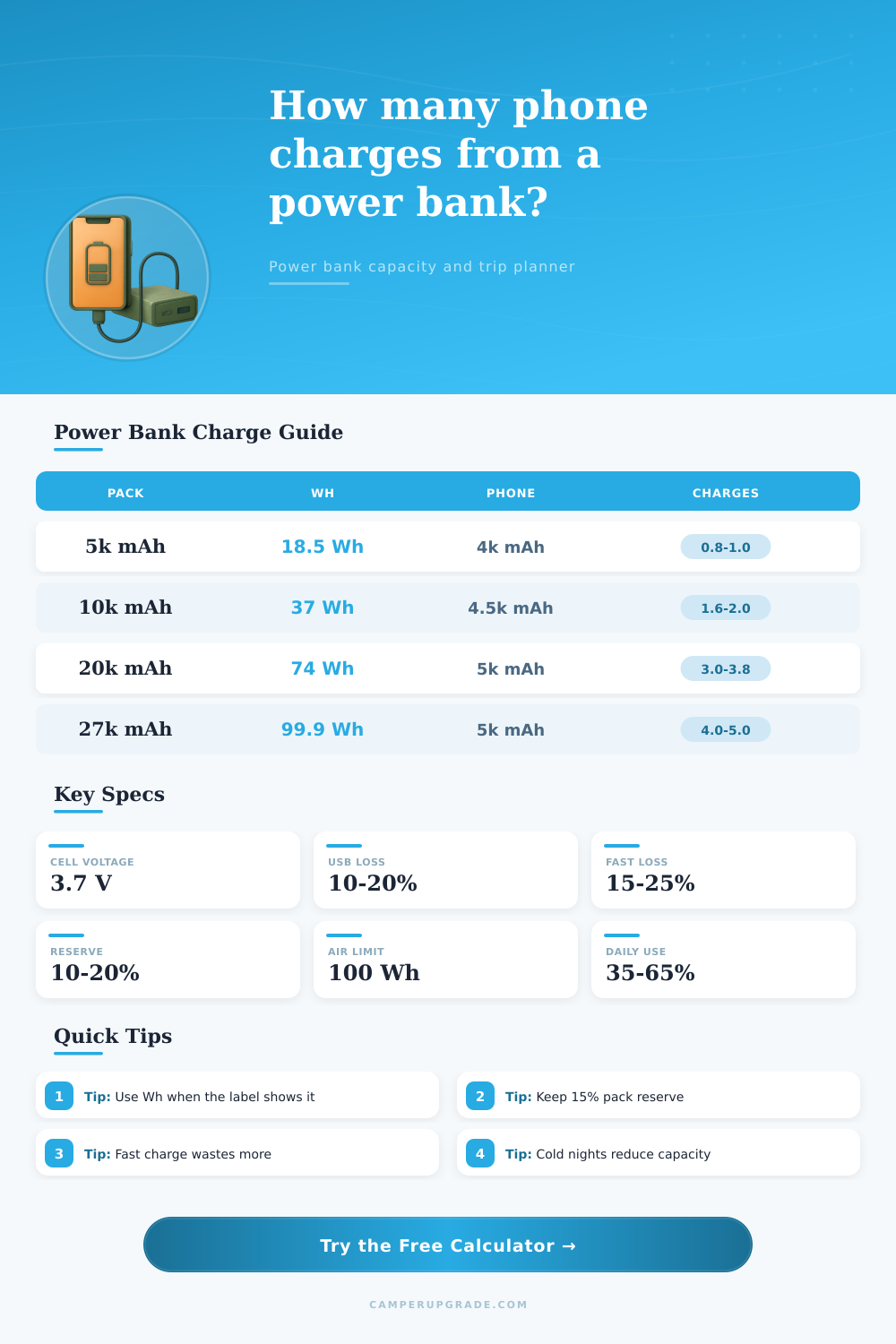
| Power bank rating | Approx stored energy | Usable wired output at 82% | Typical full phone charges |
|---|---|---|---|
| 5,000 mAh pocket bank | 18.5 Wh at 3.7 V | About 15 Wh before reserve | About 0.8 to 1.0 charges for a 4,000 mAh phone |
| 10,000 mAh slim bank | 37 Wh at 3.7 V | About 30 Wh before reserve | About 1.6 to 2.0 charges for many modern phones |
| 20,000 mAh weekend bank | 74 Wh at 3.7 V | About 61 Wh before reserve | About 3.1 to 4.0 charges depending on phone battery size |
| 26,800 mAh airline-class bank | 99.2 Wh at 3.7 V | About 81 Wh before reserve | About 4.2 to 5.3 charges for common phones |
| 30,000 mAh large camp bank | 111 Wh at 3.7 V | About 91 Wh before reserve | About 4.7 to 6.0 charges, but check travel rules |
| Phone battery class | Typical mAh | Approx phone Wh at 3.85 V | Notes for charging estimate |
|---|---|---|---|
| Compact phone | 3,000 to 3,500 mAh | 11.6 to 13.5 Wh | Small battery means more full charges from the same bank. |
| Standard modern phone | 4,000 to 4,600 mAh | 15.4 to 17.7 Wh | Good default range when exact specs are unknown. |
| Large phone | 4,800 to 5,200 mAh | 18.5 to 20.0 Wh | Large screens and cameras may also increase daily use. |
| Rugged outdoor phone | 6,000 to 8,000 mAh | 23.1 to 30.8 Wh | Huge batteries reduce charge count but may last more days. |
| Two average phones | 8,000 to 9,200 mAh combined | 30.8 to 35.4 Wh | Shared power banks should be sized from combined Wh. |
| Charging setup | Planning efficiency | Where losses happen | Best use |
|---|---|---|---|
| Short slow USB cable | 85% to 90% | Boost converter and light cable heat | Overnight camp charging and battery conservation |
| Standard USB-C cable | 78% to 85% | Bank boost circuit, cable, and phone charge controller | Most camping and RV top-ups |
| High-watt fast charging | 70% to 80% | More heat and higher conversion stress | Short stops where charging time matters |
| Wireless magnetic pack | 55% to 70% | Coil alignment, heat, and phone case spacing | Convenience top-ups, not maximum trip capacity |
| Cold-weather charging | 60% to 78% | Reduced cell output plus warmer phone charging losses | Winter hikes if bank is carried warm |
| Camping use case | Bank and phone setup | Daily phone use | Expected coverage |
|---|---|---|---|
| Solo overnight with airplane mode | 5,000 mAh bank, 4,000 mAh phone | 35% per day | Often enough for one night plus a navigation margin |
| Weekend tent trip | 10,000 mAh bank, 4,500 mAh phone | 50% per day | Usually covers two to three days with a small reserve |
| Photo-heavy campsite | 20,000 mAh bank, 5,000 mAh phone | 85% per day | Commonly covers three days if charged by cable |
| Two phones at a group site | 20,000 mAh bank, two 4,500 mAh phones | 55% per phone per day | Plan on about two shared days with reserve intact |
| Resupply leg or travel day stack | 26,800 mAh bank, 5,000 mAh phone | 70% per day | Can cover four or more days if kept warm and wired |
A phone charge from power bank calculator are a tool that allows you to determine how much energy a power bank can provide to you phone. Many people use this calculator because a power bank are unlikely to supply the energy that it advertises. A power bank have a certain energy capacity, but not all of that energy can flow from the power bank to the phone.
This calculator help people understand the energy capacity of both device. Power banks advertise their energy capacity in unit of milliamp-hours. That value are based off the voltage of the cells that is contained within the power bank.
How to Use a Power Bank Charge Calculator
Most power banks has a voltage of 3.7 volts; however, the phones that are being charged has a much higher voltage, as they use USB ports to receive the data and energy from the power bank. This loss of energy due to the voltage difference mean that the power bank cannot output as much energy as it could theoretical output; this is lost energy due to the boost that the power bank must utilize in order to transform the voltage from the power bank to that of the phone. The phone charges from power bank calculator allows you to input the capacity of the power bank (in milliamp-hours), the voltage of the cells in the power bank, the size of the phone’s battery, and the voltage of the phone’s battery.
This calculator will convert the energy capacities of the power bank and the phone to units of watt-hours so that they can be compare to one another. In the calculation of the energy that can be provided by a power bank to a phone, there are losses of energy due to numerous factor. Energy is lost due to the boost that the power bank must use to transform the voltage of the power bank to the voltage of the phone.
Furthermore, energy is lost due to the resistance of the charging cable. Other energy is lost as heat within the phone. Additionally, if the phone is being charged wirelessly, more energy will be lost due to the use of wireless charging coils and because the alignment of the phone with the wireless charging pad is not likely to be perfect.
The phone charges from power bank calculator allows you to account for the percentage of efficiency of the power bank by allowing you to select the percentage of efficiency in the fields for the phone charges from power bank calculator. An efficiency of 85% can be used for slow charging the phone with a charging cable; however, fast charging or charging a phone with cold temperature may cause the efficiency to drop to value of 75% or lower. Such a field is visible within the phone charges from power bank calculator so that the user can adjust the percentage of efficiency.
In addition to energy losses due to the charging process, many people also likes to include a portion of the power bank’s energy as a reserve. Such a reserve can be used for emergency situation like making an emergency call or using a headlamp; it can also ensure that a device has enough energy to reach the final day of a trip. Many people like to set aside 15% of the energy of a power bank as a reserve.
Such a percentage are subtracted from the power bank prior to calculating the number of times that a phone can be charged with that power bank. After the reserve is subtracted from the power bank, the phone charges from power bank calculator can also account for the energy that is lost due to temperature changes in the power bank (which is further explain in the discussion of temperature in this article). Finally, after the phone charges from power bank calculator has accounted for the reserve and the temperature of the power bank, it can calculate for the efficiency factors that may impact the power bank and phone.
The battery of a phone drain with its use. Phones that are used for navigation, that have weak signal, that sit in cold temperature, and that take many photo will drain their batteries more rapidly than phones that are not used in these ways. The phone charges from power bank calculator allows the user to input the percentage of the battery of the phone that is used each day.
If a person plan to take a three-day trip, and if that person’s phone loses 55% of its battery each day, the phone charges from power bank calculator can calculate whether the power bank can provide enough energy to allow the phone to last for that three-day trip. It is also possible for the power bank to have to supply energy to more than one phone. The phone charges from power bank calculator allows the user to adjust the calculations for situations in which the power bank will be shared among more than one phone.
The number of “top-ups” (refills of the power bank) can be multiplied by the number of phone that will utilize the power bank; in this way, the tool can calculate the energy that will be lost each day by all of the phone, and it can determine whether that power bank will be able to supply enough energy to all of the phones. The chemical activity within the cell of a power bank is affected by the temperature of the power bank. When the temperature of the power bank is low, the chemical activity is also low.
Thus, the energy that can be released from the power bank is also reduce when the temperature of the power bank is low. The phone charges from power bank calculator allows users to account for this by applying a factor that reduces the calculated capacity of the power bank to reflect the reduced energy that the power bank will be able to release under cold conditions. Thus, if power bank is to be charged in temperature as low as freezing, the output of the phone charges from power bank calculator will be lower than if the calculations are made for normal temperature of the power bank.
Due to airline rules, power banks that contain more than 100 watt-hour of energy are either banned from airplanes (in the luggage), or are required to have special approval to be carried on an airplane. The phone charges from power bank calculator will highlight power banks whose calculated energy level are above this 100 watt-hour limit; this allows travelers to make certain that they use a power bank that is permitted on the airplanes with which they will be traveling. Tables are provided on the page for which the phone charges from power bank calculator tool is published.
These tables include information about different size of power banks, and how many time each type of phone can be charged with a power bank of that size. Additionally, the tables also include information about efficiency in different situation; for example, phones that are being charged slowly with a cable will have different efficiency from phones that are fast-charged. These tables provide a baseline for understanding the power bank; for example, each table indicates that a power bank that contains 10,000 mAh of energy will not provide two full charge to a typical phone (after the reserve and efficiency are accounted for).
The phone charges from power bank calculator can be used as a planning tool for your travel. For example, if you change the efficiency percentage within the phone charges from power bank calculator, the calculator will allow you to view the effect that using a different type of charging cable will have on the number of times that a phone can be charged. Similarly, altering the percentage that is set aside for a reserve will allow travelers to see how the length or number of traveler in a trip will affect the number of times that the phones can be charged.
Testing different number for the percentage of a phone battery that is used each day will show in what ways the use of a phone will affect the number of day that the power bank will last. Each adjustment of the factors within the phone charges from power bank calculator will reveal to the user different tradeoff between those factor. Thus, the calculator makes visible to the traveler the different tradeoff that can be made with the energy of the power bank; this way, the traveler can make certain that they use the device that best fit their trip.
Furthermore, the logic behind the phone charges from power bank calculator will be the same regardless of the length of the trip that they plan to take. Thus, by understanding the phone charges from power bank calculator, any traveler will understand how much energy their power bank will be able to provide to their phone.