PFD Buoyancy Calculator
Estimate net flotation support, reserve lift, and margin for your body, clothing, and water conditions.
🛟Quick Setup Presets
⚙Body, Gear, and Water Inputs
📊PFD Selection Comparison Grid
📘Reference Tables
| PFD Class | Nominal Lift | Typical Use | Notes |
|---|---|---|---|
| 50N Buoyancy Aid | 11.2 lb | Sheltered paddles | Requires active swimmer |
| 70N General PFD | 15.7 lb | Recreation paddling | Most kayak Type III class |
| 100N Offshore PFD | 22.5 lb | Rougher conditions | Higher freeboard target |
| 150N Lifejacket | 33.7 lb | Open water exposure | Best reserve under fatigue |
| Total In-Water Load (lb) | Calm Water Need | Light Chop Need | Rough Water Need |
|---|---|---|---|
| 160 | 9.5 lb | 10.8 lb | 12.4 lb |
| 190 | 11.1 lb | 12.7 lb | 14.6 lb |
| 220 | 12.7 lb | 14.5 lb | 16.8 lb |
| 250 | 14.3 lb | 16.4 lb | 18.9 lb |
| Water Type | Density (lb/ft3) | Lift Relative | Planning Impact |
|---|---|---|---|
| Freshwater | 62.4 | Baseline 1.000x | Use standard estimates |
| Brackish | 64.0 | 1.026x | Slightly better support |
| Seawater | 64.4 | 1.032x | Most buoyant environment |
| Cold freshwater | 62.5 | 1.002x | Density gain is minor |
| Reserve Band | Reserve Lift | Interpretation | Action |
|---|---|---|---|
| Critical | < 2 lb | Little tolerance | Upgrade to higher buoyancy |
| Minimum | 2 to 5 lb | Basic calm-water margin | Acceptable for short sessions |
| Recommended | 5 to 10 lb | Better wave tolerance | Good general target |
| High Reserve | > 10 lb | Strong support margin | Useful for offshore exposure |
A PFD is stuff that you wear so that it keeps you afloat if you fall in the water. It matters to understand the buoyancy of PFD for each that goes on kayak, canoe or paddle board. Many kayakers, canoeists and paddle boarders wear PFDs that look like vests and trust foam material for buoyancy
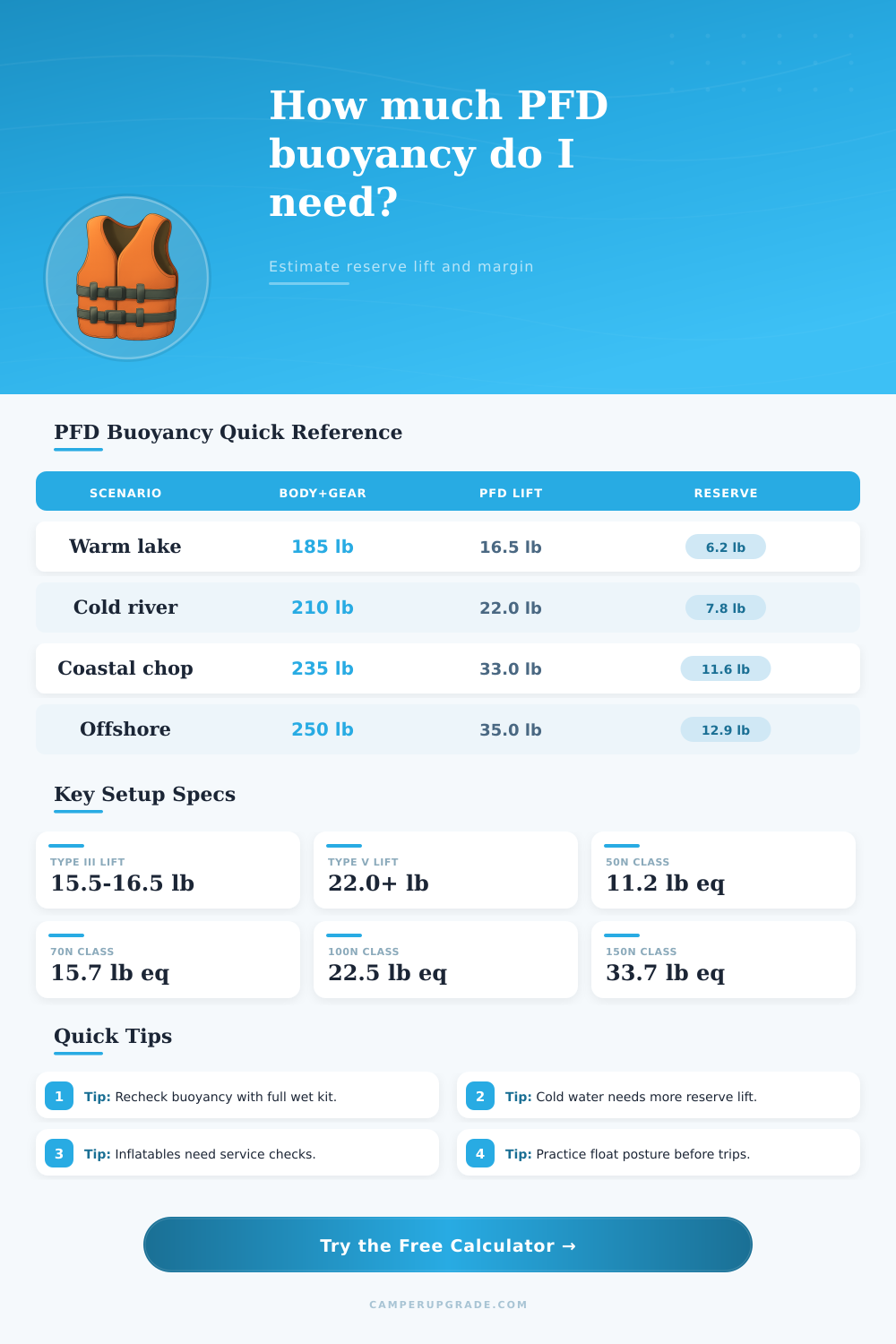
PFDs are rated Type 1 to Type 5. Every PFD belongs to one of those groups according to buoyancy and intended use. Type I PFD gives at least 22.5 pounds of buoyancy, or around 100 Newtons.
How PFDs Keep You Afloat
It gives the most buoyancy and works in all water, especially in open, rough or distant places where help comes late. It is a bigger and heavy vest, so less comfortable than others. For rivers Type III and Type V PFDs are good.
Type V PFDs help in severe conditinos by giving equal or bigger buoyancy, usually 15.5 to 22 pounds, and allow you to move. You must wear Type V PFDs during travel to meet the minimal demands of the US Coast Guard. Simply having it on the boat does not suffice.
PFDs are split in two kinds: inflatable and inherent buoyancy. Inflatable PFDs do not work for rivers and are made for emergencies, like those in planes. They inflate from around 22 pounds of buoyancy to 35 pounds.
If you swim on your belly with a secure inflatable PFD, that is hard, so you must swim on your side or back.
A buoyancy aid is the kind that kayakers wear: simply a lump of closed-cell foam. It helps a conscious person float, and only that. PFDs with only foam give around 7.5 pounds of buoyancy, which works for small paddlers on flat water.
Most adult swimmers need only 7 to 12 pounds of buoyancy to keep the head above the water.
Wearing a PFD makes it much more likely that during entry in water the head and mouth of people stays clear of it. Cold water can cause a gasp that leads to drinking water and immediate drowning. PFDs can lose buoyancy over time.
You should check the buoyancy of life jackets and PFDs at the start of the season and regularly later. The best way is to wear it in shallow water or a pool. Children should wear their lifejackets before they reachthe water.