Permit Nights Calculator
Estimate the number of permit nights, exit date, camp count, layover impact, zone demand, and permit-ready route notes for backpacking itineraries that require nightly camping zones or assigned camps.
🏕Permit and Route Presets
🧮Date, Camp, Layover, Zone, and Permit Inputs
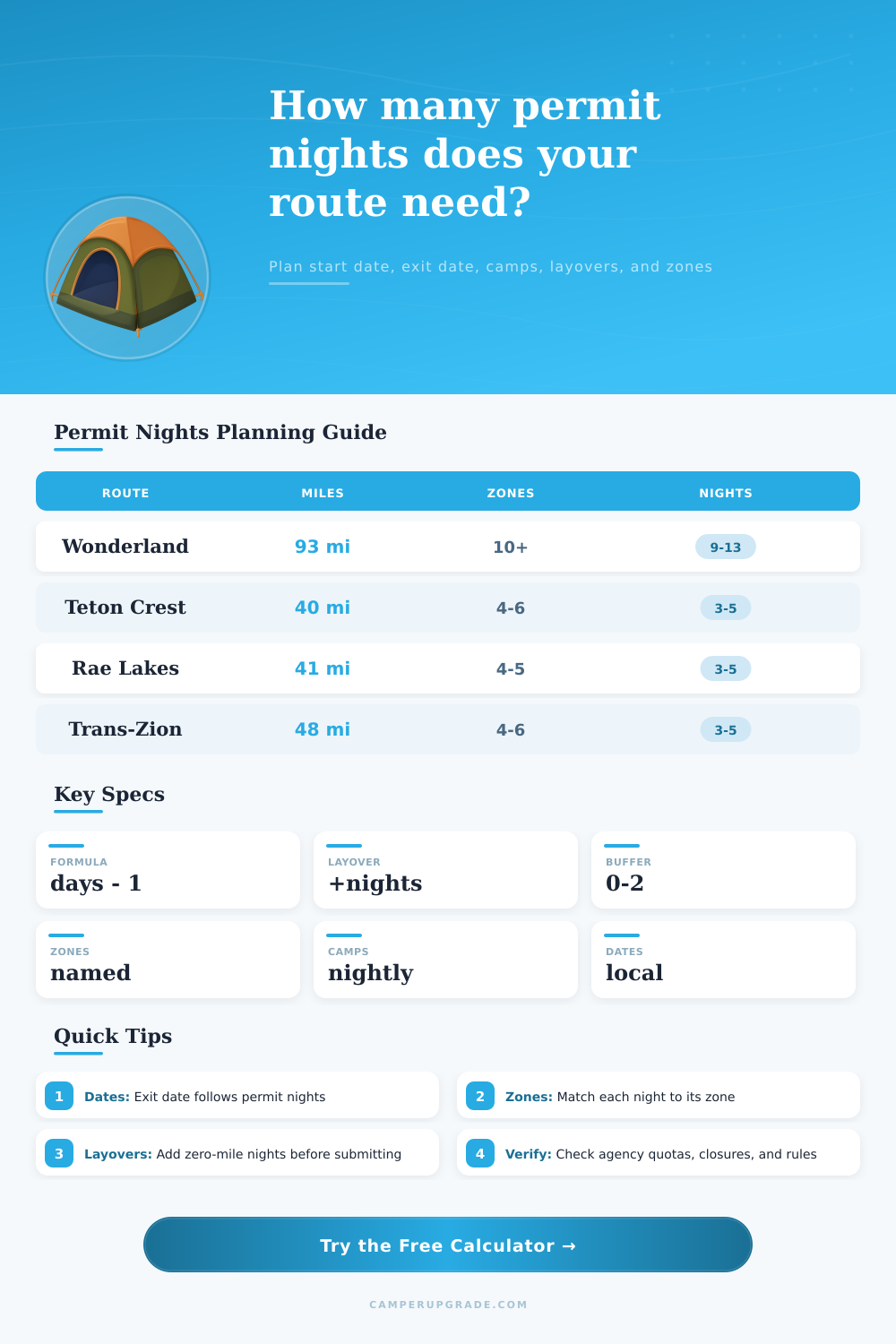
Formula basis: route days = ceiling(route distance / comfortable daily distance). Base permit nights = route days - 1. Final permit nights = base nights + layover nights + buffer nights. Exit date = start date + final permit nights.
📐Permit Night Spec Grid
📊Permit Nights Reference Tables
| Real Route | Typical Permit Focus | Miles | Common Nights |
|---|---|---|---|
| Wonderland Trail | Assigned wilderness camps | 93 | 9-13 |
| Teton Crest Trail | Backcountry camping zones | 40 | 3-5 |
| Rae Lakes Loop | Entry quota and nightly plan | 41 | 3-5 |
| Enchantments Traverse | Core and surrounding zones | 18 | 1-3 |
| Trans-Zion Traverse | Designated camps and zones | 48 | 3-5 |
| Formula Step | Calculation | Output | Use |
|---|---|---|---|
| Route days | ceil(distance / daily miles) | travel days | Sets base pace |
| Base nights | route days - 1 | overnights | Trips exit after last day |
| Layover add | base + layover nights | slower plan | Rest, weather, photos |
| Buffer add | plus allowed buffer | final nights | Only if rules allow |
| Exit date | start date + nights | calendar exit | Permit form date |
| Zone Strategy | Flexibility | Watch Item | Planning Move |
|---|---|---|---|
| Fixed camps | Low | Specific camp quota | Build alternate camp chains |
| Corridor zones | Medium | First and last night | Keep mileage balanced |
| Cross-country zones | Medium-high | Terrain and water | Mark legal camp terrain |
| Exit controlled | Low-medium | Exit date or trailhead | Protect the final day |
| Night Count | Camp Slots | Layover Pattern | Best For |
|---|---|---|---|
| 1-2 | 1-2 | None | Weekend permits |
| 3-5 | 3-5 | Optional one night | Classic loops and traverses |
| 6-8 | 6-8 | One or two | Long alpine routes |
| 9-13 | 9-13 | Built-in recovery | Full circuit trails |
💡Two Practical Permit Tips
Planning a trip that requires an overnight permit requires an understanding of the relationship between the number of days that you will be on the trail and the number of permit nights that you will need to request. The number of permit nights that you request is not the same as the number of days that you will be on the trail; the number of permit nights is the number of times that you will need to have a legal place to sleep on your trip. The number of permit nights that you request will have an impact upon whether or not your itinerary are approved for the permit, hence the importance of a permit nights calculator prior to requesting the permit.
The calculation of the number of permit nights that are necessary for your trip is based off a specific structure. In many instances, you can calculate the number of route days that are necessary to complete your trip by dividing the total distance of the trail by the number of miles that you will cover each day. From that number of route days, you must subtract one to determine the minimum number of permit nights that is required; you will leave the trail on the last of your travel days, and you will not require a camping spot for the morning that you exit the trail.
How to Calculate Permit Nights for Your Trip
If you plan on spending extra nights on the trail (for example, to take a layover), then you will need to add those extra night to the calculation of the total number of permit nights. Furthermore, those extra nights have to comply with the rules of the zones or camps in which you will be camping. A layover is when you request that you camp in the same spot on two consecutive nights.
Many people dont account for the number of nights required for layovers when they calculate the total number of permit nights that they will need. In some permit systems, asking for layover nights indicates that you are competing with other individuals who would also like to occupy that same camp or zone. Thus, the inclusion of layover nights may impact your odds of receiving the permit.
Furthermore, the permit nights calculator can help you to determine how many layover nights can be included in your itinerary, without the need to manually adjust your trip plan. In addition to calculating layover nights, you may also need to consider a strategy for the zones in which you will spend the nights on the trail. If there is a quota for each camp, each night that you spend on the trail must be accounted for a specific camp.
Depending upon the specifics of the permits that are available, you may have more flexibility with some zones than others, but the nights still need to be accounted for in those camps. Furthermore, if some of your nights will fall within high-demand zones, your nights may determine whether you are granted the permit or if the trail managers request your permit for revision. Your party size may impact your permit nights even though it isnt incorporated into the calculation of that number.
Large groups of individuals reduce the number of camping combinations that may be available on any given night. Furthermore, if some of your permit nights fall within mandatory camping zones or first-night camping zones, then your permits may also be harder to obtain; these zones typically have very few permits allowed for those camping spots. The permit nights calculator will help to show how many nights you will request versus how many may be allowed, and the permit nights calculator can help to show how these zones will impact your permit request.
The total distance that you will travel on your trip will not necessarily impact the number of permit nights that is requested. The terrain that you will travel on may impact the total number of permit nights; for example, a 40-mile trail with mountain terrain may require fewer miles per day than a flat 40-mile trail; thus, fewer permit nights would be requested. Additionally, a 90-mile trip may require 12 or 13 nights for camping permits if the trail requires camping at specific locations and includes days for recovery.
Thus, the number of permit nights may change based upon the terrain, the layover nights, and the rules of the zones that you will visit on your trip. The exit date for your trip is the last date that you will be on the trail. To calculate the exit date, you must add the total number of permit nights that you request to your start date.
The exit date is not to be determined after the fact; the start date plus the total number of permit nights will equal your exit date. Thus, calculating your exit date prior to your travel dates will help to ensure that your permit and travel plans is in sync with one another. While the permit nights calculator is a helpful tool in determining the total number of permit nights that you will request for your overnight trip, the calculator is not a replacement for reading the permit that is to be requested for your trip.
Many of the specific details within the permits change from year to year, and the calculator is only reflective of the information that you enter into the calculator. Thus, you may use the calculator to test your trip and itinerary for permits, but you must also ensure that you verify all of the details of your travel plans with the managing organization for the trail that you wish to visit. Testing the numbers with the calculator as well as verifying the details of your permit request to the trail managers will allow you to ensure that your math is honest and that your permit request is realistic.
You should of checked all the details.