⛏️ Pea Gravel Playground Calculator
Calculate cubic yards, bags, and weight for your playground pea gravel project
lbs / yd³
lbs / yd³
lbs / yd³
lbs / yd³
lbs / yd³
lbs / yd³
lbs / yd³
lbs / yd³
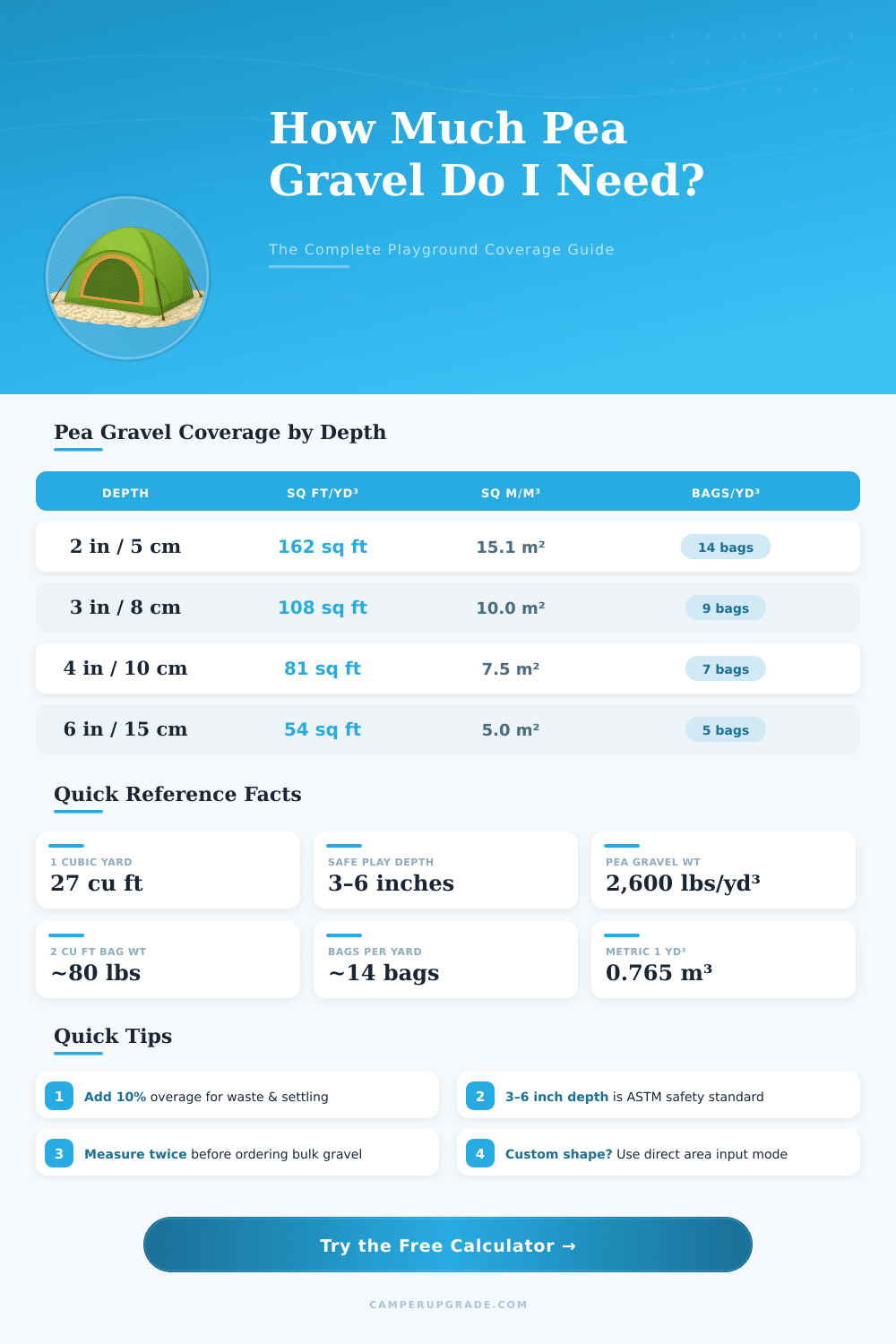
| Depth | Sq Ft per Yd³ | Sq M per M³ | Bags (2 cu ft) per Yd³ | Bags (3 cu ft) per Yd³ |
|---|---|---|---|---|
| 1 in (2.5 cm) | 324 sq ft | 30.1 m² | 14 bags | 9 bags |
| 2 in (5 cm) | 162 sq ft | 15.1 m² | 14 bags | 9 bags |
| 3 in (7.6 cm) | 108 sq ft | 10.0 m² | 14 bags | 9 bags |
| 4 in (10 cm) | 81 sq ft | 7.5 m² | 14 bags | 9 bags |
| 6 in (15 cm) | 54 sq ft | 5.0 m² | 14 bags | 9 bags |
| 9 in (23 cm) | 36 sq ft | 3.3 m² | 14 bags | 9 bags |
| 12 in (30 cm) | 27 sq ft | 2.5 m² | 14 bags | 9 bags |
| Bag Size | Volume per Bag | Bags per Cubic Yard | Coverage at 3 in Depth |
|---|---|---|---|
| 0.5 cu ft bag | 0.5 cu ft / 0.014 m³ | 54 bags | ~2 sq ft |
| 1 cu ft bag | 1 cu ft / 0.028 m³ | 27 bags | ~4 sq ft |
| 2 cu ft bag | 2 cu ft / 0.057 m³ | 13.5 bags | ~8 sq ft |
| 3 cu ft bag | 3 cu ft / 0.085 m³ | 9 bags | ~12 sq ft |
| Bulk / Bulk Bag (1 yd³) | 27 cu ft / 0.765 m³ | — | ~108 sq ft |
| Project | Area (sq ft) | Cubic Yards (3 in) | 2 cu ft Bags Needed |
|---|---|---|---|
| Small Play Area | 100 sq ft | 0.93 yd³ | ~13 bags |
| Swing Set Zone | 225 sq ft | 2.08 yd³ | ~28 bags |
| Standard Playground | 400 sq ft | 3.70 yd³ | ~50 bags |
| Large Playground | 625 sq ft | 5.79 yd³ | ~78 bags |
| School Playground | 1,200 sq ft | 11.11 yd³ | ~150 bags |
| Commercial Playground | 2,000 sq ft | 18.52 yd³ | ~250 bags |
Pea gravel is made up of little, smooth pebbles that form a round and almost equal playground covering. As the name hints, those tiny stones look like peas. One finds them naturally beside rivers or pools, usually in size of one to three eighths of an inch.
The round polished shape makes it liked for playground areas.
Pea Gravel for Playgrounds
Folks commonly choose pea gravel for playground because of its low cost. It is much cheaper than fake grass. From a money viewpoint, it seems very good for backyard playground gear.
Also, it works well as covering, that drains water well and absorbs shocks.
About safety, pea gravel in nine inches of depth well softens the impact of falls. It gives enough protection against falls up to five feet. For a playground of a thousand square feet, one requires around 18 to 25 cubic yards, if one plans six to eight inches for good safety cover.
Even so, one must think that in cold it can harden, what expands the risk of wounds. Different soft covers for playground areas, as shredded wood chips, rubber cushions or pea gravel, all help too reduce the amount and the weight of injuries compared with hard materials as asphalt or concrete.
Pea gravel proves to be very lasting material. It lasts strong usage and rough weather, so it works for playground areas with much traffic. Maintenance requires little.
It drains water quickly, so muddy marks rarely happen. In rainy areas, it helps to avoid skating on paths and playground paths.
However, pea gravel is not perfect. It does not ease access by wheelchairs and does not really help folks with disabilities. Because of that it is rarely used in public playground areas.
Fibers from processed wood and rubber cushions usually follow ADA standards, but pea gravel does not.
Pea gravel works well under playground gear for children more than five years old. Younger children maybe do not enjoy it as much. Some small stones can get in their shoes, and babies risk swallowing them.
Some noticed that it does not pack down like road sand, which is an advantage. During installation, one can remove the grass under the area, dig some dry ditches and fill them with pea gravel. Also one can use glue on it before laying down, after drying, the stones do not move easily andone can easily remove them.
Pea gravel requires a bit of regular care. Over time, parts maybe must be replaced, but because it is so cheap, that does not matter a lot. Many local public playground areas already have it as covering.