Payload Remaining Calculator
Estimate remaining payload against GVWR after scale weight, fuel, water, propane, passengers, hitch or pin load, cargo, accessories, and reserve.
Use the door sticker or chassis label, not a brochure maximum.
Best input: actual scale weight before adding trip cargo.
If your scale weight already included this fuel, enter zero.
Enter propane content weight, not cylinder tare weight.
For trailers, count tongue or pin weight on the tow vehicle.
Bumpers, racks, winch, batteries, solar, boxes, and mounts.
Optional smallest rear axle or tire capacity margin.
Payload result
| Load item | Weight factor | Example amount | Payload impact |
|---|---|---|---|
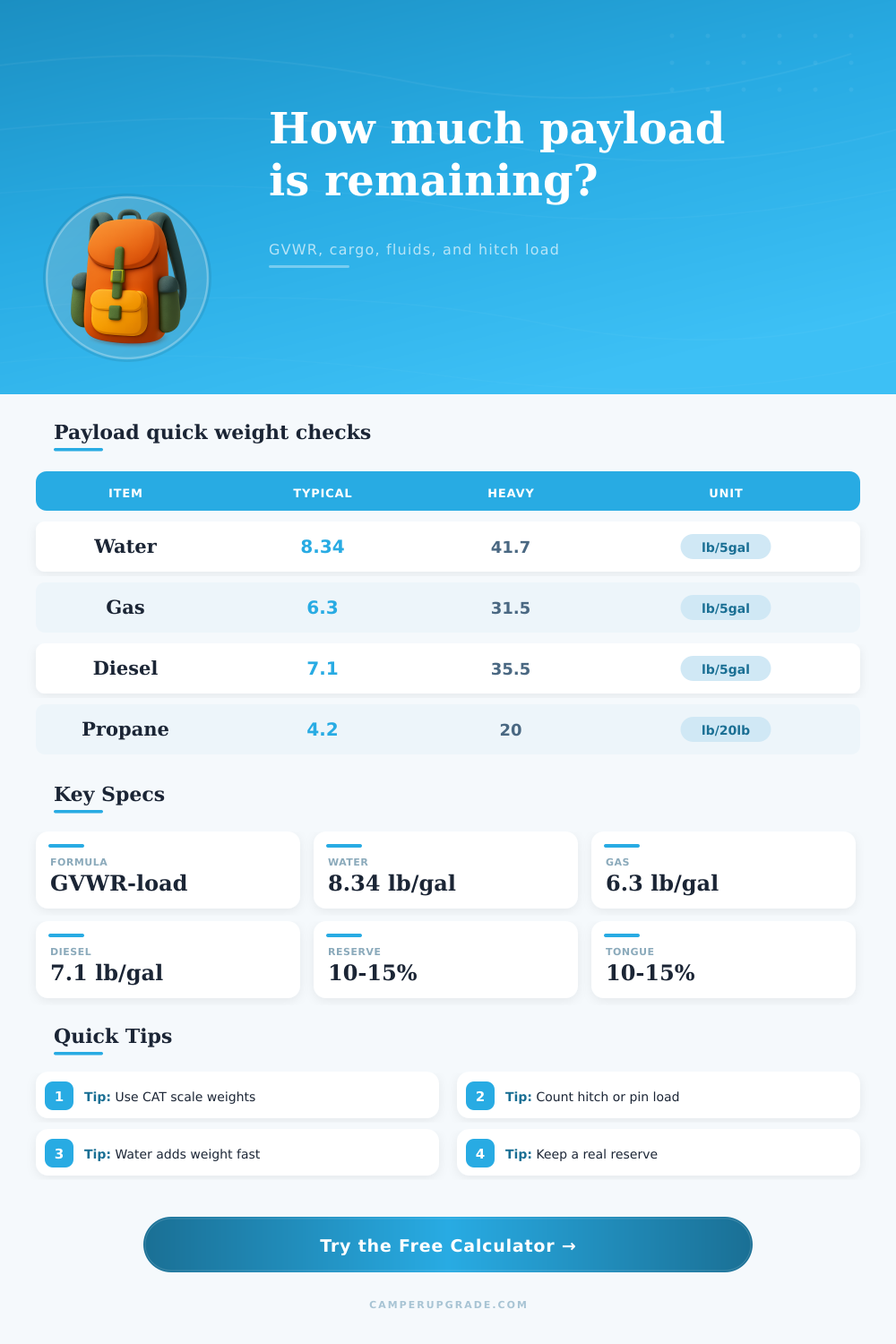
| Fresh, gray, or black water | 8.34 lb per gallon | 40 gallons | 334 lb |
| Gasoline added after scale | 6.3 lb per gallon | 20 gallons | 126 lb |
| Diesel added after scale | 7.1 lb per gallon | 20 gallons | 142 lb |
| Propane content | 4.2 lb per gallon, often sold by lb | Two 20 lb cylinders | 40 lb |
| Group 31 AGM battery | Typical installed battery | One battery | 60 to 75 lb |
| Lithium battery module | Typical 100 Ah LiFePO4 | One battery | 24 to 32 lb |
| Trailer setup | Common loaded trailer weight | Transfer range | Payload counted on tow vehicle |
|---|---|---|---|
| Small teardrop trailer | 1,500 to 2,500 lb | 10 to 15 percent tongue | 150 to 375 lb |
| Conventional travel trailer | 5,000 to 8,000 lb | 10 to 15 percent tongue | 500 to 1,200 lb |
| Toy hauler travel trailer | 7,000 to 11,000 lb | 12 to 16 percent tongue | 840 to 1,760 lb |
| Fifth-wheel trailer | 10,000 to 16,000 lb | 15 to 25 percent pin | 1,500 to 4,000 lb |
| Weight distribution hitch | Receiver hardware | Hitch head and bars | 70 to 120 lb |
| Formula | What it checks | Use when | Important note |
|---|---|---|---|
| Rated payload = GVWR - base weight | Capacity before added trip load | You know actual empty scale weight | Door sticker payload may differ |
| Loaded weight = base weight + added load | Total vehicle weight | Planning passengers, fluids, and gear | Keep below GVWR |
| Remaining = GVWR - loaded weight | Payload left after loading | Final pass before travel | Negative means overloaded |
| Reserve target = GVWR × reserve percent | Chosen planning buffer | Rough roads or uncertain cargo | Reserve is not extra rating |
| Payload used = added load / rated payload | How much payload is consumed | Comparing scenarios | Use actual scale weight if possible |
| Vehicle or RV type | Typical GVWR range | Common payload stress | Planning watch point |
|---|---|---|---|
| Half-ton pickup towing travel trailer | 6,800 to 7,850 lb | Family plus 700 to 1,100 lb tongue load | Rear axle and receiver rating |
| Three-quarter-ton pickup with camper | 10,000 to 11,500 lb | Wet camper, passengers, and batteries | Wet weight, not dry camper weight |
| Class B van conversion | 8,550 to 11,030 lb | Build-out, water, bikes, and passengers | Scale after permanent build items |
| Class C motorhome | 12,500 to 14,500 lb | Water, rear storage, and occupants | Rear axle can fill before GVWR |
| One-ton dually fifth-wheel tow rig | 12,000 to 14,000 lb | 2,500 to 4,000 lb pin load | Payload sticker and rear GAWR |
A payload remaining calculator is a tool that allow you to calculate the weight that you can add to your vehicle. Many people is often unsure whether the weight of a truck that is loaded or an RV that is loaded is within the legal driving limits for that vehicle. This uncertainty exists due to the fact that most people do not know the weight of the payload that their vehicle still have remaining.
By comparing the Gross Vehicle Weight Rating (GVWR) of the vehicle to the actual weight that the vehicle is currently carrying, the payload remaining calculator will allow you to understand how much more weight you can still add to the vehicle without exceed the GVWR. To use this payload remaining calculator effectively, you will need to enter the weight of several component of the vehicle. The best starting point for the actual weight of the vehicle is the weight that the vehicle display on a scale.
How to Check How Much Weight You Can Add to Your Vehicle
This weight is more accurate than the curb weight of the vehicle because the curb weight does not account for the weight of all the different option that the vehicle dealer may have added to the vehicle. You can enter the weight of the fuel and water that is currently contained in the vehicle in the amount of gallon of each liquid so that the payload remaining calculator can accurately provide you with the remaining payload for your vehicle. The weight of the propane that is contained within the propane tank will also be transferred to the vehicle; this weight will remain on the vehicle even if the propane tank is not filled with propane.
The weight of the passengers and pets that are within the vehicle should also be accounted for; the payload remaining calculator will allow you to account for the passengers in the same way that you would account for the weight of fifty gallons of water since the weight of an adult passenger is similar to the weight of fifty gallons of water. Finally, you can enter the weight of the hitch and pin into the payload remaining calculator; the hitch and pin will transfer part of the weight of your trailer to your tow vehicle. This weight should be accounted for in the payload of your tow vehicle.
The payload remaining calculator will display several different results for you. First, the payload remaining calculator will display the weight of the remaining payload for your loaded vehicle. Second, it will display the percentage of your payload that you have used so far.
Third, the payload remaining calculator will provide you with a display of whether or not you have maintained a safety reserve. The safety reserve is a weight that you set aside to account for the potentially rough road that you may drive on or for any inaccuracies between the weight of your vehicle that you read on the scale and the true weight of your vehicle when you depart from your location. If you do not maintain your safety reserve, the payload remaining calculator will show you this so that you can adjust the weight of your cargo prior to beginning to drive your vehicle.
While the payload remaining calculator will allow you to determine if the payload that you are adding to your trailer will exceed the GVWR of your trailer, it will not account for several different components of the trailer that can still add to the weight of the trailer even if you have not reached the GVWR. Components of the trailer such as the rear axle rating and tire load limits may be reached without reaching the GVWR of the trailer; this is because the load can become overly concentrated on one portion of the trailer. Additionally, the weight of the hitch and any aftermarket bumpers may also add to the weight of the trailer and consume any payload capacity that you had originally accounted for in your trailer.
While this payload remaining calculator cannot replace the scale that you can use to weigh your trailer, it can ensure that you account for each category of the weight of your trailer. The payload remaining calculator also includes a series of reference table that allow you to input the weight of some of the components of the trailer. For instance, there are tables that list the weight of the various fluid that are used in the trailer.
Additionally, there are tables that list the percentage of tongue weight or pin weight that different types of trailers transfer to the tow vehicle. These tables allow you to cross-check the entries that you make into the payload remaining calculator. They are also of use if you are trying to decide what gear to add to your vehicle.
The mathematics that the payload remaining calculator performs is actually very simple; the calculator will subtract the total weight of your loaded vehicle from the GVWR of the trailer and compare the remainder to your safety reserve weight. To further ensure that you do not exceed the GVWR of your trailer, you can use the payload remaining calculator at the beginning of the season to weigh your loaded vehicle. Then, when you have new gear for the season, you can use the payload remaining calculator again to weigh your loaded vehicle.
This will allow you to track how much of the payload capacity that you have for your trailer you are using. If the payload remaining is always low for your loaded trailer, for instance, it is likely that you are adding many small item to your trailer each time that you travel. By recognizing this pattern, you can make a decision as to which of those items that you often add to the trailer can be left behind when you travel.
Overall, the goal of utilizing a payload remaining calculator is to give you a clear picture of the amount of payload that your trailer has remaining prior to beginning to drive your trailer.