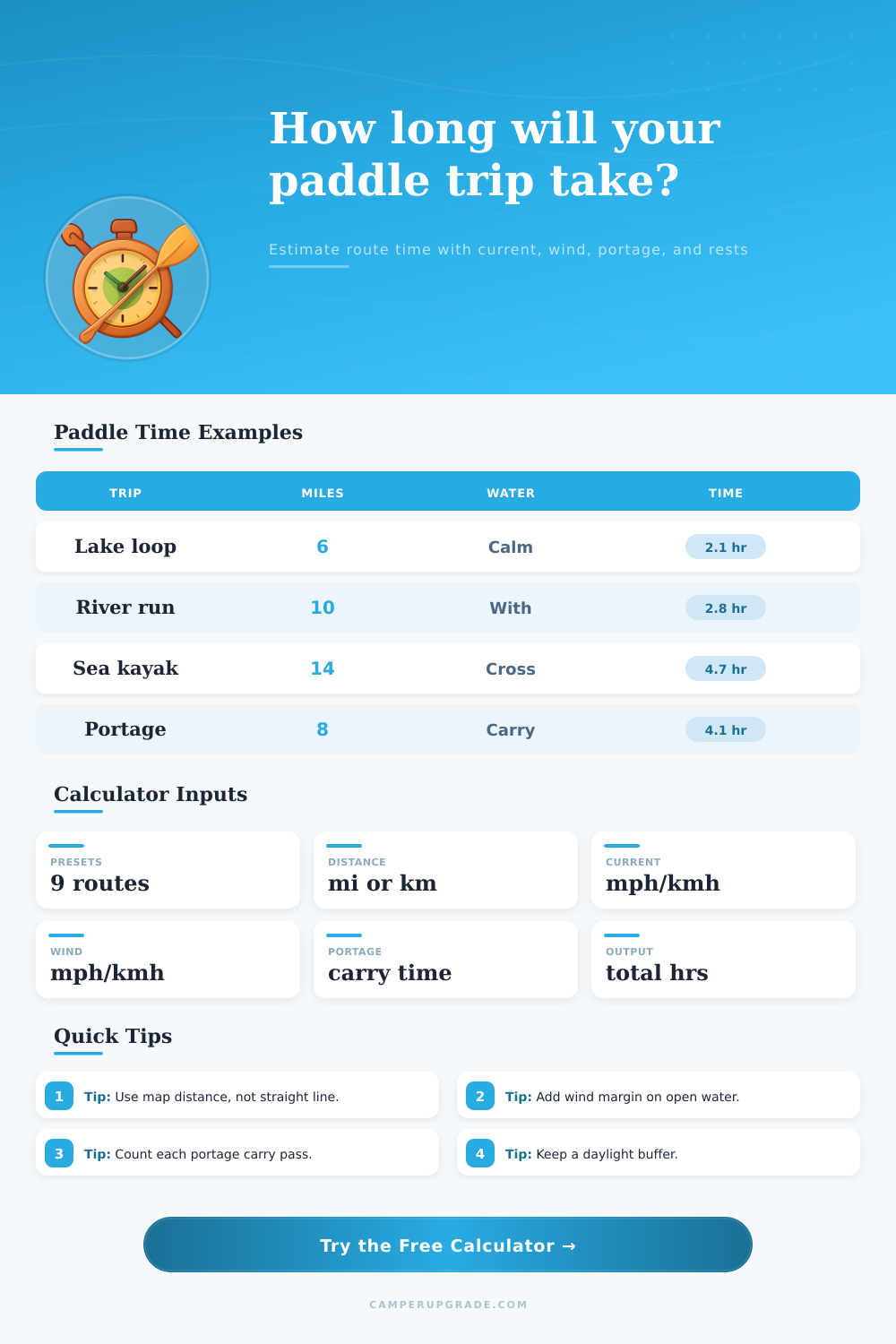
Paddle Trip Duration Calculator
Estimate canoe, kayak, SUP, or raft trip time from route distance, hull type, current, wind, portage carries, rest stops, and planning buffer.
| Condition | Speed effect | Best use | Planning note |
|---|---|---|---|
| Calm lake | 0.95x to 1.00x | Fitness pace estimate | Use route distance around points and bays. |
| Helpful current | Add 50-85% | River down trips | Eddies, bends, and shallow bars reduce the full push. |
| Head current | Subtract 70-90% | Upstream checks | Turnaround plans should be conservative. |
| Cross current | Subtract 15-30% | Tide set, ferry angle | Extra distance and correction strokes cost time. |
| Mixed current | Add 25% | Meanders, lake chains | Useful for routes with both moving and slack water. |
| Wind average | Headwind penalty | Crosswind penalty | Trip implication |
|---|---|---|---|
| 0-5 mph | 0-3% | 0-2% | Usually minor on protected routes. |
| 6-10 mph | 6-12% | 3-8% | Noticeable on wide lakes and bays. |
| 11-15 mph | 15-25% | 9-16% | Route timing can change quickly. |
| 16-20 mph | 28-42% | 17-28% | Use sheltered shorelines or delay crossings. |
| 20+ mph | 45%+ | 30%+ | Small craft plans need a serious safety review. |
| Portage plan | Walking distance | Time driver | Calculator setting |
|---|---|---|---|
| Single carry | 1x portage | Fastest with light loads | Carry passes = 1 |
| Double carry | 3x portage | Carry, return, carry | Carry passes = 2 |
| Triple carry | 5x portage | Heavy groups or rough trails | Carry passes = 3 |
| Landing time | Per portage | Unload, load, launch | 6-12 minutes is common |
| Rough footing | Lower pace | Wet rocks and roots | Reduce walking mph or km/h |
| Route type | Typical day distance | Normal time | Primary limiter |
|---|---|---|---|
| Family canoe lake | 4-8 mi | 2-4 hr | Stops and wind |
| Touring kayak day | 10-18 mi | 3-6 hr | Sea state and crossings |
| SUP flatwater | 3-8 mi | 1.5-4 hr | Wind exposure |
| River canoe | 10-20 mi | 3-7 hr | Current, scouting, strainers |
| Portage loop | 5-12 mi | 4-8 hr | Carry distance and landings |
Planning a paddling trip require that you account for many different factor. The distance that you may travel on your paddling trip may be eight miles, for example, but eight miles may take you three hours to travel on a calm lake but five and a half hours if there is any wind, current, or portage sections on your paddling trip. You must consider factors such as wind, current, and portages because these factors will changes the speed at which you can travel on your paddling trip.
The paddling trip calculator allow you to calculate the time it will take for you to travel the distance that you have chosen for your trip. The calculator asks for your route distance and your hull types. The calculator uses your hull type because different hull types allow your boat to travel different through the water.
Planning Time for a Paddling Trip
For instance, sea kayak are typically designed to travel through chop in the water with less effort than recreational boats. Additionally, the weight that you load into the boat will change the way in which your boat travel through the water. For instance, a heavy load will typically decrease the speed at which you can travel compared to a light load.
You must enter a sustainable pace into the speed field in the calculator. The calculator will use this entered speed to calculate your travel time, taking into account the current direction, the wind penalty, and the distance of any portage you must walk. Current is one of the factors that will impact the speed at which you can travel on your trip.
Despite how fast a current may appear to move, the current rarely adds the full speed of that current to your travel distance. For instance, a current of one mile per hour may appear to be relatively fast, but it will rarely add a full mile per hour to your travel distance. This is due to bends in the water, eddy, and bars.
Cross current can also pose a challenge for kayakers; the constant use of correction strokes will use up energy that could otherwise be used to move forward on the trip. Finally, wind will also impact your travel speed. Tailwinds will make it easier for you to travel faster, but a crosswind will require more effort from you.
This effort to steer your kayak create a wind penalty that will impact your travel speed. The travel speed that the calculator calculates is the net result of the impact of the wind and the current on your travel distance. Some area of your trip may involve portages.
Portages involve walking sections of the trail and could potentially introduce additional tasks into your trip. The distance that you have to walk on a portage is one factor that will impact the time required to complete your trip. However, the number of times that you have to walk that distance is another factor.
For instance, if you must perform a double carry of your kayaks, you will have to walk the same trail three times to move your kayaks and your travel distance. Additionally, time will be required to unload your kayaks from trailers, walk the trail, scout the area, re-load the kayaks, and launch them. Time will be required to perform each of these task.
Therefore, it is also important to plan for rest stops and to include a buffer percentage in your travel time calculation to allow for potential weather change or limited daylight hours. The trip planning page provides two tables that may help you to understand whether your travel time calculations are reasonable. Each of the tables provide information on typical travel speed based on a variety of factor.
These factors include the distance of your trip, the strategy for your portage, and the exposure of your kayaks to the wind. These tables dont replace your own judgment about your trip that you make on the water, but they do help to eliminate the guesswork that you would otherwise have to make about your travel time. They allow you to see how long your trip may take so that you can make decision about whether to shorten your route or to make plans to arrive at your destination at a later time.
A planning tool for paddling trip is helpful in that it forces you to consider the various variables that will have an impact upon your trip. For instance, each of the variables include considerations for wind, current, load, and the portage that may be required for your trip. By considering each of these variables, you will find that your paddling day will more closely match the plan that you create for your trip.