🏄 Paddle Board Size Calculator
Find your ideal SUP length, width & volume based on your body stats and paddling style
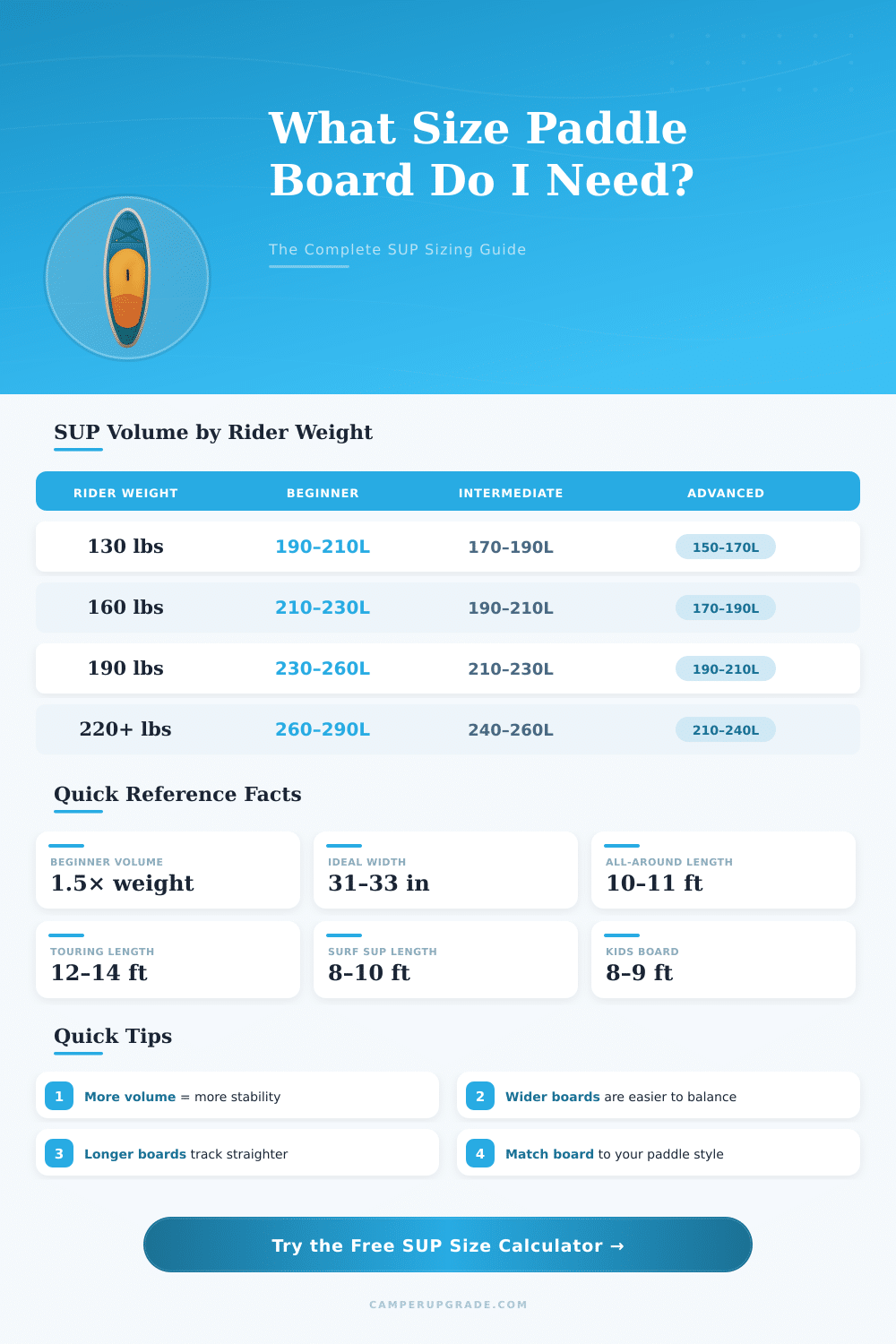
| Rider Weight | Beginner Volume | Intermediate Volume | Advanced Volume |
|---|---|---|---|
| 100–120 lbs (45–54 kg) | 150–180 L | 110–150 L | 80–110 L |
| 121–140 lbs (55–63 kg) | 180–210 L | 140–180 L | 100–140 L |
| 141–160 lbs (64–72 kg) | 210–240 L | 165–210 L | 130–165 L |
| 161–180 lbs (73–81 kg) | 240–270 L | 190–240 L | 150–190 L |
| 181–200 lbs (82–90 kg) | 270–300 L | 220–270 L | 170–220 L |
| 201–225 lbs (91–102 kg) | 300–340 L | 250–300 L | 195–250 L |
| 226–250 lbs (103–113 kg) | 340–375 L | 280–340 L | 220–280 L |
| Style | Length | Width | Thickness |
|---|---|---|---|
| All-Around / Recreational | 10–11.5 ft (305–350 cm) | 30–34 in (76–86 cm) | 4–6 in (10–15 cm) |
| Flatwater Recreational | 10–12 ft (305–365 cm) | 30–33 in (76–84 cm) | 4–5 in (10–13 cm) |
| Touring / Distance | 12–14 ft (365–427 cm) | 28–32 in (71–81 cm) | 5–6 in (13–15 cm) |
| Yoga / Fitness | 10–11 ft (305–335 cm) | 32–36 in (81–91 cm) | 5–6 in (13–15 cm) |
| Fishing | 10.5–12 ft (320–365 cm) | 33–36 in (84–91 cm) | 5–6 in (13–15 cm) |
| Surf SUP | 8–10 ft (244–305 cm) | 28–32 in (71–81 cm) | 4–5 in (10–13 cm) |
| Racing | 12.6–14 ft (384–427 cm) | 24–28 in (61–71 cm) | 5–6 in (13–15 cm) |
| Kids / Junior | 8–9 ft (244–274 cm) | 28–32 in (71–81 cm) | 4–5 in (10–13 cm) |
| Rider Height | Flatwater Paddle | Surf Paddle | Racing Paddle |
|---|---|---|---|
| Under 5'4" (163 cm) | 72–76 in (183–193 cm) | 68–72 in (173–183 cm) | 76–80 in (193–203 cm) |
| 5'4"–5'8" (163–173 cm) | 76–80 in (193–203 cm) | 72–76 in (183–193 cm) | 80–84 in (203–213 cm) |
| 5'8"–6'0" (173–183 cm) | 80–84 in (203–213 cm) | 76–80 in (193–203 cm) | 84–88 in (213–224 cm) |
| Over 6'0" (183 cm) | 84–88 in (213–224 cm) | 80–84 in (203–213 cm) | 88–92 in (224–234 cm) |
Paddle boarding is fun water activity that works for every type of person. Whether you are a total beginner or an expert after years, there are boards for every skill. Because the sport grows quickly, choose the right gear
One finds two main kinds of boards: inflatable and solid. Inflatable boards are cheap, easy to store and transport. They are ideal for SUP yoga or for paddling in fast rivers.
How to Pick the Right Paddle Board
Solid boards give better performance, because they are faster, smooth and stable with less effort. The downside is they need a lot of space and are hard to move.
When you choose a board, the size realy matters. The height, weight and your style of paddle boarding all play a role. If a board is too big, it can be unstable and hard to control.
Also the volume, weight capacity and thickness affect the stability. Long boards are usually faster, but less easy to turn. Remember to count your own weight and possible passengers when you choose the capacity.
There are three main kinds of boards: surf boards, touring boards for calm water and all-around boards. Surf boards have narrower nose and tail. For beginners, the best boards are usually wide, around thirty inches or more, with thick sides for better stability.
All-around boards are a safe choice for some who just start.
Inflatable boards are made from top PVC with synthetic fibers, that bind the upper and bottom layers. There are choices of single-layer or double-layer construction, where single-layer models are lighter. They transform from a rolled bag to a solid platform in only some minutes.
Some of them keep the air well, but they could last only four or five years.
Fishing boards are special. They come in various sizes and materials, like fiberglass, epoxy, carbon fiber or inflatable PVC. For most folks, all-around fishing boards work best; they are longer and wide than others, which makes them more comfortable on the water.
Paddle boarding in a river is a whole other experience. One can enjoy wide and slow rivers with almost any board for flat water. Even so, when the flow rushes and waves or whirlpools appear, the choice of the board becomes much more important.
For beginners, it is a good notion to start in calm, deep water during a day without wind. Paddle boarding on the knees helps to feel the balance before standing up.
Paddle boarding helps to improve the balance and the core strength. Also SUP camping becomes popular, allowing folks to explore new places and create wild memories outon the water.