Pack Liter Per Night Calculator
Estimate backpack volume from trip nights, sleep system bulk, food density, bear storage, water carry, clothing layers, shared gear, compression, and reserve space.
🧭Backpacking Presets
🎒Trip And Gear Inputs
🧵Pack Material And Spec Comparison
📊Reference Tables
| Load Element | Compact | Typical | Bulky |
|---|---|---|---|
| Food per night | 1.8-2.2 L | 2.2-3.0 L | 3.0-4.0 L |
| Quilt or sleeping bag | 8-12 L | 12-18 L | 22-30 L |
| Shelter share | 4-6 L | 6-10 L | 10-14 L |
| Extra clothing | 4-8 L | 8-16 L | 16-24 L |
| Bear Storage | Outer Volume | Food Capacity | Pack Effect |
|---|---|---|---|
| Soft food bag | Food only | Variable | Compresses well |
| Hang bag and cord | +0.8 L | Variable | Low shell bulk |
| Fabric bear sack | +2 L | About 10 L | Semi-flexible |
| Small canister | 5.5 L | About 7.2 L | Rigid cylinder |
| Large canister | 8 L | About 11.5 L | Rigid cylinder |
| Pack Size | Typical Use | Volume Signal | Fit Note |
|---|---|---|---|
| 25-35 L | Fast overnight | Low bulk | Careful packing |
| 35-50 L | Weekend | Compact kit | Common for warm trips |
| 50-65 L | 3-5 nights | Normal kit | Good all-round range |
| 65-80 L | Long or cold | Bulky kit | Frame support matters |
| 80+ L | Expedition | High volume | Check carried weight too |
| Scenario | Nights | Storage | Typical Pack |
|---|---|---|---|
| Summer tarp overnight | 1 | Soft bag | 28-38 L |
| Two-night tent weekend | 2 | Soft bag | 40-55 L |
| Bear can shoulder trip | 3 | Large can | 55-70 L |
| Four-day resupply leg | 4 | Fabric sack | 55-75 L |
| Winter snow camp | 2 | Soft bag | 70-90 L |
💡Calculation Tips
Choosing a backpack size require you to understand the volume of your gear. To understand the volume of your gear, you must look at how much space your gear will take up in your pack. Many peoples use the number of nights that they will spend on the trail to determine their backpack size.
However, the number of nights that you will be on the trail arent the only factor that will play a significant role in determining what backpack size you need. The volume of the specific item that you will carry will determine the actual size of the backpack that you require. The pack liter per night calculator will help you determine the proper size for your backpack by calculating the volume of your gear.
How to Choose the Right Backpack Size
The volume that your sleep system and shelter will take up in your backpack will be a significant factor in determining the size of your backpack. The sleeping bag that you will use during winter will take up significant more space in your backpack than a summer sleeping bag. The same is true for sleeping pads.
The volume that a winter sleeping bag and sleeping pad will take up will be more significant than the summer sleeping systems will take up in your backpack. Therefore, if you are using winter sleeping gear, your backpack will need to be larger than if you were to use sleeping gear for the summer. The pack liter per night calculator will allow you to choose the sleep system and shelter that you will use so that the program can calculate the volume that they will take up in your backpack.
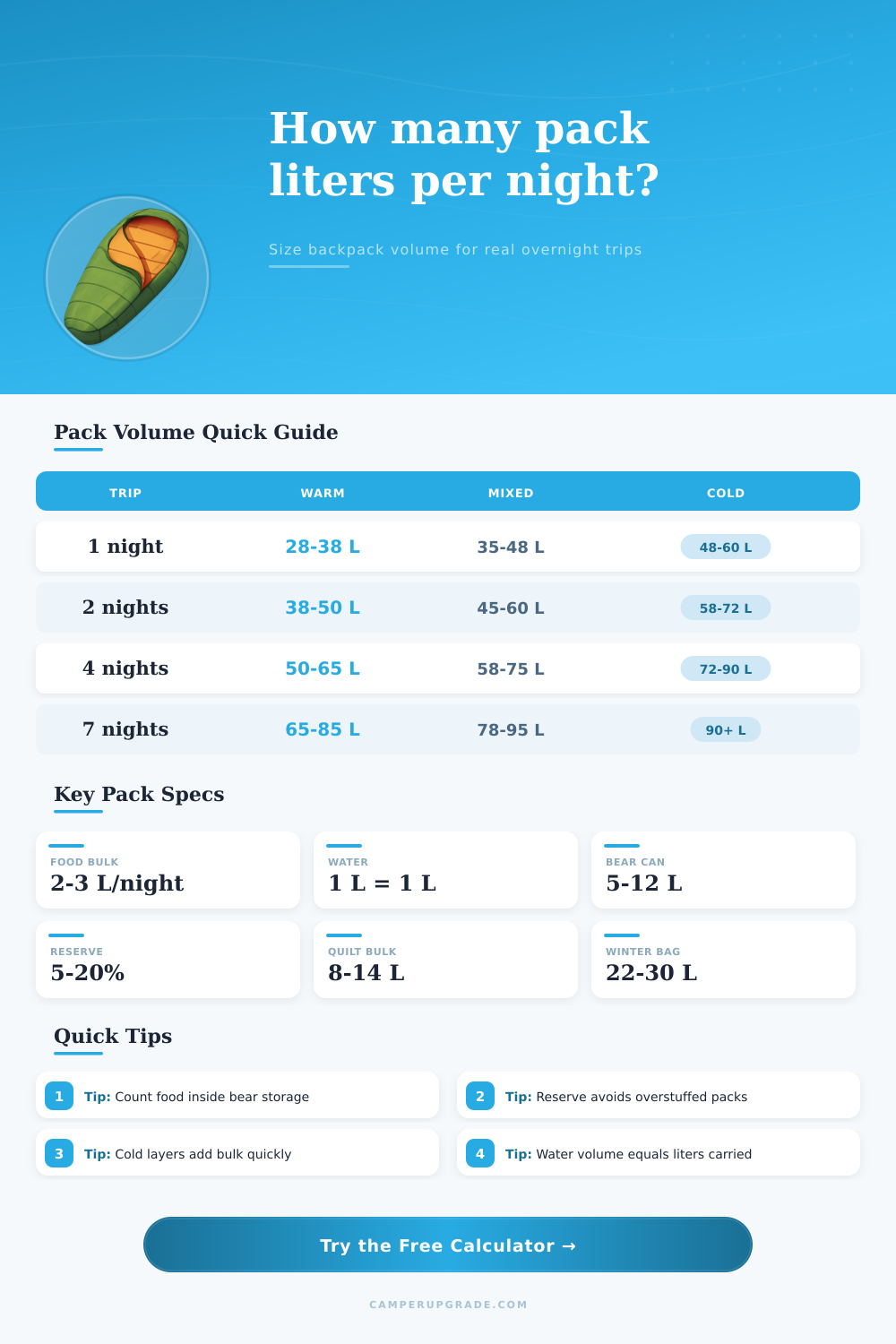
The volume that your food will take up will also play a significant role in your backpack size. The food that you will pack will take up between two and three liters of space per person each day. This volume also include the space that your food packaging will take up in your pack.
Additionally, the volume of the bear canisters that you use will impact your backpack size. The bear canister will have a certain shape around the outside of the pack that will not change. Therefore, if the volume of the food that you pack is larger than the volume of the bear canister that you use, your food will take up additional space in your pack.
The pack liter per night calculator will track the volume of your food and bear canister so that you can see how much space your food will take up in your pack. The number of liters of water that you plan to carry will also play a significant role in determining your backpack size. Water will be heavy that you carry on your hiking trip, but it will also take up a specific amount of volume in your backpack.
Every liter of water that you carry will take up approximately one liter of space in your backpack. The more water that you carry will require a larger backpack for your hiking trip. If the area that you plan to hike is dry, you will have to carry more water with you.
Additionally, you can adjust the total volume that your gear will take up by using compression on your gear or by sharing gear with others in your hiking group. Using a pack liter per night calculator will help you decide on the best backpack size prior to purchasing one. A small frameless backpack may not have the space for a bear canister and the water that you will need for your hiking trip.
A large backpack may take up too much empty space with the gear that you will carry on your hike. Many people make the mistake of choosing a backpack size based off the number of nights that they will spend on the trail for a trip that they will take in the future. For instance, if you decide to purchase a 70-liter backpack for a hiking trip that you will go on in the future, but your gear take up only 40 liters of space, the 70-liter pack will take up too much empty space.
Similarly, if you purchase a 35-liter pack for the convenience of having a lightweight pack to carry on hikes, but your gear take up significant more space than 35 liters, then your pack will be too small for your gear. In both instances, you should of run your gear through the backpack calculator to determine the volume that the items that you have will take up. The backpack calculator will provide you with a range of volume instead of a specific number.
This range of volume will tell you if your gear will fit into the backpack or if you need to adjust your gear to make it fit into the specified backpack. By understanding which item will increase the volume of your backpack, you can decide whether to purchase a larger backpack for your gear or change your gear to fit into the backpack that you would like to purchase for yourself.