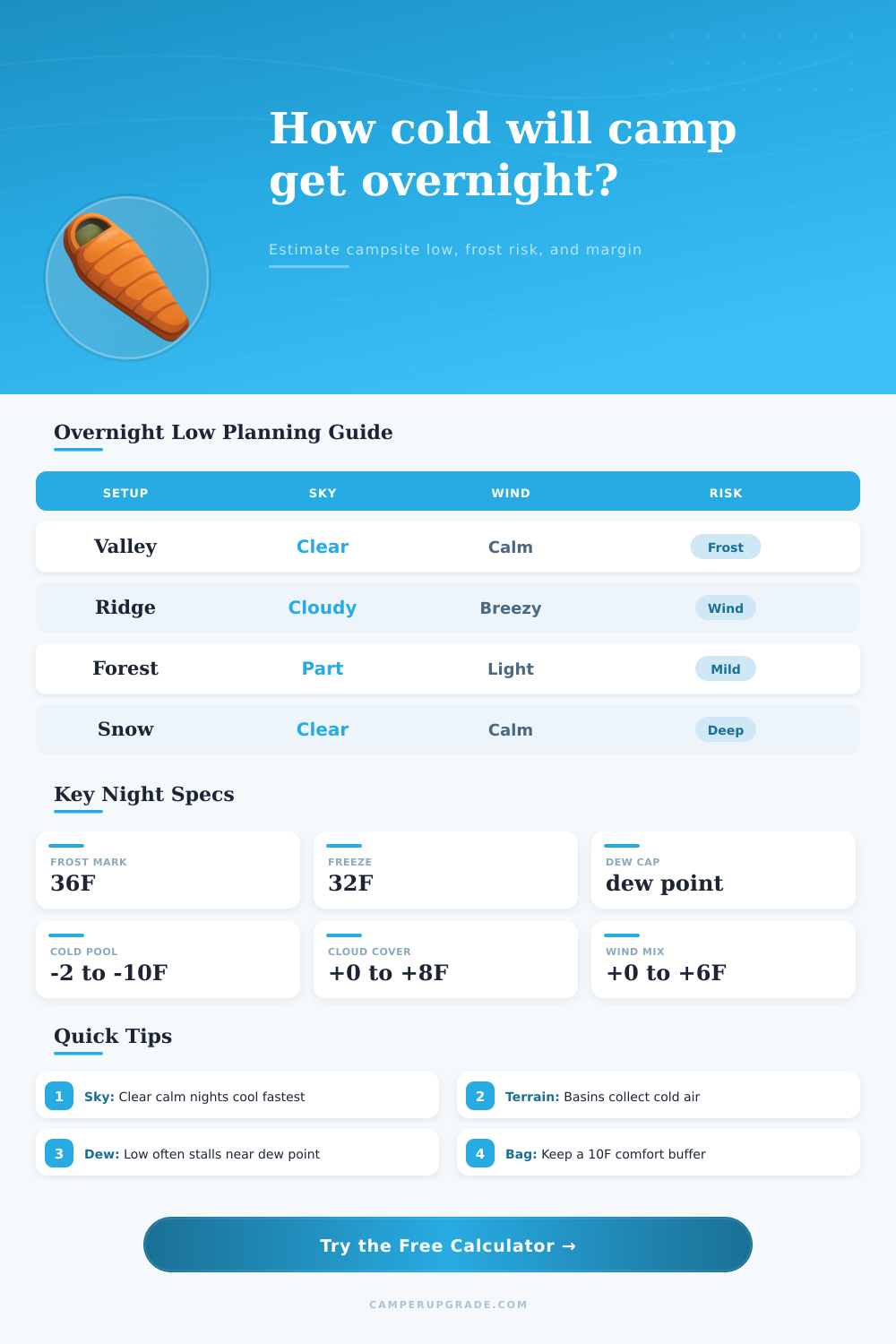
Overnight Low Temperature Estimate Calculator
Estimate a campsite overnight low from the nearby forecast, elevation difference, sky cover, wind mixing, humidity, terrain cold pooling, canopy, water exposure, ground surface, shelter type, and sleeping-system margin.
🏕Real Overnight Camp Presets
⚙Forecast, Terrain, Shelter, and Sleep Inputs
📌Overnight Forecast Spec Grid
📋Overnight Low Reference Tables
| Night setup | Typical effect | Why it matters | Calculator field |
|---|---|---|---|
| Clear and calm | Colder than forecast | Ground radiates heat quickly to open sky. | Sky cover plus wind. |
| Cloudy and breezy | Warmer low | Clouds trap heat and wind mixes air layers. | Sky cover plus wind. |
| Cold basin or wash | 2 to 10 F colder | Dense cold air settles into low terrain. | Terrain position. |
| Forest canopy | 1 to 5 F warmer | Canopy lowers sky exposure and frost. | Canopy cover. |
| Snow-covered ground | Colder near surface | High reflectivity and cold ground reduce margin. | Ground surface. |
| Frost cue | Air low | Dew gap | Planning read |
|---|---|---|---|
| Low | Above 40 F | 8 F or more | Frost is unlikely except on exposed metal. |
| Patchy | 36 to 40 F | 4 to 8 F | Grass, table tops, and fly edges may frost. |
| Likely | 32 to 36 F | 0 to 6 F | Expect frost or heavy condensation by dawn. |
| Freeze | Below 32 F | Any gap | Protect water, filters, batteries, and damp gear. |
| Fog hold | Near dew | 0 to 2 F | Low may stall, but everything gets wet. |
| Campsite position | Night behavior | Common sign | Estimate note |
|---|---|---|---|
| Wash or hollow | Strong cold pooling | Still air, frost first, no outlet. | Use basin setting. |
| Open meadow | Radiates fast | Wet grass and clear sky exposure. | Use valley and grass. |
| Mid-slope bench | Often warmer | Cold drains downslope overnight. | Use slope setting. |
| Ridge or saddle | Mixed but exposed | Breezy, less frost, more wind chill. | Use ridge and wind. |
| Paved RV loop | Slightly warmer | Buildings, asphalt, vehicles nearby. | Use developed setting. |
| Sleep setup | Margin cue | Pad cue | Field check |
|---|---|---|---|
| Open bivy | Needs extra buffer | R3+ in cool weather | Wind strips warmth quickly. |
| Backpacking tent | Small interior gain | R3 to R5 for shoulder season | Vent to manage condensation. |
| Canvas tent | Moderate draft control | Ground insulation still matters | Large air volume cools fast. |
| Van or camper | Useful shell buffer | Mattress reduces ground loss | Metal walls can condense. |
| Insulated RV | Best passive margin | Floor insulation varies | Plumbing still needs freeze care. |
💡Overnight Temperature Tips
An overnight low temperature estimate calculator allow you to calculate the actual temperature that will occur at your campsite. The temperature at your campsite is more different than the temperature that the weather service projects for the nearby town. There is various reasons for the difference in the temperatures, including the difference in elevation between the campsite and the weather service’s location, the differences between the coverage of sky over your campsite as compared to the weather service location, the effect of wind on your campsite in comparison to the weather service monitoring location, and the terrain position relative to other terrain features in your area.
Elevation play a role in the calculation of the temperature at your campsite due to the fact that the temperature at any given location decreases with an increase in elevation. In order to account for the different elevation at your campsite as compared to the location from which the weather service obtains its temperature measurement, you must enter the elevation of your campsite into the calculator. The tool use the elevation information to calculate the rate at which the temperature changes with the stability of the air mass over your campsite.
Check the overnight low temperature for your campsite
Similarly, the calculator consider the dew point of the air at your campsite as another factor. The dew point is important because the overnight low temperature will stabilize near the dew point for areas with high humidity level. Weather service temperature projections dont take into account factors like these, so adjusting for them produces a more realistic projection for the temperature that will reach your sleeping area.
Terrain position is another factor that the overnight low temperature estimate calculator consider. Because cold air is more dense than warm air, cold air tends to settle into valleys and low areas in the land. Conversely, areas that are situated on hills or on relatively flat areas in the middle of slopes will experience higher temperatures than areas that are located in valleys due to the movement of cold air to those low area.
In addition to terrain position, the overnight low temperature estimate calculator consider the coverage of the sky overhead your campsite and the ground cover at your campsite. Areas that has extensive forest cover or snow-covered ground will experience different overnight low temperatures than areas that are exposed to the sky and have no ground cover. The choices of wind and shelter impact the sleeping temperature at your campsite.
The overnight low temperature estimate calculator can factor the impact of wind on overnight sleeping temperatures, though the calculation separate the impact of wind on sleeping temperature from the effect of exposure on sleeping temperature. This is because exposure impacts an individual’s sleep margin, or amount of time they take to fall asleep, while sleeping temperature impacts only how comfortable an individual feel during sleep. Additionally, the overnight low temperature estimate calculator can calculate the potential risk of frost form at your sleeping area.
If there is a risk of frost forming at your sleeping area, you may want to protect sleeping water bottle and water filters, as well as your sleeping clothing. The calculator also calculates an individual’s sleep margin, which is calculated by subtracting the sleeping bag’s comfort rating, the performance of any sleeping pad, the impact of exposure to the sleeping individual, and a safety margin from the calculated interior sleeping temperature. This value help to indicate the individual’s sleep margin for the night.
Many campers may make the mistake of only considering their sleeping bag comfort rating. However, the sleeping bag comfort rating does not consider the difference between the location from which the sleeping temperature was measured, and their sleeping area. For instance, temperature measurement are regularly taken from locations in valley towns, but sleeping bags may be rated for temperatures in high elevation areas.
The overnight low temperature estimate calculator allow individuals to see these differences. Additionally, reference table are provided with the calculator for measuring the temperature differences that may occur due to these factors. For instance, cold temperature occur more quickly with clear skies than with clouds above the sleeping area.
Finally, cold air settles in hollows and valleys in the land, and the snow-covered ground allow for the ground to radiate heat quickly that can lower the sleeping area’s temperature. These factor can have a major impact on sleeping comfort; the overnight low temperature estimate calculator allow an individual to view the impact of each of these factors on sleeping comfort. By using this calculator before setting out on a camping trip, an individual can determine if they will need to adjust their sleeping setup to optimize their sleeping comfort.
For instance, if the calculated temperature risk of exposure indicates that they may be exposed to temperatures that is different than the weather service measurements, they may want to increase their safety margin for sleeping or add more insulation under their sleeping pad. Furthermore, these calculations can indicate if an individual should change their sleeping location, shelter, or sleeping setup for better sleeping comfort. Thus, the purpose of the overnight low temperature estimate calculator is not to calculate the sleeping temperature with precision, but to make the variable visible so that an individual can use them to decide if any changes should of be made to their sleeping gear or sleeping setup.