Overland Fuel Range With Jerry Cans Calculator
Estimate practical driving range from current tank fill, real fuel economy, terrain derate, jerry can fuel, reserve margin, generator sharing, and payload fuel weight.
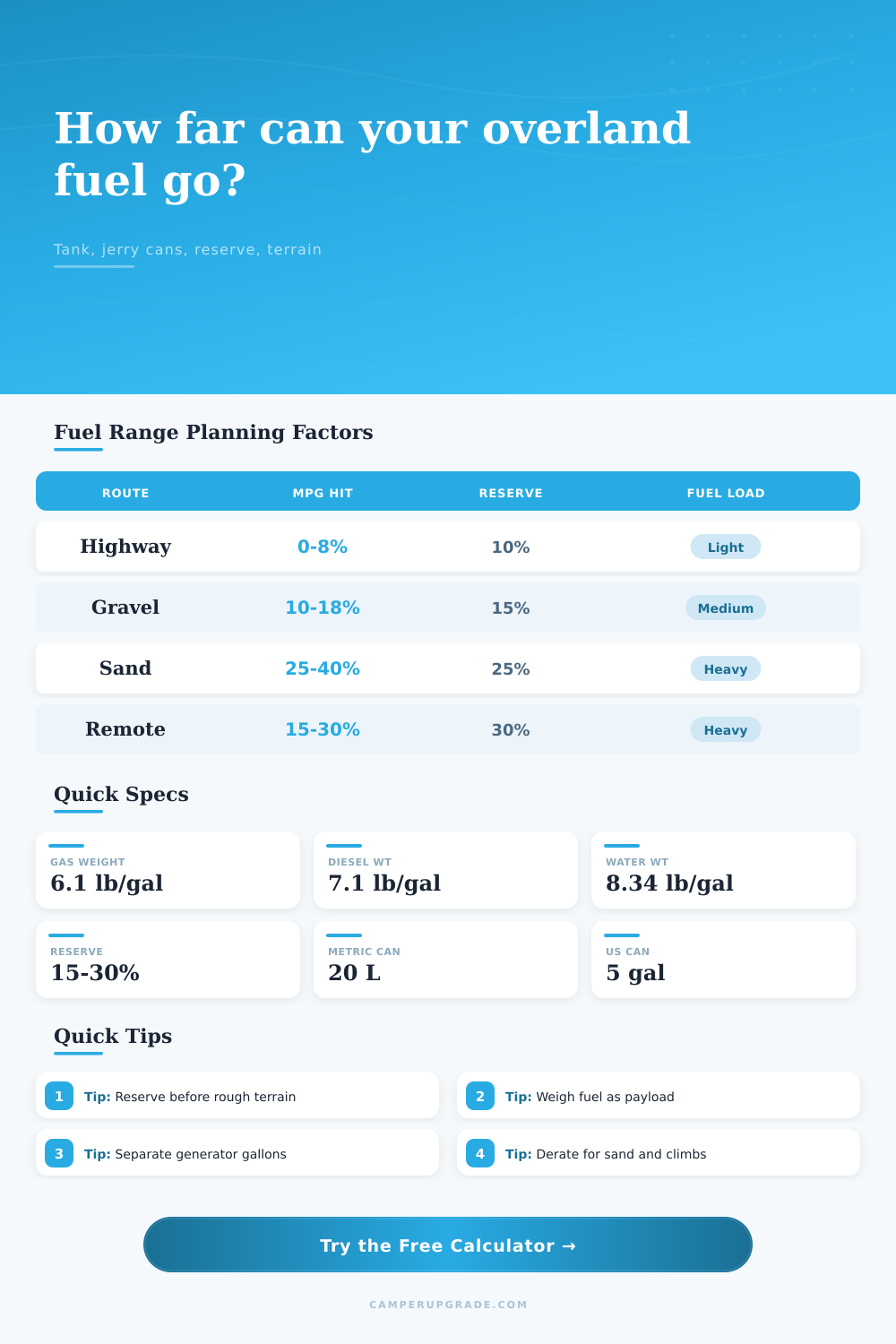
Fuel range breakdown
| Driving condition | Typical range derate | Why fuel use rises | Planning note |
|---|---|---|---|
| Pavement transit with roof load | 0% to 8% | Aerodynamic drag, added tire mass, moderate speed changes. | Use recent trip MPG if the rig is already loaded. |
| Fast gravel and washboard | 10% to 18% | Lower tire pressure, surface drag, speed changes, and corrugations. | Increase reserve if fuel stops are far apart. |
| Mountain passes and forest roads | 15% to 25% | Climbing load, low gears, switchbacks, and long idle periods. | Count descents carefully; they do not fully repay climbs. |
| Sand, mud, snow, and low range | 25% to 45% | High rolling resistance and extended throttle at low speed. | Set a conservative turnaround point before the hard section. |
| Remote mixed expedition segment | 15% to 30% | Mixed surfaces, scouting, detours, idling, and heavy cargo. | Use 20% to 30% reserve when exit options are limited. |
| Container setup | Fuel volume | Gasoline fuel weight | Diesel fuel weight |
|---|---|---|---|
| One 5 gal can | 5.0 gal / 18.9 L | 30.5 lb / 13.8 kg | 35.5 lb / 16.1 kg |
| Two 5 gal cans | 10.0 gal / 37.9 L | 61.0 lb / 27.7 kg | 71.0 lb / 32.2 kg |
| One 20 L can | 5.3 gal / 20.0 L | 32.2 lb / 14.6 kg | 37.5 lb / 17.0 kg |
| Four 20 L cans | 21.1 gal / 80.0 L | 128.9 lb / 58.5 kg | 150.1 lb / 68.1 kg |
| Six 10 L side cans | 15.9 gal / 60.0 L | 96.7 lb / 43.9 kg | 112.6 lb / 51.1 kg |
| Vehicle and route | Baseline economy | Fuel carried | Practical planning range |
|---|---|---|---|
| Mid-size gas truck on weekend trail | 15 to 18 MPG | 21 gal tank plus 10 gal cans | 320 to 420 mi with 15% reserve and mild derate. |
| Diesel wagon on remote desert tracks | 18 to 24 MPG | 24 gal tank plus 20 L can | 380 to 520 mi with 25% reserve and rough terrain. |
| Full-size camper truck on gravel loop | 10 to 14 MPG | 36 gal tank plus two cans | 330 to 470 mi depending on payload and wind. |
| Van camper using a shared fuel generator | 14 to 20 MPG | 24 gal tank plus 5 gal can | 280 to 430 mi after generator gallons are subtracted. |
| Heavy expedition truck in low-speed terrain | 7 to 11 MPG | 40 gal tank plus 80 L cans | 300 to 500 mi with a very conservative reserve. |
| Reserve style | Reserve kept unused | Best for | Turnaround rule |
|---|---|---|---|
| Light reserve | 10% | Known roads, close fuel stops, mild terrain. | Turn around before half of safe range is gone. |
| Standard backcountry reserve | 15% to 20% | Mixed dirt, changing weather, moderate distance. | Compare round trip plus detour allowance. |
| Remote desert or winter reserve | 25% to 30% | Soft surfaces, slow recovery, limited exit routes. | Keep reserve separate from the out-and-back fuel. |
| Support vehicle reserve | 30% to 40% | Group travel where one rig may assist another. | Plan for both your range and emergency transfer fuel. |
tank fuel = tank capacity x current fill percent.jerry fuel = jerry count x can size x fill percent.driving fuel = total fuel - reserve fuel - shared generator fuel.safe range = driving fuel x terrain-adjusted fuel economy.
When you go off road to gravel you lose your fuel gauge accuracy. Half a tank might read 50 miles until next station. Now, it is longer to the next station and the rough ride use up more of your engine’s fuel.
Fortunately there is a fuel range calculator that will assist you in planning out your adventure. On this site they have made the overland fuel range calculator. This take some of the guesswork out of having enough gas, and instead uses actual calculations. How many miles do I want to get, not how much gas do I have.
Plan Your Fuel for Safe Off-Road Trips
When preparing for remote trips, most people rely on their highway mileage rating. That’s the wrong way to do things. A loaded-down vehicle isn’t going to perform like some new car on a test track, its base economy should reflects that fact. Also, you need to derate for terrain. Twenty to forty percent of your range can goes away when you’re climbing hills, driving through mud or sand, etc.
Fortunately, the calculator take this into account and gives you an idea of your real-world range in nasty stuff. Chances are it’ll be less then what you think, but it will be right.
Jerry cans increase your range, but they adds weight. A gallon of gasoline weighs approximately 6 pounds; diesel weighs more. Two or three five-gallon jerry can will weigh down your rig by sixty pounds. It’s also usually up high and far back on your tow vehicle, impacting handling and payload limits. Use the calculator and put your own payload limits into it so you don’t go past what your suspensions can handle. Too many folks forget about that compromise until they becomes stuck.
Many people don’t understand what a fuel reserve is. Don’t assume that you’ll run out of gas when needle hits “reserve.” Reserve is for running out of gas if you’re lost, or if the road has become more difficult then anticipated. Remote trips usually have a reserve percentage set at 15%, 30%.
For example, let’s say you put $100 worth of gas in car and want to take trip with 20% reserve. You’d enter $80 into the calculator and it will tell you how far you can safely drive. It’s less range but it’s safer. Planning to run out of gas gives you nothing to fall back on.
You’ll also want to calculate how much fuel your generator will use. Depending on the load, generators can consumes as much as a gallon of fuel in four hours. With the calculator, you can subtract the fuel used by both the vehicle and the generator. That way you won’t run out of gas while crossing the desert with a full tank just because you burned through all your generator fuel powering your camp lights at night. So it’s important to factor in that shared fuel when calculating your overall amount of gas.
The page have a reference table breaking those down in terms of volumes and weights so you can get a real picture of what you’re carting around.
Because terrain comes in all shapes and sizes, make sure you plan for it. For example, if you’re running a multi-day trip on soft sand, you’ll need a larger reserve than if you were out for a weekend of trail runs on some fast gravel. Use the calculator’s presets as a starting point. Modify from there according to your own vehicle type and the conditions of your route.
Monitor the adjusted fuel economy. That is the calculator’s estimate of your actual MPG while considering both weight and terrain. If it starts getting dangerously low, you should of consider reducing your daily drive leg distance or altering your fuel strategy.
Risk management is part of overlanding. And nowhere is that more evident than with fuel. Gas is a serious issue, especially when miles from civilization. Running out of gas is more than just an inconvenience; it can be dangerous. The calculator eliminates guessing and sets limits on what is possible. How much fuel do you carry? Where is your safety buffer? How far can you go?
Once you run the numbers, you’ll have answers, and you can drive confidently knowing you’ve accounted for the worst-case scenario. Your plan should match your numbers, and those numbers is correct.