🌲 Osage Orange Firewood BTU Calculator
Estimate usable heat from osage orange firewood with moisture, split size, bark load, and stove efficiency. Use this calculator to plan dense loads fast.
📌Fence-Line Presets
🧮Calculator Inputs
Enter the mass of the stack, tote, or sample you want to rate.
20% means 20 lb of water per 100 lb of oven-dry wood.
Represents how much of the fuel energy becomes useful heat.
🧭Osage Heat Snapshot
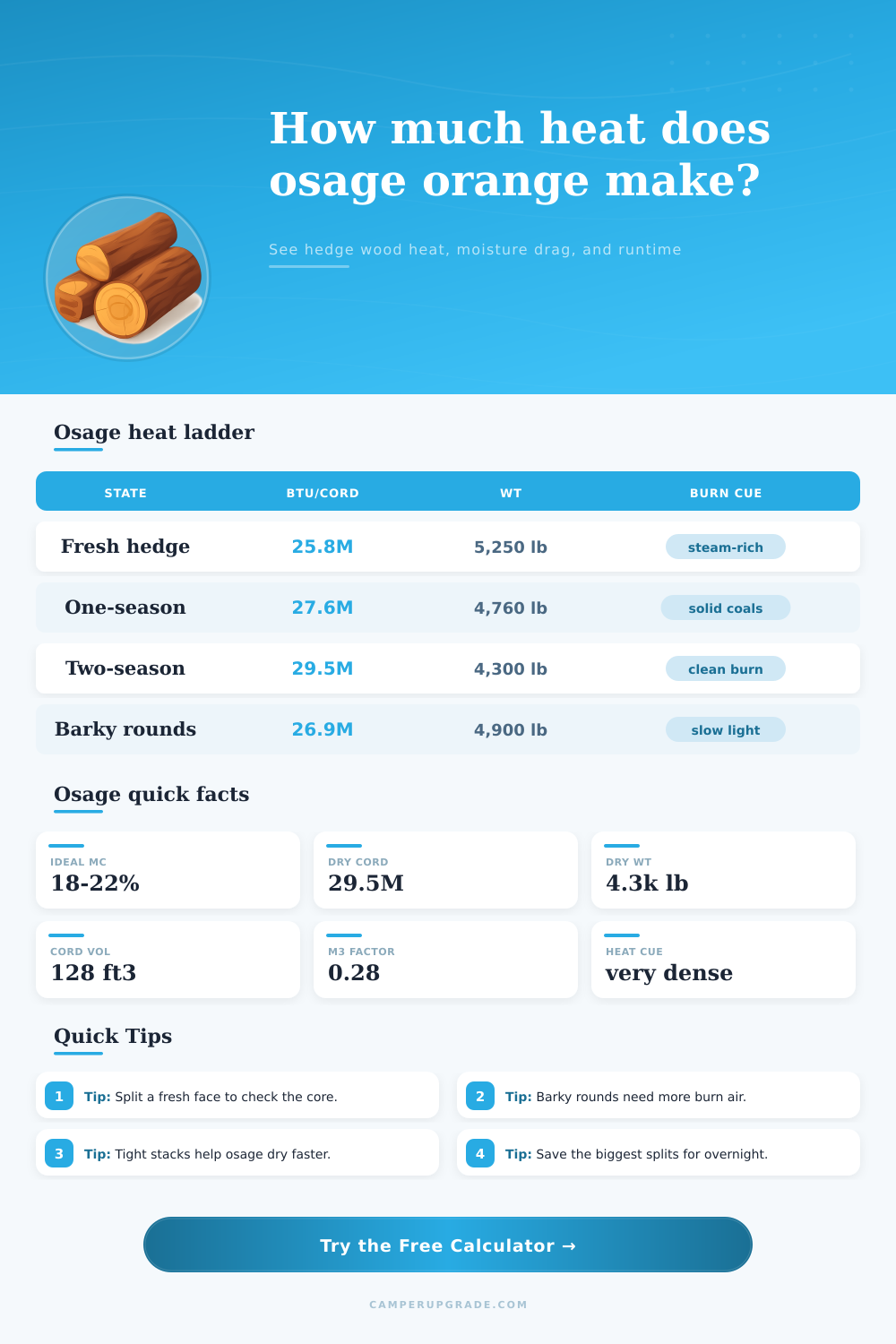
🌲Bois dArc Heat Ladder
| State | BTU/cord | Weight | Burn cue |
|---|---|---|---|
| Fresh hedge | 25.8M | 5,250 lb | Steam-rich |
| One-season | 27.6M | 4,760 lb | Solid coals |
| Two-season | 29.5M | 4,300 lb | Clean burn |
| Barky rounds | 26.9M | 4,900 lb | Slow light |
💧Moisture Drag Ladder
| Moisture | Dry frac. | Net BTU/lb | Use cue |
|---|---|---|---|
| 10% MC | 0.91 | ~7600 | Snap-dry |
| 18% MC | 0.85 | ~7100 | Ideal stove |
| 25% MC | 0.80 | ~6600 | Good shoulder |
| 35% MC | 0.74 | ~5900 | Still damp |
| 50% MC | 0.67 | ~5100 | Fresh hedge |
| 75% MC | 0.57 | ~4000 | Green core |
| 100% MC | 0.50 | ~3400 | Very wet |
| 120% MC | 0.45 | ~3000 | Storm cut |
🔧Split and Bark Matrix
| Condition | Factor | Airflow | Best use |
|---|---|---|---|
| Rounds / unsplit | 0.94 | Slow | Outdoor cure |
| Chunky splits | 0.98 | Medium | Long burns |
| Standard splits | 1.00 | Balanced | Daily heat |
| Small splits | 1.03 | Fast | Shoulder use |
| Kindling / slats | 0.93 | Very fast | Ignition |
| Nearly bark-free | 1.02 | Open | Clean stack |
| Light bark skin | 1.00 | Normal | General burn |
| Barky rounds | 0.95 | Tight | Slower cure |
📈Runtime Benchmarks
| Load size | Safe BTU | Hours | Note |
|---|---|---|---|
| 0.5 cord | ~8.0M | 670 | Short bank |
| 1.0 cord | ~16.0M | 1,330 | Main heat |
| 1.5 cords | ~24.0M | 2,000 | Cold snap |
| 2.0 cords | ~32.0M | 2,670 | Deep reserve |
Osago orange contain a high amount of heat when burning. Osago orange is a dense wood; the density of osago orange allow the wood to burn for a long time. Because osago orange is dense, it contains more energy per pound than other type of woods, such as oak or hickory.
However, there are several factor that may impact the amount of heat that osago orange produces when it is burning. For example, the moisture content of the wood can reduce the amount of heats that the wood produces. If there is a high amount of moisture within the osago orange when it is burning, the fire must work to evaporate the water within the wood.
How to Burn Osago Orange Wood
Thus, energy is use to evaporate the water instead of producing heat, reducing the amount of heat that can warm a room. The ideal moisture content of osago orange are between 18 and 22%. If the moisture content of the osago orange is higher than 22%, the wood will produce smoke yet will not burn efficient.
However, if the moisture content of osago orange is lower than 18%, the wood may burn too quickly to be effective in controlling the fire. The size of the splits in the osago orange can also impact the burning of the wood. Osago orange splits that are large in size can be difficult to light, but will help maintain a fire throughout the night.
Smaller splits will ignite more quickly but will remain lit for shorter period of time. Finally, the amount of bark that is present on the osago orange splits will also impact the burning of the wood. Bark will trap moisture within the wood splits and cause the wood to take longer to ignite.
The setting of the stove in which the osago orange is burned can impact the efficiency of the burning of the wood. For instance, if the draft within the stove is opened too wide, the osago orange will burn like an large bonfire. Thus, it will not efficiently provide heat to a home.
However, if the stove is burned in a tight draft, more heat can be extracted from the osago orange. Finally, even with a good stove, the efficiency will be around 75% because 25% of the heat will escape the chimney of the stove. A person can calculate the heat output of osago orange if a person knows the moisture content and the weight of the osago orange.
For instance, if the osago orange is seasoned for two seasons, it will contain more heat than if the osago orange was cut recent. Seasoned osago orange will burn to provide 29.5 million BTUs per cord of wood but fresh wood will only provide 25 million BTUs per cord of wood. A person should also consider the weight of the osago orange because it is a very heavy type of wood due to its density.
A person can make several mistake when burning osago orange. For instance, a person should never burn green osago orange within the home because it will produce creosote within the chimney flues. Creosote can build up within the chimney and become dangerous to individuals who lives in the home.
Additionally, a person should not stack osago orange that contains moisture too tightly; however, someone should cover the top of the stack of osago orange to prevent rain from making the wood too wet. Finally, a person should always split the osago orange to check the moisture content of the wood prior to attempting to burn the wood itself.