Oil Per Meal Camp Calculator
Estimate cooking oil for camp breakfasts, skillet dinners, stir-fries, griddle meals, and reserve bottles without planning by guesswork.
🏕Trip Presets
🥣Camp Meal Inputs
Oil Packing Result
📐Formula Used
🛢Oil Spec Grid
🍳Oil Per Meal Reference
| Camp Menu Style | Oil Per Person | 4-Person Meal | Typical Use |
|---|---|---|---|
| Light nonstick eggs | 6 ml / 0.4 tbsp | 24 ml / 1.6 tbsp | Coated nonstick pan |
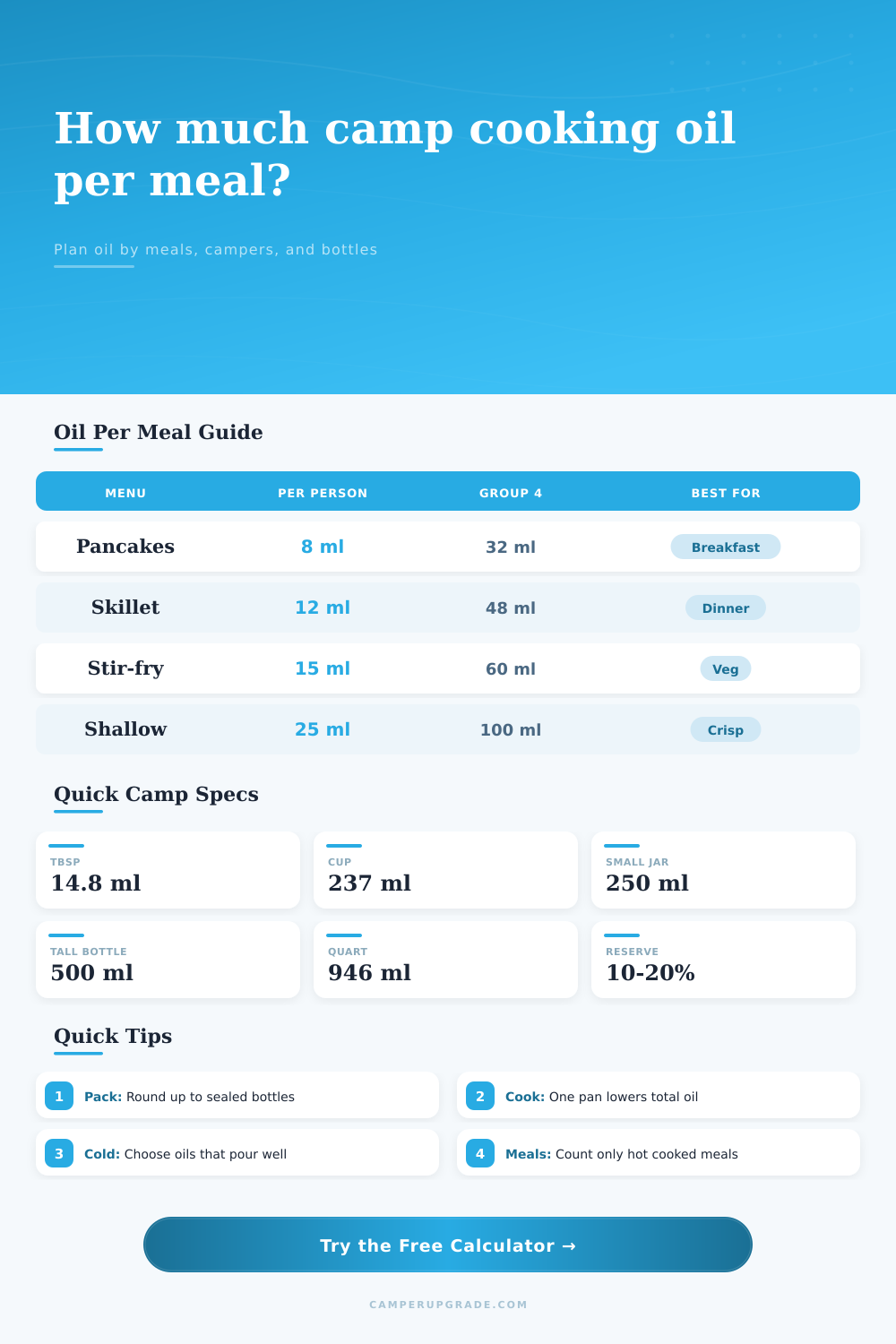
| Pancakes or griddle toast | 8 ml / 0.5 tbsp | 32 ml / 2.2 tbsp | Thin griddle film |
| General skillet meal | 10 ml / 0.7 tbsp | 40 ml / 2.7 tbsp | Sausage, onions, eggs |
| Hash, tacos, rice skillet | 12 ml / 0.8 tbsp | 48 ml / 3.2 tbsp | Starch plus protein |
| Vegetable stir-fry | 15 ml / 1.0 tbsp | 60 ml / 4.1 tbsp | Hot wok or pan |
| Dutch oven browning | 20 ml / 1.4 tbsp | 80 ml / 5.4 tbsp | Meat browning base |
| Shallow crisping or fish | 25 ml / 1.7 tbsp | 100 ml / 6.8 tbsp | Crisp edges, shallow oil |
Values are planning amounts, not nutrition servings. The calculator reduces group totals when one shared pan is used efficiently.
📊Bottle Conversion Table
| Container Size | Metric Volume | US Kitchen Volume | Best Camp Use |
|---|---|---|---|
| Mini condiment bottle | 60 ml | 2.0 fl oz | Solo overnight |
| Small trail flask | 120 ml | 4.1 fl oz / 0.5 cup | Two people, one weekend |
| Medium camp bottle | 250 ml | 8.5 fl oz / 1.1 cups | Family weekend |
| Tall kitchen bottle | 500 ml | 16.9 fl oz / 2.1 cups | Group basecamp |
| Quart bottle | 946 ml | 32.0 fl oz / 4.0 cups | Large patrol kitchen |
Round bottle count up because partially filled bottles still need leak-safe headspace and lids.
🔥Oil Type Handling Table
| Oil Type | Density Used | Heat Role | Camp Handling Note |
|---|---|---|---|
| Olive oil | 0.91 g/ml | Medium heat | Flavorful and compact |
| Canola oil | 0.92 g/ml | Medium-high heat | Neutral for many meals |
| Avocado oil | 0.91 g/ml | High heat | Good for searing |
| Coconut oil | 0.93 g/ml | Medium heat | May solidify when cool |
| Ghee or clarified butter | 0.91 g/ml | Medium-high heat | Spoonable if chilled |
| Toasted sesame oil | 0.92 g/ml | Low finish heat | Strong flavor, use sparingly |
| Peanut oil | 0.91 g/ml | High heat | Useful for crisping |
| Vegetable oil blend | 0.92 g/ml | Medium-high heat | Predictable camp default |
📋Common Camp Meal Plans
| Meal Plan | Cooked Meals | Oil Before Reserve | Suggested Bottle |
|---|---|---|---|
| Solo 2-day breakfast skillet | 2 | 18 ml | 60 ml mini |
| Two-person weekend dinner pan | 3 | 65 ml | 120 ml flask |
| Family 3-day pancakes and dinners | 5 | 180 ml | 250 ml bottle |
| Six-person stir-fry basecamp | 6 | 459 ml | 500 ml bottle |
| Twelve-person patrol kitchen | 8 | 1,632 ml | Two quart bottles |
Example totals assume shared-pan reductions and do not include personal salad dressing, marinade, or fuel bottle lubrication.
💡Camp Oil Planning Tips
Don’t get me wrong, I know how this goes: it’s 8am, your oil-less camp kitchen dawns on you with panic. There are hash browns to be fried and four mouths ready to eat them. And there you are, holding an empty bottle of cooking oil, staring at a screaming pan.
Why? Because most campers don’t measure their oil with math, they eyeball it. They pull out a bottle that sorta looks about right and cross their fingers. Before you even hit the driveway, our calculator does the math for you so you can turn your vague ideas into accurate milliliter measurements. It factors in all those variables that lead to kitchen catastrophes, namely group size, meal frequency, and those unexpected little spills that always occur when you’re standing on uneven ground.
How to Measure Your Cooking Oil
Before we get into it, let’s clarify: What are you making? The volume depends on the type of meal. Flipping pancakes doesn’t use as much oil than searing a steak. A good shallow fry or stir-fry may require up to twenty-five milliliters (a bit less than a tablespoon) per person. That is double the amount needed for a thin layer over a griddle. That makes all the difference in the world to your packing list.
Do you plan on cooking big, oily meals each night for an entire week? If so, then you’re going to run out of that tiny condiment bottle by Tuesday. The calculator lets you compare your meal plans with the amount you’ll need and avoid any dead weight or too-small-to-work situations.
Are you planning on having a backyard barbecue or a trail crew to feed? That all changes when you get into batch cooking. If you’re feeding yourself and only using a single small skillet, you’ll probably have to smear an entire tablespoon of oil around. That is not the case if you are now making food for four. Even though there’s four times as much food going in the pan, the oil has to go on a greater surface area, meaning it doesn’t require four times as much. That volume remains the same, just distributed over more surface area, decreasing the amount of oil required per person.
Shared-pan reduction is another setting built into the tool; it will take your target amount and reduce the overall by accounting for efficiency. And here’s where it gets really cool: this isn’t just some wonky detail about the device; it’s a real-world representation of how we actualy cook outdoors. We’re not doing a dozen individual servings of pancakes, or a batch of eggs, or whatever. Most often, we’re doing one big thing, like stirring a single large pot or flipping a bunch of eggs. However, without the reduction setting, we’d be overpacking. And overpacking is a backpacker’s nightmare. Every ounce counts.
The other piece to keep in mind when choosing an oil is its physical characteristics: not all fats behave similarly outdoors. While olive oil will be dense (and flavorful), it can become sluggish as the weather cools. Coconut oil, meanwhile, may solidify if temperatures fall, leaving you with a block of wax rather than a liquid to pour. Ghee’s heavy but stable. The table on the page provides this breakdown by illustrating the relative density of each option, meaning how much weight it will add overall to your pack. Every gram matters when you’re packing in for a backcountry hike; opting for a smaller size or lighter oil can literally mean the difference between a pleasant trip vs one that feels like a slog. The calculator will convert volume-to-weight so you can make this trade-off clearly.
Experience beats optimism when it comes to building a safety margin. Your math may be flawless, but then there’s life. Yes, you’ll spill some oil onto the floor and yes, you’ll probably need some extra fat to keep food from sticking to a well-abused pan under fire. Everyone gets hungry. Why not fry another meal? A ten to twenty percent reserve accounts for these variables. It is the difference between having just enough for one more meal or running out on the final night. It is not wastefulness, but preparation for the challenges of real cooking.
The last step is packing into the proper container. A half-full bottle is not ideal for a pack. It will slosh and leak and make a mess of everything else. If it’s a small flask on a solo adventure, then round up to full; if it’s a quart bottle at a group basecamp, the tool can tell you exactly how many bottles to round up to so there’s no guessing. I don’t have to wonder if I need one more; instead, I know I have exactly as much as I need.
Camping shouldn’t be hard. Cooking outdoors should be easy, but you need to be accurate to keep it that way. Measure out how much oil you’ll need before leaving to remove another possible stress point on your journey. Bring what’s necessary, whip up those grub bags calmly, and depart with no mess at the campsite.
That’s camping smart. Plan. Don’t guess.