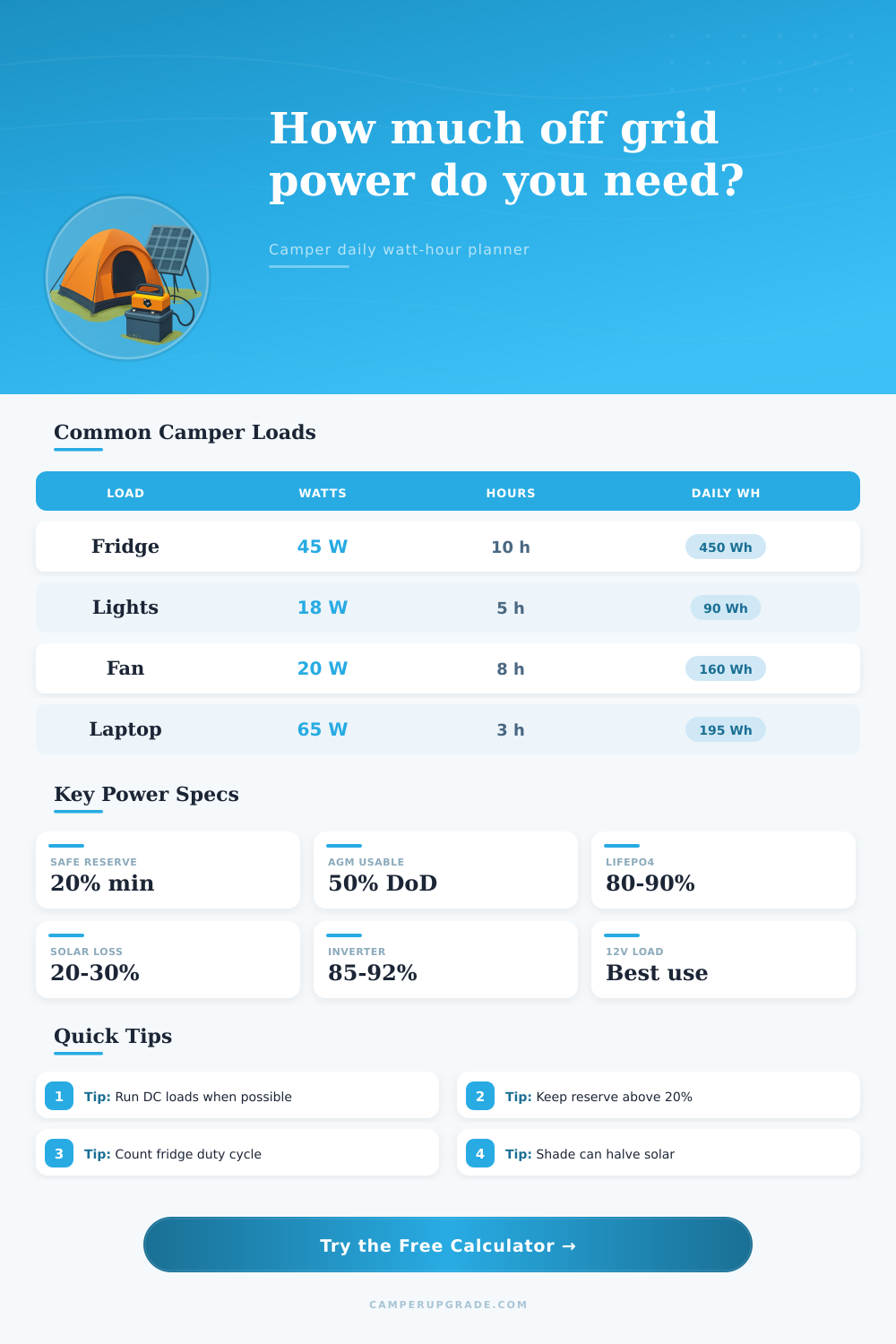
Off Grid Daily Power Budget Calculator
Estimate camper daily watt-hours, usable battery capacity, solar harvest, reserve margin, and off-grid runtime from real appliance loads.
| Appliance | Typical watts | Use pattern | Daily energy |
|---|---|---|---|
| 12V compressor fridge | 35-60 W average while running | 8-14 hr equivalent run time | 280-840 Wh |
| LED cabin lights | 10-25 W combined | 3-6 hr evening use | 30-150 Wh |
| Roof vent fan | 12-35 W | 4-12 hr ventilation | 48-420 Wh |
| Furnace blower | 35-90 W | 2-10 hr cold weather cycling | 70-900 Wh |
| Water pump | 45-90 W | 0.1-0.4 hr intermittent use | 5-36 Wh |
| Laptop charging | 45-100 W | 1-5 hr work or media | 45-500 Wh |
| Starlink or router | 20-75 W | 2-10 hr connectivity | 40-750 Wh |
| CPAP without humidifier | 25-45 W | 7-9 hr sleep period | 175-405 Wh |
| Battery type | Daily usable depth | 100Ah at 12V usable | Notes for calculator |
|---|---|---|---|
| Flooded lead acid | 50% | 600 Wh before reserve | Best kept shallow for cycle life |
| AGM lead acid | 50% | 600 Wh before reserve | Handles vibration well, still reserve-sensitive |
| Gel lead acid | 70% | 840 Wh before reserve | Use proper charge settings |
| LiFePO4 conservative | 80% | 960 Wh before reserve | Strong daily cycling choice |
| LiFePO4 deep cycle | 90% | 1080 Wh before reserve | Check BMS and cold-charge limits |
| Solar array | 3 peak sun hours | 4.5 peak sun hours | 6 peak sun hours |
|---|---|---|---|
| 100 W portable panel | 225 Wh at 75% | 338 Wh at 75% | 450 Wh at 75% |
| 200 W roof array | 450 Wh at 75% | 675 Wh at 75% | 900 Wh at 75% |
| 400 W camper roof | 900 Wh at 75% | 1350 Wh at 75% | 1800 Wh at 75% |
| 600 W large van array | 1350 Wh at 75% | 2025 Wh at 75% | 2700 Wh at 75% |
| Load path | Efficiency assumption | Best use | Calculator effect |
|---|---|---|---|
| 12V or 24V DC direct | About 95-100% | Fridge, lights, fans, USB-C DC | Uses watts × hours directly |
| Small inverter AC | About 85-90% | Laptop bricks and small appliances | Raises battery Wh draw |
| High quality inverter | About 90-94% | Workstation and induction bursts | Lower conversion penalty |
| Idle inverter left on | 5-25 W standby | Only when AC is needed | Add standby as other load |
| Camper scenario | Typical daily Wh | Suggested usable battery | Solar recovery target |
|---|---|---|---|
| Minimal weekend minivan | 250-500 Wh | 500-800 Wh | 100-200 W solar |
| Truck camper with fridge | 700-1200 Wh | 1200-2000 Wh | 200-400 W solar |
| Class B remote work | 1300-2200 Wh | 2500-4000 Wh | 400-700 W solar |
| Family travel trailer | 1500-3000 Wh | 3000-5000 Wh | 500-800 W solar |
| CPAP overnight focus | 500-1000 Wh | 1200-2000 Wh | 200-400 W solar |
A dead battery light doesn’t mark your first failure in your plan for off-grid power. Your first failure is realizing that you haven’t been planning with math, but hoping. You purchased sufficient battery capacity to operate your fridge. You installed enough solar panels to feel secure. But then it’s late afternoon, the inverter clicks off and you remember. Winter sun angles in, and your water pump take minutes, which add up fast. Energy usage must be planned as a limited currency, not an endless resource.
The above calculator do the watt-hour math and reserve margin calculations to free you from guesswork about what happens when clouds roll in. Remember: Your average doesn’t apply to you. First, figure out what’s really being pulled each day and go from there.
How to Plan Your Off-Grid Power
Because they’re a compressor fridge, those things turns on and off; they don’t operate continuously for a full 24 hours like a standard fridge does. If you think about the total amount of time the compressor hums throughout an entire days worth of cycles, that’s the equivalent run time you mark down. Remember why marking it as a direct DC load is important; doing so avoids efficiency hit incurred with converting power into AC then into DC once more. Each step of conversion steals a bit of power, which compounds over weeks of camping.
The chemistry of your batteries also determine the practicality of items from your bank. While two hundred amp-hours in a lead acid battery might sound good, don’t forget, it’s dead if you drop below fifty percent during a discharge cycle. That means you’re down to half your purchase and less if you maintains any reserve for bad weather. With lithium iron phosphate batteries you can go deeper, typically 80-90 percent instead, leaving you with more available energy in a given physical space. Your total capacity is adjusted to match this battery chemistry selection. This way, you know exactly how many watt-hours remains after taking into account your desired reserve buffer and battery depth of discharge limitations.
Where most plans come undone is in solar harvesting. Most people gets confused between rated panels and what they realy get out. You won’t get three hundred watts from a three hundred watt array all day. Angle losses, heat, wiring resistance and dust will eat a bunch out of that. Assuming an efficiency of seventy five percent mean a reasonable assessment of how many watt-hours are really getting into the battery during peak sun hours.
Do mountainous terrain or tree-covered areas blocks your southern sky? Lower that estimate of efficiency. Boondocking in a shady forest is very different than dry camping in the sunny desert. It can be the difference between having power when the lights go out and waking up in silence.
Because inverters are energy hogs, they require special care. If you run your laptop charger through an inverter it’ll waste roughly ten to fifteen percent of its available battery power converting into heat. You can avoid this loss by using a DC adapter instead (when available). After labeling appliances as DC or AC it’ll automatically calculate those losses for you. It’ll even tell you exactly how long you can run on your stored energy, no solar input required. This is critical if you’re going camping during a weekend storm.
Do you know you’ve got three days of runtime? You can watch movies and cook meals without worry. One day? Every watt has to count.
Novice users tend to oversize their solar capacity and undersize their mix of load. They fail to account for the steady, though tiny, draw of router standby, LED strip illumination, phone charger, or other low-wattage devices. Those little loads adds up to big daily drains. When you list them all in the tool, it shows a complete picture of your power usage. It tells you what you really need and lets you know when you can unplug an appliance. The idea is to make sure that you’re not consuming more than you generate, that your battery never reaches zero.
Ideally, you’ll have enough left over to keep things comfy while making a comfortable buffer against unexpected needs or bad weather conditions. Once you get a handle on how the juice flows through the system (sun-to-storage-to-load), the worry subsides. You know how much is in the tank for tomorrow so you no longer spend time worrying about the meter. Now you can kick back by the campfire and enjoy the moment.