🌲 Oak Firewood BTU Calculator for Dense Heat
Size oak loads by species, stack shape, moisture, bark, and burn control before you commit the stack to the stove.
📋Oak Presets
🧮Load Calculator
Use this for multiple cords, rows, or bundles.
Depth changes with the rack style and split pack.
📋Oak Heat Snapshot
🌲Oak Species Heat Map
| Species | Dry BTU/cord | Dry weight | Burn trait |
|---|---|---|---|
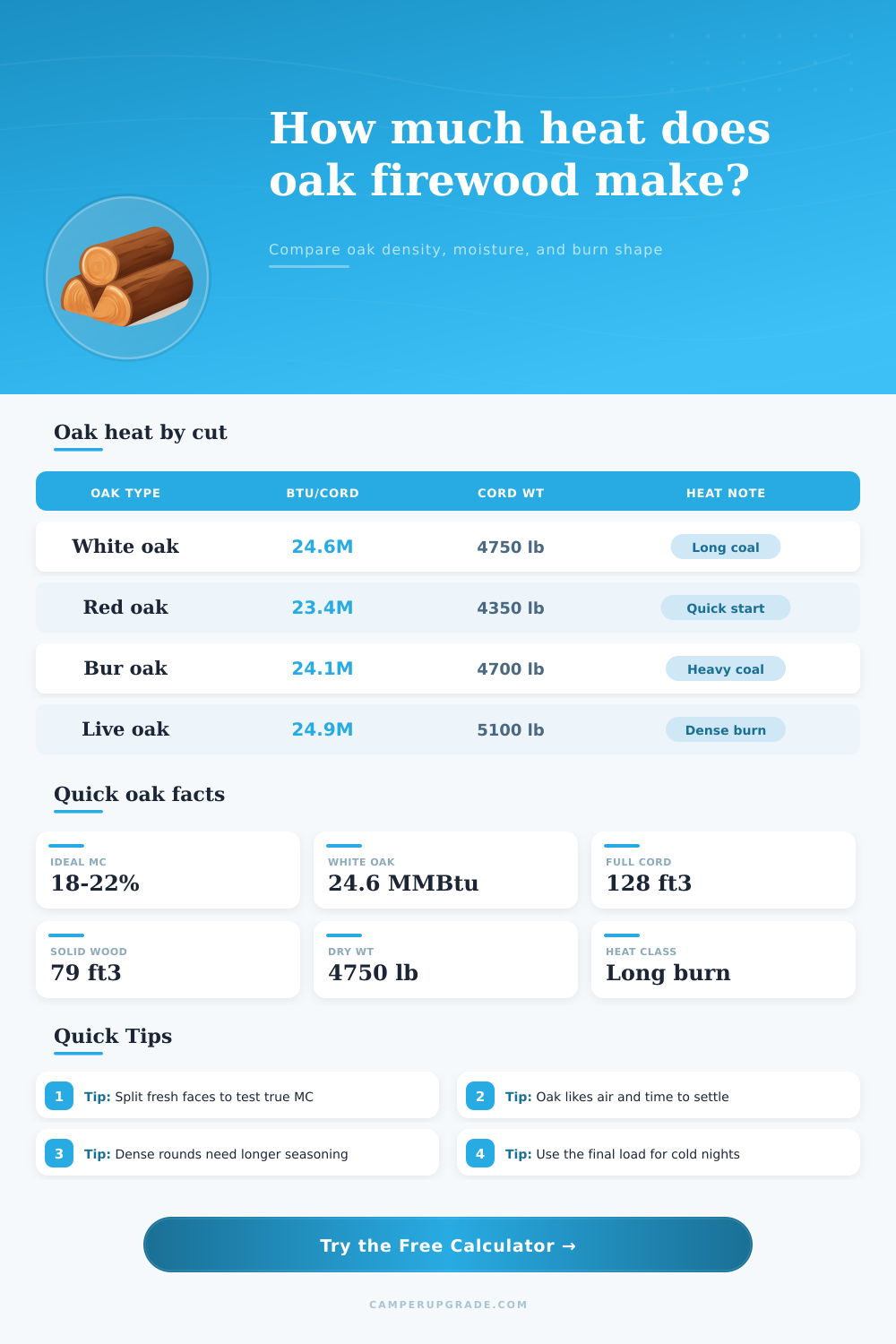
| White oak | 24.6M | 4,750 lb | Long coal bed |
| Red oak | 23.4M | 4,350 lb | Faster lightoff |
| Bur oak | 24.1M | 4,700 lb | Heavy coals |
| Live oak | 24.9M | 5,100 lb | Very dense |
| Post oak | 24.3M | 4,950 lb | Slow release |
| Chestnut oak | 23.7M | 4,500 lb | Steady heat |
| Black oak | 23.2M | 4,400 lb | Balanced burn |
| Swamp white oak | 23.9M | 4,600 lb | Wet-site oak |
💧Moisture Drag Curve
| Moisture | Dry share | Water load | Use note |
|---|---|---|---|
| 0% MC | 1.00 | 0 lb | Oven dry |
| 10% MC | 0.91 | 475 lb | Very dry |
| 20% MC | 0.83 | 950 lb | Good oak |
| 30% MC | 0.77 | 1425 lb | Still wet |
| 40% MC | 0.71 | 1900 lb | Fresh split |
| 60% MC | 0.63 | 2850 lb | Green load |
| 80% MC | 0.56 | 3800 lb | Recently cut |
| 100% MC | 0.50 | 4750 lb | Very green |
🔧Split and Bark Factors
| Condition | Factor | Effect | Best fit |
|---|---|---|---|
| Rounds / unsplit | 0.94 | Slow dry | Outdoor rack |
| Jumbo splits | 0.98 | Less edge | Long burns |
| Standard splits | 1.00 | Even stack | Daily heat |
| Thin splits | 1.03 | Quick light | Shoulder use |
| Kindling | 0.92 | Flash burn | Starts only |
| Mostly stripped | 1.02 | Better dry | Stored oak |
| Clean faces | 1.00 | Normal burn | General heat |
| Heavy bark shell | 0.96 | More drag | Wet storage |
📈Stack Form Ledger
| Mode | Cord eq. | Volume | Use note |
|---|---|---|---|
| Full cord | 1.00 | 128 ft3 | Base load |
| Face cord 16 in | 0.33 | 42.7 ft3 | Standard face |
| Face cord 18 in | 0.38 | 48.0 ft3 | Deep face |
| Face cord 24 in | 0.50 | 64.0 ft3 | Big rack |
| Loose pile | 0.78 | 128 ft3 | Thrown stack |
| Custom measured | See calc | By dims | Exact fit |
Oak is a type of hardwood that is often use for firewood due to the energy that the dense wood of an oak tree can produce. Additionally, oak can be used to create a coal bed that can last for an extensive period of time, allowing individual to retain heat throughout the night. Depending on the type of oak that is used, the burning characteristic can differ.
White oak will produce long-lasting embers that is useful in retaining heat in a room for many hours. Additionally, red oak will light more quick than white oak and is thus helpful for starting a fire in the morning. Live oak is very dense but season for a longer period of time before it can be burned efficient.
How to Use Oak Wood for Firewood
The heat output of oak wood is related to its density and its moisture content. A full cord of dry white oak weigh 4,750 pounds. However, many individual will burn oak wood with high moisture content.
The more higher the moisture content, the lower the heat output that the burning oak emits. If the moisture content within the oak are high, the fire stove must use energy to evaporate the water within the oak wood. This process prevent the oak from reaching its maximum heat output.
The ideal moisture content in oak wood is between 18 and 22%. At this moisture content level, the wood will burn without create excessive creosote. Moisture play a role in how the oak wood burns.
Freshly cut oak contains a high amount of moisture content. Freshly cut oak may contain as much moisture as the weight of the oak wood its self. To reduce the moisture content in the oak wood, seasoning should occur for at least 18 month.
Moisture content can be tested by splitting the oak wood. The center of the split oak will accurately present the moisture content of the oak. Large piece of oak will take longer to dry than small pieces of oak.
The way in which you stack oak will play a role in the heat that is deliver to the room. A full cord of oak will produce 128 cubic feet of wood. A face cord will produce only one-third the amount of a full cord of oak wood.
Oak should be stacked in a way that allow it to dry and burn efficienty. Additionally, the thickness of the oak will impact its burning characteristic. Thin splits will burn quickly while large rounds of oak will take longer to burn.
To retain its burn characteristic, oak should be stored under a cover to prevent exposure to the rain. Flue management will play a role in the burning of oak in the stove. If you manage the flue closely, the oak will produce a long-lasting coal bed.
If the flue is opened, the oak will burn more quick. Depending on the number of hours the fire should burn, you can plan the proper amount of oak. If the oak contains alot of bark, that bark may hold moisture and cause creosote to build up in the flue.
Lastly, to continue to allow the oak to burn efficient, the stove should be periodically maintained to remove ash and to clean the glass.