MRE Expiration Date Calculator
Estimate shelf-life windows from pack date, temperature load, humidity, and packaging condition to keep field meals in a safer rotation cycle.
🏕️Storage Profile Presets
⚙MRE Shelf-Life Inputs
📊Storage Factor Grid
📘MRE Expiration Reference Tables
| Average Temp | Temperature Band | Model Factor | Planning Note |
|---|---|---|---|
| ≤60 °F (≤15.6 °C) | Cool storage | 1.25x | Best long-term reserve conditions |
| 61-70 °F (16.1-21.1 °C) | Nominal indoor | 1.00x | Baseline shelf-life behavior |
| 71-80 °F (21.7-26.7 °C) | Warm ambient | 0.78x | Increase inspection frequency |
| 81-90 °F (27.2-32.2 °C) | Hot ambient | 0.58x | Shorter rotation cycles needed |
| 91-100 °F (32.8-37.8 °C) | Very hot | 0.36x | Use near-term, not long reserve |
| >100 °F (>37.8 °C) | Extreme heat | 0.22x | Rapid quality loss risk |
| Condition Group | Selection | Factor | Observed Effect |
|---|---|---|---|
| Humidity | 20-50% RH | 1.05x | Supports longer pouch stability |
| Humidity | 51-65% RH | 1.00x | Typical indoor baseline |
| Humidity | 66-75% RH | 0.90x | Higher moisture stress on seams |
| Humidity | 76-95% RH | 0.80x | Elevated seal and corrosion risk |
| Seal Condition | Factory to compromised | 1.00x to 0.62x | Mechanical wear can dominate expiry |
| Cycling Pattern | None to severe | 1.00x to 0.72x | Repeated thermal swings reduce life |
| Storage Profile | Typical Avg Temp | Typical Peak Temp | Recommended Review Cadence |
|---|---|---|---|
| Climate room reserve | 65-70 °F | 72-76 °F | Every 180 days |
| Indoor pantry bin | 68-76 °F | 80-85 °F | Every 120 days |
| Garage cabinet | 75-85 °F | 95-105 °F | Every 60-90 days |
| Vehicle emergency kit | 82-95 °F | 110-135 °F | Every 30-60 days |
| Humid coastal locker | 75-82 °F | 88-95 °F | Every 45-60 days |
| Days Remaining | Risk Status | Recommended Action | Trip Planning Signal |
|---|---|---|---|
| >180 days above buffer | Low | Keep in standard rotation queue | Safe for scheduled trips |
| 90-180 days above buffer | Moderate | Prioritize next outing consumption | Plan replacement case soon |
| 0-89 days above buffer | High | Move to immediate use section | Inspect each pouch before loadout |
| Inside lead buffer | Critical | Replace or re-stage immediately | Avoid storing for peak season |
| Past estimated date | Expired estimate | Use emergency policy only | Inspect odor, seal, swelling first |
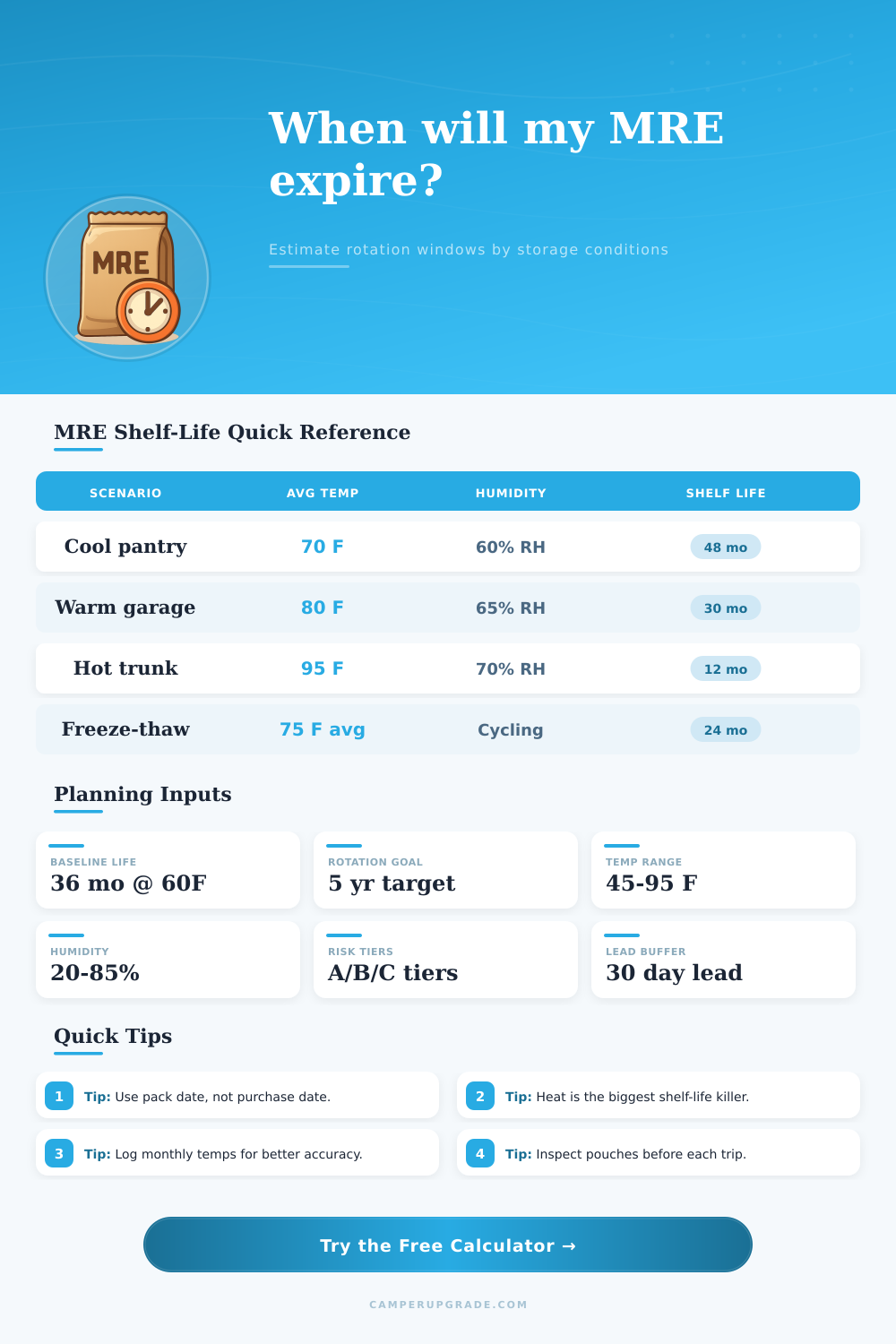
Meals ready to eat (MREs) is meals stored within specialized pouches. The shelf life of these meals depend upon the number of environmental factors that may impact the MREs. MREs can be found in a variety of locations within a persons home, such as within the garage or within the pantry.
The location at which a person choose to store their MREs will have an impact upon the shelf life of those meals. MREs have a baseline shelf life of approximately three years. This shelf life is provided the MREs are stored in cool and ideal conditions; the retort pouch and nitrogen gas within the pouch help to prevent the ingress of oxygen and light into the pouch.
How to Store and Check MREs
However, environmental factors that expose the MREs to increases in humidity, heat, or temperature cycles will reduce the shelf life of the meals. One of the factors that can impact the shelf life of MREs is the temperature at which the meals is stored. The more higher the temperature at which the MREs are stored, the shorter the shelf life of those meals.
The rate of the chemical processes within the MRE will increase at higher temperatures, which will reduce the length of time before the meals spoils. For instance, storing the MREs in a garage that maintains an average temperature of 80 degrees will reduce the shelf life of the meals compared to storing those meals in a basement closet. Additionally, the peak temperature within the storage area can also impact the shelf life of the meals.
For instance, if a car reaches peak temperatures of 120 degrees, those high temperatures can lead to the development of off-flavors in the meals. Humidity within the storage location is another environmental factor that can impact the shelf life of MREs. If the level of humidity within the storage area are low (under 50%), the low humidity will help to prevent the storage pouch of the MREs from becoming wet.
However, high humidity levels (70% or higher) may lead to the storage pouch of the MREs to becoming wet, which could lead to the failure of the seals of the MRE pouches or to the development of corrosion on the metal components of those pouches. Additionally, the number of times the temperature within the storage area decreases and increases (temperature cycles) can impact the shelf life of the MREs. For instance, if a storage area like a shed becomes hot during the day and cool at night, these cycle may reduce the shelf life of the MREs by 15 to 30 percent.
A person can inspect the MREs to determine if they are still good to eat. A person can squeeze the MREs to determine if the pouch increases in size (swelling) which may indicate that the MREs has spoiled. Additionally, a person can smell the MREs to determine if they have spoiled; rancid or chemical smells indicates that the MREs have spoiled.
Finally, a person can heat the MREs to assess their taste; any off-tastes indicate that the MREs have spoiled. Rotation of the MREs is one technique that can be used to help manage the shelf life of the meals. The rotation method suggest moving the MREs with the earliest pack date to the front of the line or inventory so that they are consumed first.
The pack date should be used rather than the purchase date of the MREs; the purchase date does not account for the number of days that the MREs may have spent on the stores pallet. MREs should be stored in an environment between 60 and 70 degrees within the home. If the meals are to be stored in a freezer, care should of be taken to avoid the cycles of thawing and refreezing the MREs, as these processes may lead to condensation within the pouches.
Through tracking the temperature where the MREs are stored and through regular inspection of the MREs, a person can manage the risks of consuming spoiled meals.