Motorhome Fuel Range Calculator
Estimate safe driving range, generator-adjusted range, fuel runtime, and fuel stops from tank size, MPG, reserve margin, terrain, wind, towing, speed, idle time, and gauge buffer.
🚙Motorhome Range Presets
⚙Fuel, Route, Generator, and Reserve Inputs
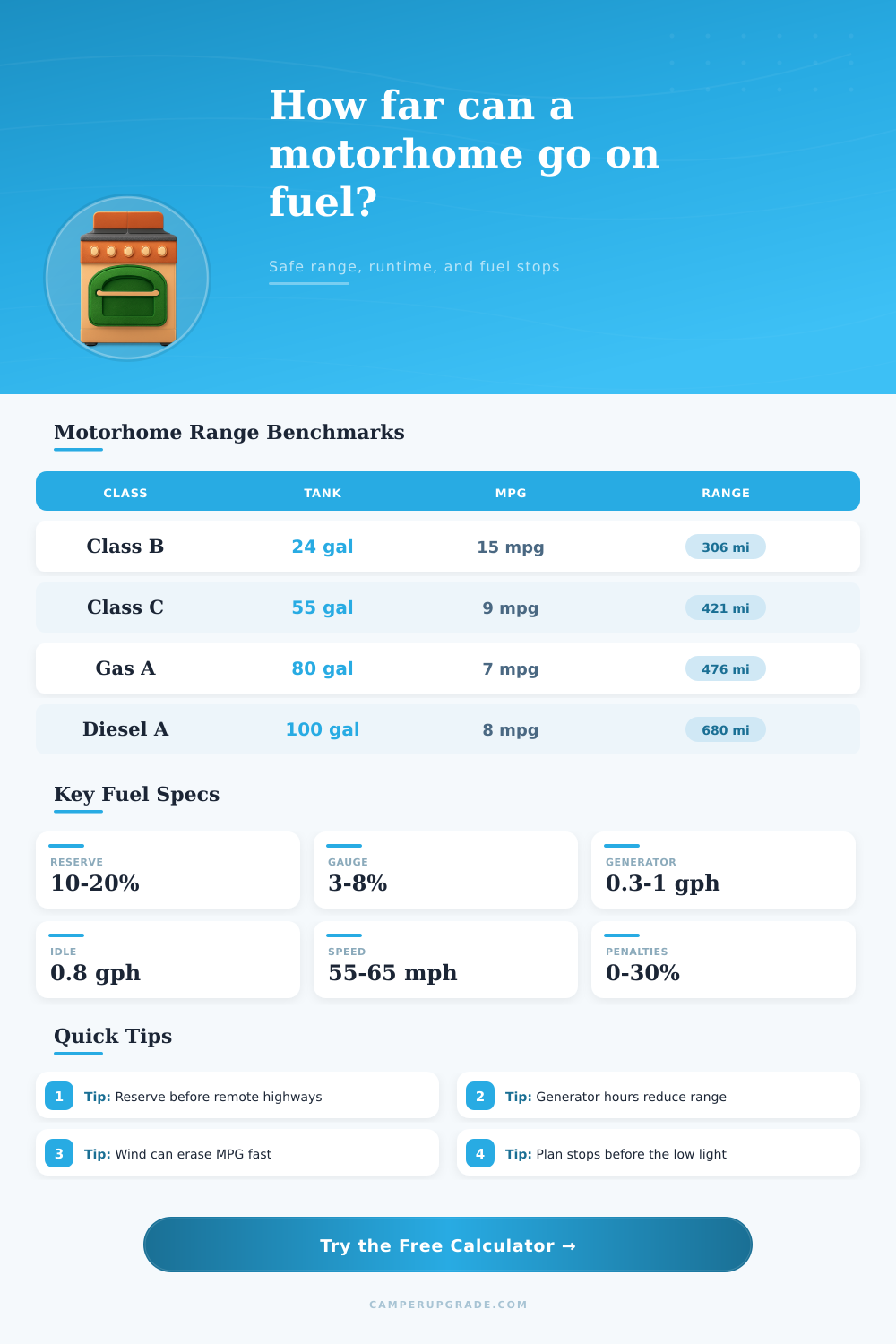
This calculator models gasoline or diesel motorhome range from usable tank gallons, adjusted MPG, fixed fuel margins, and accessory fuel use. Idle fuel is estimated at 0.8 gal/hour.
🧮Range Formula Cards
Planning gallons
Tank gallons minus reserve percentage and gauge buffer gives gallons available for planning.
Adjusted economy
Baseline MPG is reduced by terrain, wind, and towing penalties before range is calculated.
Accessory fuel
Generator gallons and idle gallons are subtracted before computing generator-adjusted range.
Route planning
Trip distance divided by adjusted range estimates how many fuel stops are needed after starting full.
⛽Motorhome and Fuel Spec Grid
📊Motorhome Fuel Range Reference Tables
| Motorhome | Tank | MPG Band | Planning Note |
|---|---|---|---|
| Class B van | 24-35 gal | 13-18 mpg | Longest MPG, smaller tank |
| Small Class C | 40-55 gal | 10-14 mpg | Good range for size |
| Gas Class A | 75-100 gal | 6-9 mpg | Big tank offsets low MPG |
| Diesel pusher | 90-150 gal | 7-10 mpg | Strong range if reserve is planned |
| Penalty Source | Mild | Moderate | Heavy |
|---|---|---|---|
| Terrain | 3-6% | 7-12% | 15-25% |
| Headwind | 3-8% | 9-15% | 18-30% |
| Towing | 4-8% | 9-15% | 16-25% |
| Speed above 65 | 3-6% | 7-12% | 15%+ |
| Accessory | Fuel Rate | 4 Hours | Range Impact |
|---|---|---|---|
| Small generator | 0.3 gph | 1.2 gal | 8-18 miles |
| Mid generator | 0.5 gph | 2.0 gal | 12-28 miles |
| Large generator | 0.9 gph | 3.6 gal | 22-50 miles |
| Engine idle | 0.8 gph | 3.2 gal | 20-45 miles |
| Route Gap | Safe Range | Reserve Check | Action |
|---|---|---|---|
| 120 mi | 250 mi | Large margin | Normal stop spacing |
| 220 mi | 260 mi | Close margin | Top off early |
| 300 mi | 280 mi | Short range | Add fuel stop |
| 420 mi | 500 mi | Remote margin | Check station hours |
💡Motorhome Fuel Range Tips
Planning a motorhome trips requires an understanding of the fuel range of that motorhome. To understand the fuel range of an motorhome, there are many different variable that must be accounted for. The fuel range of the motorhome is the distance that the motorhome can travel before the fuel in it’s tank become empty.
However, the actual fuel range of the motorhome is typicaly more less than the theoretical fuel range of the motorhome due to the various factor that reduce the efficiency of the motorhomes engine. Many people calculates the fuel range of their motorhome by multiplying the size of the fuel tank by the miles per gallon that the motorhome can travel. However, this calculation is typicaly inaccurate because such calculations does not account for the effects of wind, terrain, and the use of a generator.
How to Plan Fuel for a Motorhome Trip
The terrain that the motorhome travels upon and the wind that blow upon the motorhome are two variables that alter the amount of fuel that the motorhomes engine consume. For instance, when the motorhome is traveling uphill, the motorhome’s engine must work harder to move the motorhome forward, thus requiring the motorhome to use more fuel. Similarly, when the motorhome is moving forward into head winds, the engine must work harder to move the motorhome forward, thus requiring the motorhome to use more fuels.
These factors are not independent of one another, however; the motorhome may experience uphill terrain and wind blowing against the motorhome at the same time. Thus, each of these factor will decrease the fuel range of the motorhome. The use of the motorhomes generator can also decrease the fuel range of the motorhome.
The generator utilize some of the same fuel as the motorhome’s engine to function. Thus, if the motorhome is utilizing the generator, the motorhome consumes fuel without providing movement. If the motorhome utilizes the generator for long period of time, then the amount of fuel available for the motorhome’s engine to utilize for movement is reduced.
Similarly, idling the motorhome engine use some of the fuel reserves without moving the motorhome. If the motorhome sits idling for long periods of time, the fuel range will be reduced as fuel is consumed in this manner. The fuel gauge for the motorhome also introduce an element of uncertainty into the fuel range calculation.
While the fuel gauge displays the amount of fuel in the motorhome’s fuel tank, the fuel gauge is not always accurate in its measurement. Therefore, fuel must be reserved in the fuel tank for situation in which the fuel gauge may not be accurate. This fuel reserve is an amount of fuel that is kept in the motorhome’s tank to ensure that the motorhome does not run out of fuel.
Without maintaining such a fuel reserve, a motorhome trip might lead to the motorhome running out of fuel due to inaccuracies in the fuel gauge or due to the consumption of fuel from terrain or wind factor. To plan a motorhome trip, it is helpful to use a calculator that can calculate the fuel range. Fuel range calculators allow the trip planner to enter variables related to the trip, such as the amount of time that the generator is to be used, and the type of terrain and wind that the trip planner will encounter during the trip.
It is recommended that the user enter the calculator into various scenario to calculate the best and worst-case scenarios. For instance, the trip calculator can be entered for scenarios without any wind, and for scenarios with heavy wind blowing against the motorhome; the scenario with the heavy wind will have a reduced fuel range. Finally, when planning a motorhome trip, it is important to gain an understanding of the various variables that impact the fuel range of the motorhome.
By understanding the impact of terrain, wind, generator use, and idling, the motorhome traveler can better determine at what points along the trip the motorhome should stop for fuel. If the traveler understands these various factor, they will be able to calculate how much fuel is necessary to travel from one fuel station to the next. Thus, by calculating the amount of fuel required to travel between fuel stations, the motorhome traveler will be able to ensure that there is enough fuel to travel between fuel stations without running out of gas.
You should of checked the fuel gauge more often than that.