Moka Pot Camp Ratio Calculator
Plan the exact coffee, water, rounds, scoop count, yield, and bean pack weight for moka brewing at camp.
Camp Brew Plan
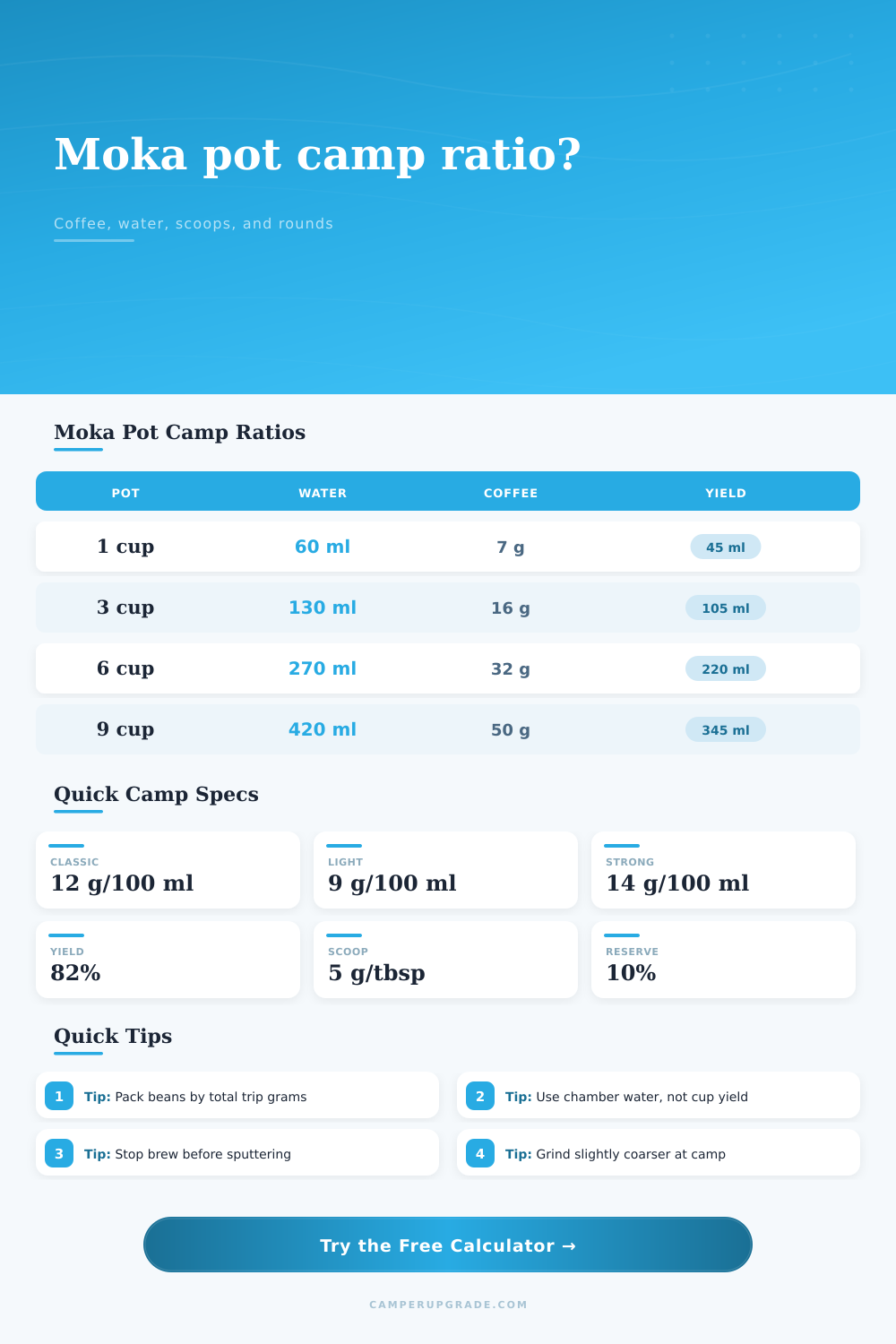
| Moka pot size | Typical chamber water | Classic dose at 12 g/100 ml | Typical brewed yield at 82% |
|---|---|---|---|
| 1-cup | 60 ml / 2.0 fl oz | 7.2 g | 49 ml |
| 2-cup | 90 ml / 3.0 fl oz | 10.8 g | 74 ml |
| 3-cup | 130 ml / 4.4 fl oz | 15.6 g | 107 ml |
| 4-cup | 170 ml / 5.7 fl oz | 20.4 g | 139 ml |
| 6-cup | 270 ml / 9.1 fl oz | 32.4 g | 221 ml |
| 9-cup | 420 ml / 14.2 fl oz | 50.4 g | 344 ml |
| 12-cup | 650 ml / 22.0 fl oz | 78.0 g | 533 ml |
| Strength profile | Dose formula | 3-cup dose | Best camp use |
|---|---|---|---|
| Light trail brew | 9 g per 100 ml water | 11.7 g | Long morning sips |
| Balanced camp brew | 11 g per 100 ml water | 14.3 g | Shared breakfast |
| Classic moka brew | 12 g per 100 ml water | 15.6 g | Default moka flavor |
| Strong morning brew | 14 g per 100 ml water | 18.2 g | Short, bold cups |
| Milk concentrate | 16 g per 100 ml water | 20.8 g | Iced or milk drinks |
| Camp measure | Metric equivalent | Imperial equivalent | Calculator use |
|---|---|---|---|
| 1 level tablespoon grounds | About 5 g | 0.18 oz | Scoop count |
| 1 fluid ounce water | 29.57 ml | 1 fl oz | Water conversion |
| 1 moka demitasse | 50 ml | 1.7 fl oz | Serving count |
| 1 half camp mug | 150 ml | 5.1 fl oz | Shared cup fill |
| 1 full camp mug | 240 ml | 8.1 fl oz | Large serving check |
| Elevation | Approx water boil point | Moka adjustment | Flavor note |
|---|---|---|---|
| Sea level | 100°C / 212°F | Use normal low flame | Full extraction window |
| 1,000 m / 3,281 ft | 96.7°C / 206°F | Preheat water helps | Slightly softer brew |
| 2,000 m / 6,562 ft | 93.3°C / 200°F | Use finer end of moka grind | May taste lighter |
| 3,000 m / 9,843 ft | 90.0°C / 194°F | Favor stronger ratio | Shorter extraction |
A camping trip revolves around coffee the first morning. You’re cold, tired, but you crave that caffeine ASAP. That’s why a moka pot is a good option: it’s tough, heavy, and produces strong coffee. But using one properly can be tricky. Get your ratios off and your coffee will taste watery (or just bad).
Avoid these errors with the moka pot camp ratio calculator. You’re probably thinking: Brewing with a moka pot is easy, I just put some coffee and water inside and wait. True. At home this is no big deal, since it’s easy to correct mistakes. On the road however, there’s just one opportunity per day.
How to Use the Moka Pot Calculator for Camping
Enter the trip length and your pot size into the calculator, and it will do all the math for you. No need to guess which conversions applies. Most importantly, it forces you to plan out the brew before packing the beans.
People often don’t understand how moka pots works, and that makes them think they’ve run out of coffee when really all they ran out of was water. Because, see, when you use a moka pot some of your water goes into the bottom chamber and some goes into grounds, and then some evaporates. Most times, you end up getting roughly eighty-two percent of what you put in as coffee. So if you’re planning based off the amount of water you poured in, you’ll be finished with coffee long before you’re done with beans. The tool includes this loss automatically. It’ll give you a reasonable number of servings, something that’s missed by a lot of people.
And then there’s strength. How strong do you like your coffee? Most people don’t think about it, but when you get into camping, that becomes a variable. Usually, a normal brew ratio involve twelve grams of coffee per one hundred milliliters of water. That’s fine in camp, too, except for situations where water boils at a lower temp (i.e., at altitude), which means extraction takes less time. In this case, the coffee will be under-extracted and taste thin. To compensate, you can increase the amount of grounds used, or perhaps go finer to ensure that there’s some flavour in your mug. The calculator allow for this adjustment as well.
Finally, remember that this isn’t all about backpacking but it does come into play there. If you’re hiking and packing weight matter, carrying extra beans adds up over a long trip. There’s a reserve percentage option in the calculator. No, it’s not only for waste. Sometimes things don’t work out perfectly with brewing the first time. Sometimes you find yourself wanting to make an additional pot. That second pot will require more fuel and water which can be covered by a ten percent reserve. A ten percent reserve is usually enough to cover these variables without punishing your back.
On the page are some reference tables which give you the standard dose for each size of pot. These allow you to see whether what you’re putting in makes sense. For example, for a six-cup pot the standard fill is about two hundred and seventy milliliters. That’s what the calculator uses as default, but maybe your pot is older than that? Maybe you like it lighter (or heavier)? You can adjust comfortabley.
Lastly, think about grind. A typical level tablespoon will weigh roughly five grams, which is what the calculator assumes. But this isn’t exact; it depends on the roast and density of the beans. For camping, close enough, but if you’ve got a small scale, use it at home to determine how much your spoon weighs. Adjust the input value in the calculator accordingly, so that it knows exactly how many tablespoon you’ll need for each brew. No guessing required.
A cup of coffee in camp is more than just fuel. It’s about starting your morning off with one of your favorite comfort objects, and having confidence it’ll be right is part of the comfort. There’s no need to wonder whether you’ve got the ratio right. There should be no doubt. You would of wanted to know it’ll work out. That’s why we made the calculator; so there’s no wondering anymore.
So there are no variables anymore, just a clear plan for how much to pack, how to fill the chamber, what yield you can expect. Then you can enjoy your first cup of hot deliciousness. Everything else is just logistics.