Mechanical Advantage Calculator
Estimate theoretical MA, real-world actual MA, required haul force, and main anchor load for rope haul systems, recovery lines, and campsite rigging.
Mechanical advantage estimate
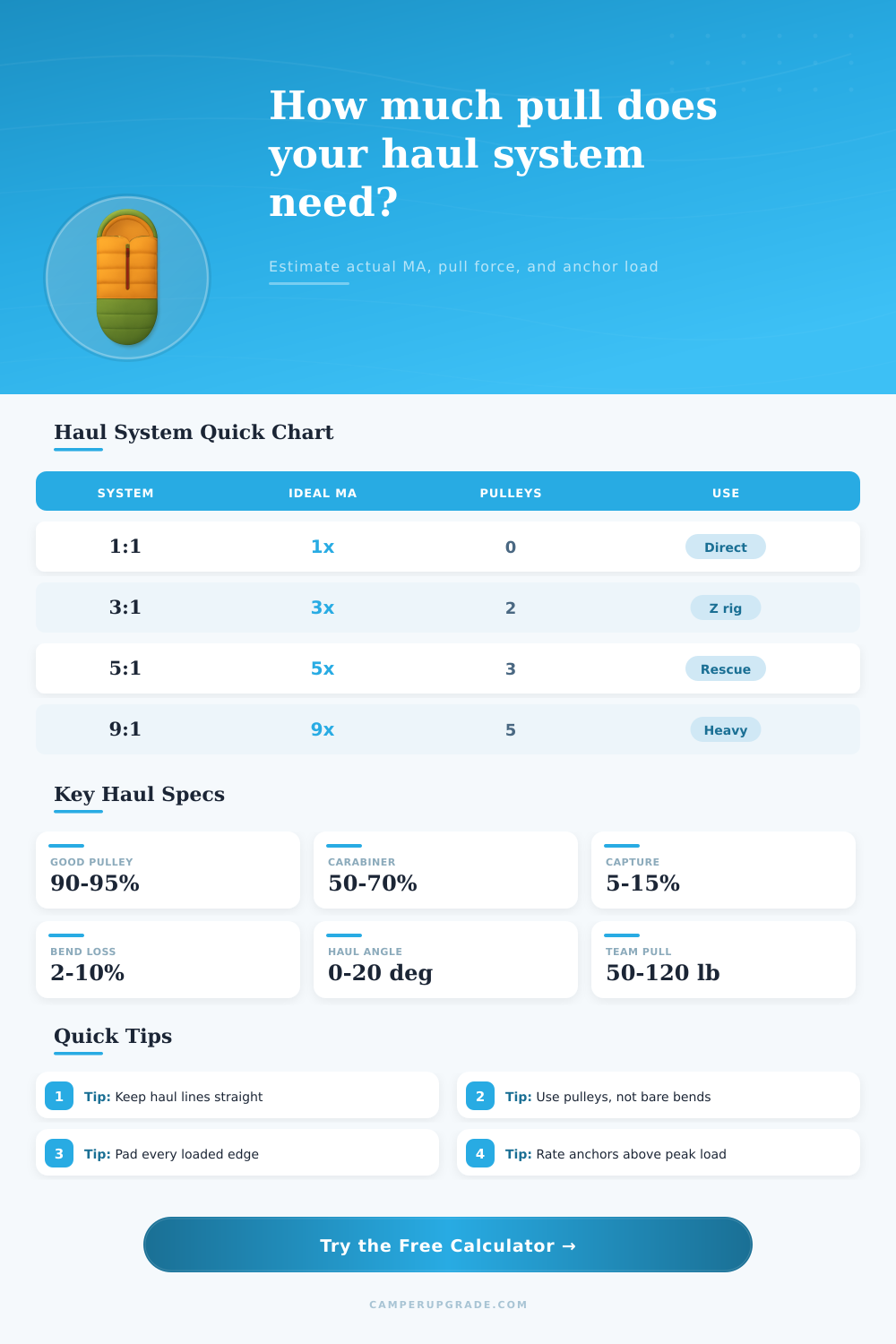
| System | Ideal MA | Typical pulleys | Best field use |
|---|---|---|---|
| Direct pull | 1:1 | 0 | Short drags with low friction |
| Single redirect | 1:1 | 1 | Change pull direction |
| Moving pulley | 2:1 | 1 | Simple lift or ramp assist |
| Z-rig | 3:1 | 2 | Stuck gear, sled, small boat |
| Simple tackle | 4:1 | 3 | Bank haul or trailer assist |
| Compound haul | 5:1 to 6:1 | 3-4 | Heavier recovery with less team force |
| Compound Z-rig | 9:1 | 5 | High load, slow progress |
| Piggyback haul | 12:1 | 6 | Very heavy load with careful anchors |
| Hardware or bend | Typical efficiency | Loss to enter | Field note |
|---|---|---|---|
| Ball-bearing pulley | 92-96% | 4-8% | Best for high MA systems |
| Bushed rescue pulley | 85-92% | 8-15% | Good all-around field choice |
| Small utility pulley | 75-85% | 15-25% | Watch heat and side loading |
| Carabiner redirect | 50-70% | 20-35% | Useful but costly in force |
| Edge or bark rub | Variable | 10-40% | Pad and redirect if possible |
| Progress capture | 85-95% | 5-15% | Depends on device and rope |
| Angle off haul line | Useful force | Loss | Practical read |
|---|---|---|---|
| 0° | 100% | 0% | Ideal straight pull |
| 10° | 98% | 2% | Usually fine |
| 20° | 94% | 6% | Still workable |
| 30° | 87% | 13% | Reposition if possible |
| 45° | 71% | 29% | Large force penalty |
| 60° | 50% | 50% | Poor haul direction |
| Load | Actual MA | Required pull | Main anchor estimate |
|---|---|---|---|
| 200 lb | 2.4:1 | 83 lb | 365-450 lb |
| 300 lb | 2.3:1 | 130 lb | 545-690 lb |
| 500 lb | 3.1:1 | 161 lb | 820-980 lb |
| 800 lb | 4.0:1 | 200 lb | 1,300-1,600 lb |
| 1,200 lb | 5.0:1 | 240 lb | 1,900-2,300 lb |
| 2,000 lb | 6.0:1 | 333 lb | 3,100-3,800 lb |
Mechanical advantage are a mathematical concept that allows a person to calculate the force that they can reduce to move a load. Mechanical advantage is useful in that it allow human to move heavy loads with less force and effort. However, factors such as friction and angle of the systems that is used often reduce mechanical advantage.
A person may calculate the mechanical advantage that a pulley system provides. However, the actual mechanical advantage that humans experience during the process may be less due to friction and other loss factor that reduce the effectiveness of the mechanical advantage. A team can use a calculator to calculate the force that is required to accomplish a given mechanical advantage by entering the weight of the load that is to be moved, the type of system that is to be utilized, and the various loss factors of the system.
Mechanical Advantage in Pulley Systems
Each of these loss factors will reduce the amount of force that is able to move the load. One of these factors is pulley efficiency. Pulley efficiency is based upon the type of hardware that is used in the system.
For instance, a sealed ball-bearing pulley will have high efficiency in that the ball-bearing system allows the rope to move through with very little friction and resistance. In contrast, a carabiner will have low efficiency in that the carabiner create high friction for the rope moving in that device. Any time that the rope passes through a device that has low efficiency for movement of the rope will result in friction loss for the system.
Additionally, the rope often makes bends in the system that create friction between the rope and the non-rotating surface. The percentage of friction loss due to these bends can be estimated based off the roughness of the surface of the object upon which the rope makes these bends. Finally, the angle at which the rope is pulled also has a loss factor for the system.
Any pull that is not straight from the haul strand will lose some of its mechanical advantage. Any angle for the pull that is not straight will cause the team to waste some of there pulling force. Another loss factor is the loss that occurs due to the capture devices of the system.
For instance, if the system includes a ratchet or a cam device that holds the rope between the pulls, it will create a loss of efficiency of that system. Though the resistance created by these devices is small when only using the system for a single pull, it will become a significant problem during long hauls of the load. The calculator includes this factor in the calculation of total efficiency to calculate the forc
You should use a safety factor to increase the target rating for the anchor.
While adding more strands to a pulley system will increase the theoretical mechanical advantage for the system, the number of friction points will also increase. A system with a high degree of mechanical advantage, like a nine-to-one system, can allow a person to move a very heavy load with very little force. However, a high degree of mechanical advantage also means that the system will require a lot of rope travel to move the load.
High degrees of rope travel, however, will require the team to reset the system many times. A team may opt for a three-to-one system instead of a nine-to-one system if it can allow them to finish their job faster; even if it requires more force to move the load with a three-to-one system. The calculator will provide the force numbers for each scenario, but will not indicate if the team has the space and time to perform the resets required of high degrees of mechanical advantage.
Many people make mistakes when they are setting up their system to provide mechanical advantage. One such mistake is to use a carabiner to redirect the rope instead of using a pulley. A carabiner will allow the rope to change direction, but it will create a large amount of friction in the system, reducing its efficiency.
Using a pulley would require less effort from the team. Another common mistake is to ignore the angle at which the team members will pull on the rope. If the team pulls the rope at an angle, the team will waste some of their strength since the force is not directed towards the load.
It is more efficient to move the anchor to straighten the pull of the rope. The reference materials will provide information that will assist the team with their decisions regarding rigging. The efficiency ranges for different types of hardware will help them to make an informed decision regarding whether to use a pulley or a carabiner.
The angle table will allow them to know how much force they will waste if they dont straighten the rope prior to pulling. The system comparison table will help them to decide which system to employ based upon the characteristics of the load that they are moving. While none of these tools will replace the experience that a team member has with rigging, they will assist in their understanding of how the calculations relates to the force that they will feel in their rope.
A person must also remember that the real world is not always the same as the calculations made by the mechanical advantage calculator. The load may be heavier than calculated due to the load being wet or embedded into the ground. The anchor may move from its set position once the load is pulled.
Team members may not be able to pull with the same force as calculated. However, the load calculator will help a person to name these variables. Should the person calculate that they will not have enough force to move the load, they will have to change their plan for rigging the load.