Meal Calorie Density Calculator
Calculate trail meal calorie density from total calories, packed food weight, packaging, moisture, reserve margin, meal split, and daily carry targets.
🍜Trail Meal Presets
⚙Meal Density Inputs
📊Calorie Density Spec Grid
📘Reference Tables
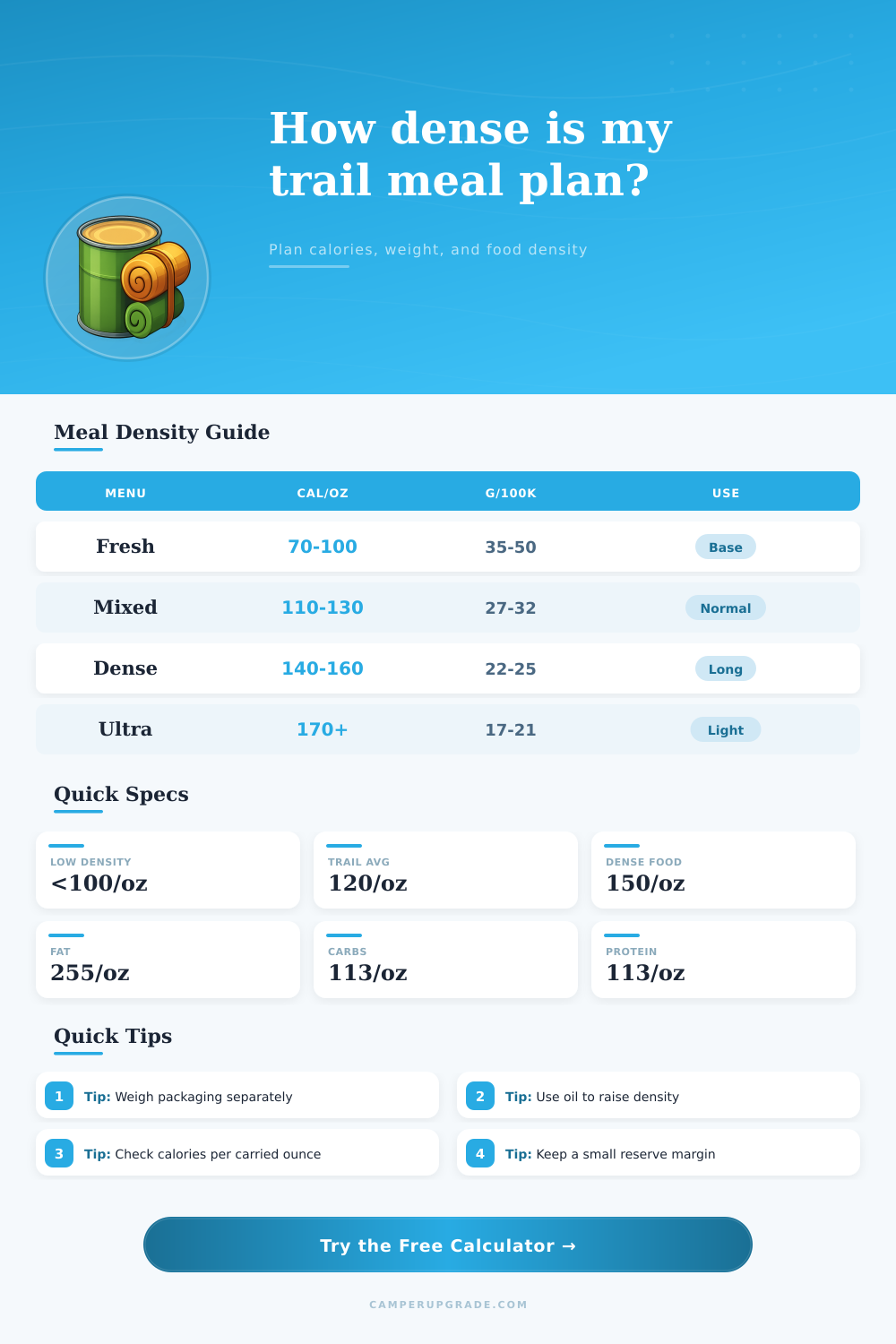
| Density Class | Cal/Oz | Kcal/100 G | Best Use |
|---|---|---|---|
| Fresh or cooler-heavy | 60 to 95 | 212 to 335 | Short campground meals where food weight matters less |
| Standard mixed grocery | 100 to 125 | 353 to 441 | Weekend trips, vehicle camping, and moderate backpacking |
| Dehydrated trail menu | 126 to 155 | 445 to 547 | Multi-day hiking, bikepacking, and compact resupply boxes |
| Fat-forward compact menu | 156 to 185 | 550 to 653 | Long carries where every packed ounce is scrutinized |
| Specialized high-fat add-on | 186+ | 656+ | Oil, nut butter, hard cheese, and calorie boosters |
| Food Type | Typical Cal/Oz | Kcal/100 G | Planning Note |
|---|---|---|---|
| Olive oil or ghee | 240 to 255 | 847 to 900 | Very dense, but needs leakproof handling |
| Nut butter packets | 160 to 180 | 565 to 635 | Dense snack or meal booster with easy portioning |
| Trail mix with nuts | 140 to 170 | 494 to 600 | Reliable no-cook calories for snack blocks |
| Freeze-dried entree | 110 to 140 | 388 to 494 | Packaging can reduce carried density |
| Instant rice or oats | 105 to 115 | 371 to 406 | Light dry base, usually needs added fat |
| Fresh fruit or wet pouch | 15 to 80 | 53 to 282 | Useful variety, poor density for long carries |
| Calories Needed | At 100 Cal/Oz | At 125 Cal/Oz | At 150 Cal/Oz |
|---|---|---|---|
| 2,000 cal | 1.25 lb | 1.00 lb | 0.83 lb |
| 2,500 cal | 1.56 lb | 1.25 lb | 1.04 lb |
| 3,000 cal | 1.88 lb | 1.50 lb | 1.25 lb |
| 3,500 cal | 2.19 lb | 1.75 lb | 1.46 lb |
| 4,000 cal | 2.50 lb | 2.00 lb | 1.67 lb |
| Meal Pattern | Daily Calories | Meals | Snack Blocks |
|---|---|---|---|
| Campground light | 2,200 | 3 x 530 | 2 x 305 |
| Backpack steady | 3,000 | 3 x 720 | 2 x 420 |
| Long-mile hiking | 3,600 | 3 x 840 | 3 x 360 |
| Winter effort | 4,300 | 4 x 780 | 3 x 393 |
| Family shared box | 9,000 | 9 meal parts | 6 snack parts |
Formula notes: 1 ounce equals 28.3495 grams. Kcal per 100 g equals calories per ounce multiplied by 3.5274. Target weight equals adjusted calories divided by target calories per ounce, then converted back to your selected unit.
🧭Density Planning Tips
When planning foods for a multi-day trip, it is important to consider both the weight of the food that you will be taking and the calorie densities of that food. The calorie density of a food items is a measurement of the number calories that the food contains within a specific weight. It is important to consider the calorie density of the foods that you plan to take because foods that has a high calorie density will provide you with the energy that you need without adding to the total weight that you must carry with you on your trip.
Conversely, if you select foods that has low calorie densities, you will have to carry the food with you at a higher total weight in order to provide your body with the same amount of energy. In preparing food for a trip, many individuals will calculate the amount of calories that they needs each day by multiplying a set number of calories by the number of days that they will be traveling. The total weight of the foods that you take on a trip will, however, change depending off the type of food that you choose to bring on the trip.
Packing Food for a Multi-Day Trip
Foods that contain a high amount of water, for instance, will add to the total weight that you must carry without adding to the energy that your body can recieve from those foods. Foods that have a low amount of water within them, like nuts and oils, has a high calorie density because they contain a high amount of calories without adding to the total weight of the food that you take on your trip. The calculator that can be found on this page will allow you to mathematically calculate the calorie density of the foods that you plan to take on your trip.
The calculator will ask for the total weight of the food that you plan to take, the percentage of that weight that comes from packaging and moisture content, the total number of calories that you require each day, and the target calorie density that you wish to reach with the food that you plan to take. The calculator will display to you the calorie density of your food plan and allow you to compare that density to your target calorie density. This allows you to understand whether the foods that you plan to take are high in calorie density or low in calorie density without having to perform the calculations yourself.
There are a few factor that can play a role in the total calories of edible food that you will need to carry with you on your trip. One of the factors is the weight of the food packaging; you will have to carry the food packaging itself, but it does not provide any calories for your body to use for energy. Another factor is the moisture content of the foods that you take on the trip.
Foods with high moisture content will add to the weight that you have to carry but will not add to the amount of energy that you receive from your food. Finally, you will have to account for the calories in a reserve margin for your food plan; this is the additional food that you will take in case you encounter delays in the trip or if you need to perform extra physical effort during your trip. If you set the reserve margin too low, you may not have enough food for your trip, but if you set it too high, you will be carrying more weight than you need with the food that you take.
In planning your meals, there are a few factor that will change how the foods that you plan to take will actualy be consumed. For instance, your appetite may decrease if the weather is hot but increase if the weather is cold or if you are performing extra physical effort during your trip. Additionally, individuals has different preferences for the type of meals that they consume; some individuals may prefer foods that contain a high amount of fat but others may require a higher volume of food in order to feel satisfied.
Thus, there is a chance that the meal plan that you calculated on paper will not work if your food plan does not match your eating habit while you are tired. To accommodate for this, there is a menu-style adjustment within the calorie density calculator that will allow you to adjust your target calorie density according to your eating preferences. The reference tables located on this page allow you to see how calorie dense the different types of foods are.
Foods like olive oil and nut butters are very high in calorie density because they contain almost no water. Freeze-dried meals are of medium calorie density because while the meals contain little water, the packaging for the meals is still an additional weight that must be carried. Finally, foods like fresh produce and wet food pouches are of low calorie density because they contain a high amount of water.
You should not make high calorie density of the food that you take on your trip your only goal. Foods that are extremely high in calorie density may be monotonous and may not provide enough volume of food that will make you feel full. Therefore, you should aim to find a calorie density that allows for your pack to remain of a reasonable weight while your meals are still satisfying.
The weight of your pack can be seen in the calculator in different scenarios with the food that you may consume so that you can find a balance between weight of your pack and your level of satisfaction with the meals that you eat on the trip. In addition to the calorie density of the foods that you take on your trip, you may wish to consider how you would like to divide the food that you take throughout your trip. You may wish to portion your food into full meals that you consume throughout your trip and break your food into snack blocks to consume at different times throughout the day.
If you place too many calories within meals like breakfast and dinner, for instance, you may be hungry for long periods during your trip. By adjusting the percentage of your food that is made up of meals and snack blocks, you can find a balance that maintains your energy level throughout your trip without changing the total number of calories that you carry with you. When you use the calorie density calculator to create food plans for different scenarios, you will begin to notice some pattern to the food items that you select.
For instance, you may notice that certain foods provides an increase to the calorie density of your plan while having little effect on your level of satisfaction of the meals that you plan to prepare. Additionally, you may notice that reducing the weight of your food packaging or the amount of moisture content in your foods will reduce the total weight of your pack; reducing the weight that you must carry on your trip is one of the reason for using such a calculator. The goal in creating a plan for your food with such a calculator is not to create a food plan with the highest possible calorie density.
Instead, your goal should be to create a food plan that contains enough fuel to keep you active, that will remain of a manageable weight for your trip, and that contains foods that you enjoy to eat on the trip. Additionally, because the calculator removes the need for you to perform the mathematical calculations, you can focus on creating the food plan that you would like to have while on your trip.