🌳 Maple Firewood BTU Calculator
Estimate usable heat from maple cords, moisture, split size, and stove efficiency with realistic stacked-wood math.
| Condition | BTU/Cord | Weight | Note |
|---|---|---|---|
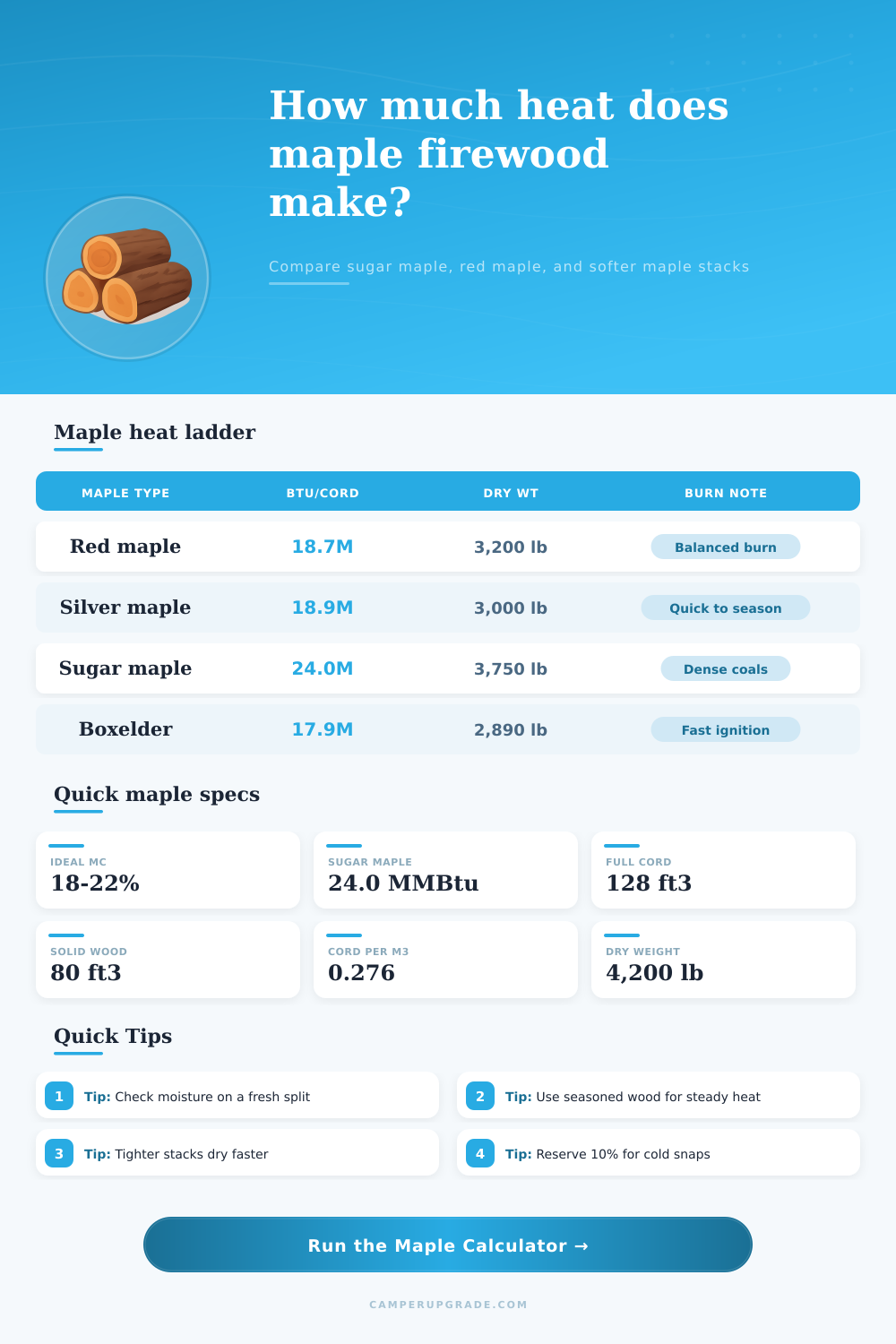
| Red maple | 18.7 MMBtu | 3,200 lb | Balanced burn |
| Silver maple | 18.9 MMBtu | 3,000 lb | Quick to season |
| Sugar maple | 24.0 MMBtu | 3,750 lb | Dense coals |
| Boxelder | 17.9 MMBtu | 2,890 lb | Fast ignition |
| Measure | Cord Eq. | Stack Ft3 | Use |
|---|---|---|---|
| Full cord | 1.00 | 128 | Base unit |
| Face 16 | 0.33 | 42.7 | Short wall |
| Face 18 | 0.38 | 48.0 | Common rack |
| Face 24 | 0.50 | 64.0 | Deep rack |
| Moisture | Factor | Split | Burn note |
|---|---|---|---|
| 12% | 1.05 | Small | Very dry |
| 18% | 1.01 | Medium | Ready |
| 24% | 0.93 | Large | Wet edge |
| 30% | 0.84 | Rounds | Hard start |
| Task | BTU/hr | Hours | Note |
|---|---|---|---|
| Small cabin | 8,000 | 8-12 | Easy load |
| Main heat | 12,000 | 6-10 | Typical stove |
| Cold snap | 16,000 | 4-8 | Hard burn |
| Night bank | 20,000 | 3-6 | Deep coal |
Measure moisture on a fresh split, not the outside shell.
Use the lower BTU result for cold weather planning.
Maple wood can be used as a fuel source to heat homes. The quality of the heat that the maple wood provides depend upon the cut of the maple wood, the way that it is stacked, and for how long the maple wood is seasoned. If the maple wood isnt seasoned correct, then the energy that is released from the burning of the wood will be used to evaporate water from the wood instead of providing heat to the room in which it is burning.
Sugar maple wood contain more energy per pound than silver maple or boxelder woods. The silver and boxelder woods is softer woods, and they ignite quick but dont burn for long periods of time. Red maple wood is a different type of wood with the same genus as sugar maple.
Using Maple Wood to Heat Your Home
Although red maple wood is easier to find and to season, it does not stay burning as long as sugar maple wood do. Because every wood pile are different, it is important for individuals to understand the characteristics of the wood pile they plan to use for heating there homes. Another important factor to consider with maple woods is the moisture content of the wood.
Fresh-cut maple woods can contain up to forty percent water. Thus, the fire will have to expend energy to boil the water out of the maple wood before it can begin to release heat into the home. The moisture content of the maple wood should ideally be between eighteen and twenty-two percent water.
To determine the moisture content of the maple wood, an individual can split the wood and test a sample of the wood. The outer shell of the wood pile may be dry, but the interior wood may contain more moisture. Another important factor is the seasoning time of the maple wood.
The majority of maple wood types will require a minimum of twelve month to season under cover. If the summer months within which the maple wood is seasoned are wet months in the area where the wood is harvested, it is possible that the maple wood may require more than twelve months to season properly. Smaller splits of maple wood will dry faster than large chunks of maple wood.
Additionally, the wood may be stacked in such a way that allows for the wood to dry; however, a tight stack that allows for some airflow will dry the wood the fastest. Sixteen inches for the depth of the wood stack is considered the ideal depth for allowing the maple wood to dry. Additionally, the bark that is present on the wood will burn hot within the fireplace.
However, the burning of the bark will produce dirty smoke. The efficiency in which the heating appliance will burn the maple wood will affect the amount of heat that is released from the fire. For instance, moddern stoves can be seventy-five percent efficient at burning maple wood.
However, open hearths may only be thirty percent efficient at burning maple wood. Additionally, if there are common cold weather months in the area where the individual intends to heat their home with the maple wood, they should ensure that there is a ten percent reserve of maple wood as a backup in case the heating appliance does not reach the necessary temperature. Depending upon the use that they will make of the maple wood, individuals can use different types of maple wood.
For instance, red maple wood can be used to start fires in the morning. However, sugar maple wood can be used to start fires that will burn throughout the night. In each case, the smaller the improvement in one variable, such as moisture content or density of the maple wood, the greater the improvement in the heat that the maple wood will release.
When measuring the amount of maple wood that will be used for heating, it is important to ensure that the maple wood is measured properly. A cord of maple wood contain one hundred twenty-eight cubic feet of maple wood. However, face cords will not contain as much maple wood as a full cord.
Additionally, loose piles of maple wood will contain air gaps that will take up twenty percent of the total amount of volume of maple wood that is measured. When measuring maple wood, ensure that the length, height, and depth of the maple wood are measured so that the volume of maple wood can be determined. By measuring the amount of maple wood that will be used, the number of hours that the maple wood will provide heat for the home can be calculated.
Another factor to consider when burning maple wood is that different types of maple wood can assist with starting the fire. For instance, people often use boxelder wood as kindling for fires because it easily ignites. Additionally, silver maple wood can be used in conditions where the wood needs to dry quick.
In addition to the type of maple wood that will be burned, there are tradeoffs that can be made between the different types of maple wood. For instance, there are tradeoffs between the density of the wood and the ease of drying maple wood. Additionally, another tradeoff that can be made is between the type of heat that is desired from the maple wood fire and the rate at which the maple wood will heat the home.
Environmental factors can impact the drying of maple wood. For instance, exposure to wind will dry maple wood faster if it is placed on an open rack. However, exposure to rain may soak the maple wood if it is not covered.
Additionally, the elevation at which the maple wood is placed may impact how fast the maple wood dries; dry air may allow the maple wood to season faster than if it were at an area with higher humidity. In order to ensure the maple wood stove reaches the temperatures necessary to heat the home, the individual should always test a piece of maple wood prior to utilizing the entire stack of maple wood. Additionally, the flame and ash that result from burning a portion of the maple wood can reveal important information about the wood.
For instance, dense coals indicate that the sugar maple wood is working as it should. However, flaky remnants of burned wood suggest that the maple wood may be too soft or may be wet. Another common mistake that can be made when using maple wood for heating is to ignore the bark that is on the maple wood.
The bark will burn hot within the fire place, but the smoke that is released can be dirty. Additionally, another common mistake is to overstack the maple wood without using a tarp to cover the wood pile. If maple wood is too deeply stacked, it will retain moisture.
An alternative is to elevate the maple wood on pallets so that the breeze can pass through the wood. Additionally, it is recommended that individuals always have an extra ten percent of maple wood in their reserves; the weather may not be as pleasant as the weather forecast predicts. Finally, another important factor in the consideration of maple wood as fuel is that maple wood is a sustainable fuel source.
Additionally, over time, it may prove to be more cost-effective than using propane for heating the home during the winter months. Finally, an individual can experiment with the different types of maple wood within the family. For instance, one can use half sugar maple wood and half red maple wood.
By tracking how many hours of burn time each type of maple wood provides, the individual may be able to create a system for burning wood that will effectively heat the home during the winter months.