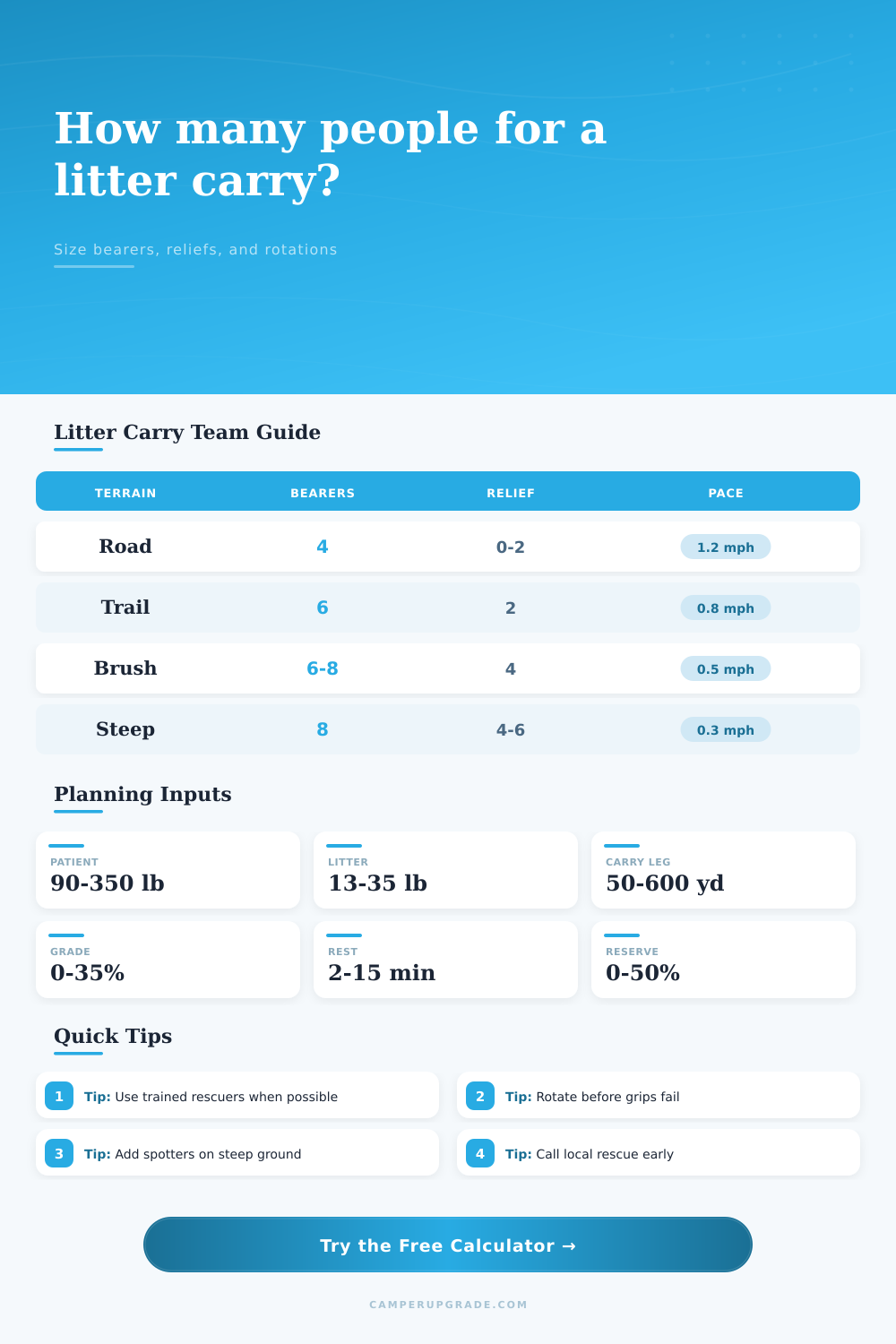
Litter Carry Team Size Calculator
Estimate how many carriers, relief carriers, spotters, and rotation cycles are needed for a stretcher or rescue litter carry over road, trail, brush, snow, sand, or steep ground.
| Terrain | Base pace | Active bearers | Relief guidance |
|---|---|---|---|
| Road or hard path | 1.1 to 1.4 mph | 4 | 0 to 2 for short moves; 2 for longer carries. |
| Maintained trail | 0.7 to 1.0 mph | 6 | 2 relief carriers for steady rotations. |
| Rough trail or roots | 0.45 to 0.7 mph | 6 | 4 relief carriers reduce grip fatigue. |
| Brush or off trail | 0.3 to 0.55 mph | 6 to 8 | 4 to 6 relief carriers plus a route scout. |
| Snow, sand, or scree | 0.25 to 0.5 mph | 6 to 8 | 4 to 8 relief carriers depending on depth. |
| Steep technical ground | 0.15 to 0.35 mph | 8 | Use rescue leadership, belay, spotters, and staged teams. |
| Load per active bearer | Carry quality | Best use | Planning action |
|---|---|---|---|
| Under 30 lb | Light | Training, short road moves, small patient | Speed may be limited more by patient care than load. |
| 30 to 45 lb | Moderate | Fit adults on maintained trail | Normal rotation interval usually works. |
| 45 to 60 lb | Heavy | Rough terrain or larger patient | Add active bearers or shorten carry legs. |
| 60 to 75 lb | Very heavy | Only brief moves by strong carriers | Increase team size and relief count. |
| Over 75 lb | Critical | Emergency repositioning only | Stop and rescale with trained rescue support. |
| Carry leg | Terrain fit | Why it works | Watch point |
|---|---|---|---|
| 50 yd | Steep, slick, brush, stairs | Frequent resets protect grip and footing. | Rest stops can dominate total time. |
| 100 yd | Rough trail or soft ground | Good balance of motion and recovery. | Needs organized relief positions. |
| 150 yd | Maintained trail | Common outdoor planning leg. | Shorten if load per bearer is high. |
| 300 yd | Road, firm path, gentle grades | Fewer handoffs and faster movement. | Grip fatigue can appear suddenly. |
| 600 yd | Very smooth route only | Works for wheeled or low-load carries. | Plan medical checks between legs. |
| Scenario | Distance | Typical team | Notes |
|---|---|---|---|
| RV site to park road | 0.1 to 0.3 mi | 4 to 6 | Short firm route, low relief need. |
| Camp loop to trailhead | 0.3 to 0.8 mi | 6 to 8 | Use one relief pair for fatigue control. |
| Singletrack trail evacuation | 0.8 to 2 mi | 8 to 12 | Narrow turns and roots slow transfers. |
| Creek bank or muddy approach | 0.2 to 1 mi | 10 to 14 | Add spotters and shorten carry legs. |
| Long backcountry carry | 2 to 6 mi | 12 to 20+ | Requires command, communications, and staging. |
Slick rocks make for a tricky hike and twisting an ankle is easy. The air’s fresh with the scent of pine needles and the sun warms your face, but then you see that person who can’t walk and you don’t know how you’re going to get him back to the trailhead in one piece. Then you think to yourself: I need four of my buddies to help me get this guy up and put him on a soft stretcher or backpack. It makes sense; until you attempt to do so. Grip strength wanes rapidly, the load move too far across an uneven surface, and it becomes a disorganized scramble. What saves him can also drop him.
Before anybody raises a finger, there’s planning. There’s terrain friction, rotation schedules, and pacing: all part of moving a litter. When you have two-hundred pounds (plus gear) being humped up switchbacks and around tree roots, most groups greatly under-estimate the rapid onset of fatigue.
How to Plan a Safe Rescue
Plug in the specifics of your route into the calculator. It will crunch the numbers for you. Save yourself the guesswork of wondering if you should bring 6 people. Or do we go with 12?” You’ll be forced to consider factors that spell success, not depend on heroics.
Unexpected terrain class catches many teams off guard. If it’s a nice gravel road, they’ll power along at an easy clip without much effort. When they hit loose scree or thick brush, it will greatly increase their exertion. Soft surfaces like muck slow your steps and feel like a brake on each stride. This type of surface require additional bearers to keep from sliding around.
Even if fit hikers believe they can conquer some nasty uphill, gravity will impact how they carry things. Terrain factors in footing quality and grade, so that you aren’t sending out volunteers to climb a forty five degree hill while under-supported. People commonly plan for distance, more than the vertical challenge.
There are also limitations to what humans can hold with their hands. It doesn’t matter how strong your grip is (holding a solid), rigid litter for thirty minutes straight will lead to failure. If carriers become fatigued, accidents occur. The best approach involve exchanging carriers before collapse. This reduces the carry leg; however, it increases the evacuation duration. It’s slow but it’s safe. It’s reliable under emergency conditions. You sacrifice speed for security.
A support staff doesn’t bear the load, but they keeps the team moving efficiently. Route scouting removes obstacles. Spotters help avoid slip-ups on steep terrain. While these folks don’t haul pack weight, they keep the team moving at a good pace. A reserve percentage added to your team keep fresh legs for when the main bearers give out. This prevents bottlenecks at rest points. Better that there are several people standing idle than everyone worn out half way up the hill.
Carrying an injured party in the backcountry demands both training and humility. Rushing can end up with everyone straining their backs. Further injury could of been caused to the patient. Planning well transforms what could have been a disaster into a controlled event. Weight distribution and human endurance is respected, keeping you focused on caring for the patient instead of trying to manage crises. Sizing your team for the most difficult ten minutes of the route, not for the easiest miles, helps. Everybody walks out under his or her own power, that’s the goal: everybody walks out safe.