Lithium Battery Sizing Calculator
Estimate daily energy, required LiFePO4 amp-hours, a recommended battery bank, BMS amp margin, and charging time from real camper load and battery settings.
Lithium battery bank estimate
| Preset bank | Nominal voltage | Rated energy | Typical BMS range |
|---|---|---|---|
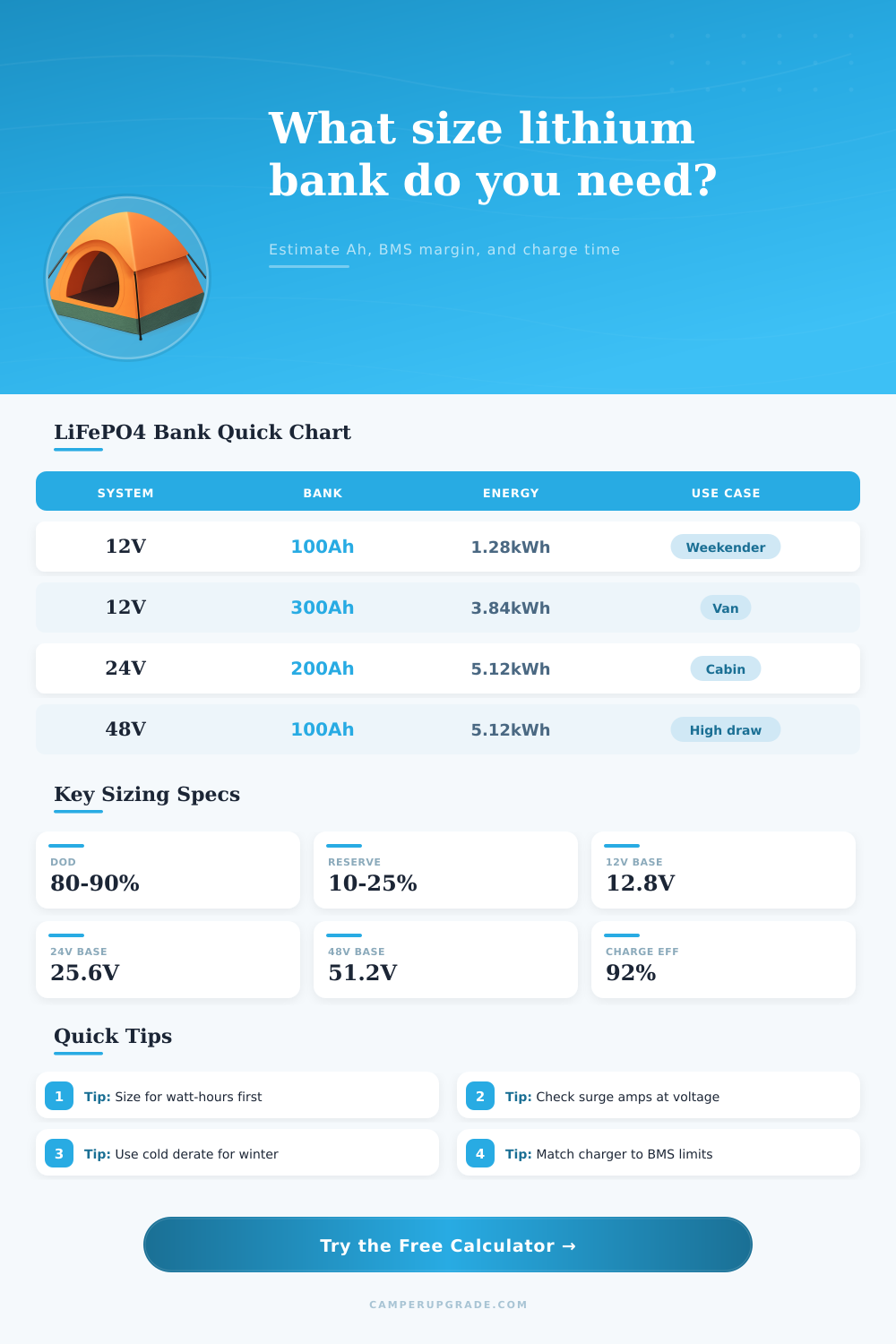
| 1 x 12V 100Ah lithium battery | 12.8V | 1.28 kWh | 100A continuous |
| 1 x 12V 200Ah lithium battery | 12.8V | 2.56 kWh | 150A to 200A continuous |
| 2 x 12V 100Ah in parallel | 12.8V | 2.56 kWh | 200A total continuous |
| 3 x 12V 100Ah in parallel | 12.8V | 3.84 kWh | 300A total continuous |
| 4 x 12V 100Ah in parallel | 12.8V | 5.12 kWh | 400A total continuous |
| 2 x 12V 100Ah in series | 25.6V | 2.56 kWh | 100A continuous |
| 24V 200Ah lithium bank | 25.6V | 5.12 kWh | 150A to 200A continuous |
| 48V 100Ah lithium bank | 51.2V | 5.12 kWh | 100A continuous |
| 48V 200Ah lithium bank | 51.2V | 10.24 kWh | 150A to 200A continuous |
| Inverter surge | 12V DC amps | 24V DC amps | 48V DC amps |
|---|---|---|---|
| 1,500 watts | 130A planning draw | 65A planning draw | 33A planning draw |
| 2,000 watts | 174A planning draw | 87A planning draw | 43A planning draw |
| 3,000 watts | 260A planning draw | 130A planning draw | 65A planning draw |
| 4,000 watts | 347A planning draw | 174A planning draw | 87A planning draw |
| 6,000 watts | 521A planning draw | 260A planning draw | 130A planning draw |
| Charge source | Common current | 12V charge watts | Planning note |
|---|---|---|---|
| Portable solar controller | 10A to 20A | 115W to 235W | Slow but useful for fridge and small loads |
| Roof solar MPPT | 30A to 60A | 350W to 705W | Good daily recovery if sun hours are realistic |
| DC-DC alternator charger | 30A to 50A | 350W to 590W | Predictable recovery while driving |
| High output DC-DC charger | 60A to 100A | 705W to 1,180W | Check alternator and BMS charge limits |
| Shore converter or inverter charger | 40A to 120A | 470W to 1,415W | Fastest when campground power is available |
| Planning condition | Cold derate | Routine DoD | Use in calculator |
|---|---|---|---|
| Heated interior battery bay | 0% to 5% | 80% to 90% | Normal three-season camper planning |
| Cool cabinet or under-seat box | 5% to 12% | 80% to 90% | Add reserve for shoulder-season nights |
| Unheated compartment above freezing | 10% to 20% | 75% to 85% | Useful for winter travel estimates |
| Near-freezing battery area | 20% to 35% | 70% to 85% | Use only with proper low-temp charge protection |
| Conservative emergency reserve | 25% to 40% | 60% to 80% | For remote trips with limited charging windows |
When you calculate how much energy your van appliance use, you find that every watt-hour must come from an power source. Most travelers use a lithium battery bank to power their travel van. The size of the battery bank must match the energy demands of your trip.
Otherwise, you have to start the engine more often or the inverter shut down. Because the chemistry of the batteries requires planning, you have to plan your bank carefully. The best way to start planning your lithium battery bank is to determine the energy consumption of your van in one day.
How to Size a Lithium Battery Bank for Your Van
Components like the fridge, lights, water pumps, and phone chargers all use energy. So does the inverter when you use a laptop or other small appliance. Each device draw energy in different patterns.
The fridge runs according to the ambient temperature of the van. Yet other devices tend to be used in clusters during the morning and evening. Adding these energy usage together gives you a total daily energy load.
Autonomy days determine the total amount of energy your battery bank must contain. If you select two days of autonomy, the calculator doubles the energy load for one day. The number of days of autonomy you use in the calculator depend on your driving habits.
If you drive the van every day, you require fewer days of autonomy. The person who camps in a remote location require more days of autonomy. You must decide how often you will use the solar panels, the alternator, or shore power to charge the lithium battery bank.
The voltage you use in the calculator determine your system’s wiring and components. Many people select 12 volts because they are familiar with the components. However, many use 24 or 48 volts to use smaller wires or large inverters.
You can use the voltage settings in the calculator to determine the amp-hour requirement for the battery bank at different voltages. The energy remains the same, but the system requirements for wires and components changes with the voltage. The depth of discharge and the cold derate settings determine the usable capacity of the lithium battery bank.
Lithium iron phosphate batteries can deliver 80 to 90 percent of the rated energy. However, the usable energy from the batteries shrinks if they are within a cold environment in the van. The cold derate setting account for the lowered chemical activity of the batteries in cold environments.
Always use a reserve margin in your plan for the energy needs of the van. The settings help determine how much energy you can use based on the environment in which you will travel. The BMS continuous rating and the inverter surge rating tell you whether your system can remain operational.
Inverters has a higher surge rating than their continuous output. The calculator determines the inverter surge in DC amps at the voltage you choose. This number is compared to the BMS rating of the lithium battery bank.
A positive margin indicate the battery bank can provide the inverter with the current it needs. A negative margin requires adding more batteries in parallel to the bank or buying a BMS with a higher rating. The charge time calculates how long it will take to replace the energy used by the vans appliances.
Using solar power, DC-DC alternator chargers, and shore power converters will charge the battery bank. The calculator will show you how long the charge current you choose will take to replace the energy used by your vans appliances. This number will show you whether the solar array you have is adequate or whether you will need to add an alternator charger.
The charge time setting in the calculator will show you how long it will take for the battery bank to replenish its energy at a specific rate. Many people make mistakes when purchasing a lithium battery bank. One group purchases one large battery bank to suit their budget.
However, the BMS cannot handle the surge from the inverter. Another group designs their battery bank to provide energy for the fridge only. However, they dont account for the energy used by the inverter and small appliances that run continuously.
Enter each category in the calculator so that the calculator accurately calculates the total energy requirement for your vans living space. The reference tables provide the configurations of the battery banks and BMS made by different companies. These tables display the scaling of the charge sources according to the voltage of the battery bank.
These tables will assist in deciding whether you will use a solar charge controller or a DC-DC inverter charger. The tables will not replace the manufacturer’s datasheets for the products but will provide context for the numbers. Most lithium battery banks has low-temperature protection for the charging of the batteries.
However, the available capacity of the battery bank does not increase in cold weather. The derate setting in the calculator for the lithium battery bank models the shrinking capacity of the battery bank in cold weather. However, the low-temperature protection of the battery limits the charging of the battery bank in cold weather.
If the van will be traveling in the winter months, place the battery bank in an insulated or heated compartment in the van. Ultimately, the calculator will allow you to design a lithium battery bank that match your travel habits. By testing the settings in the calculator, you can find the best setting for your needs.
Once you have determined the settings and the numbers you will use in the lithium battery bank, you can focus on the physical attributes of the battery bank. When sized appropriately, the battery bank will provide energy for the fridge and the lights in your van without having to pay close attention to the state of the battery bank.