🛡 Life Jacket Buoyancy Calculator
Estimate the lift needed to keep the airway clear across weight, clothing, gear, water, rescue delay, and fit.
📋Quick Presets
🧮Calculator Inputs
Use the dressed weight if you are already in foul-weather layers.
Add wet clothing, boots, or winter layers that soak up water.
Include radios, knife, flashlight, tools, and pocket items.
📋PFD Reference Grid
📘Buoyancy Standards
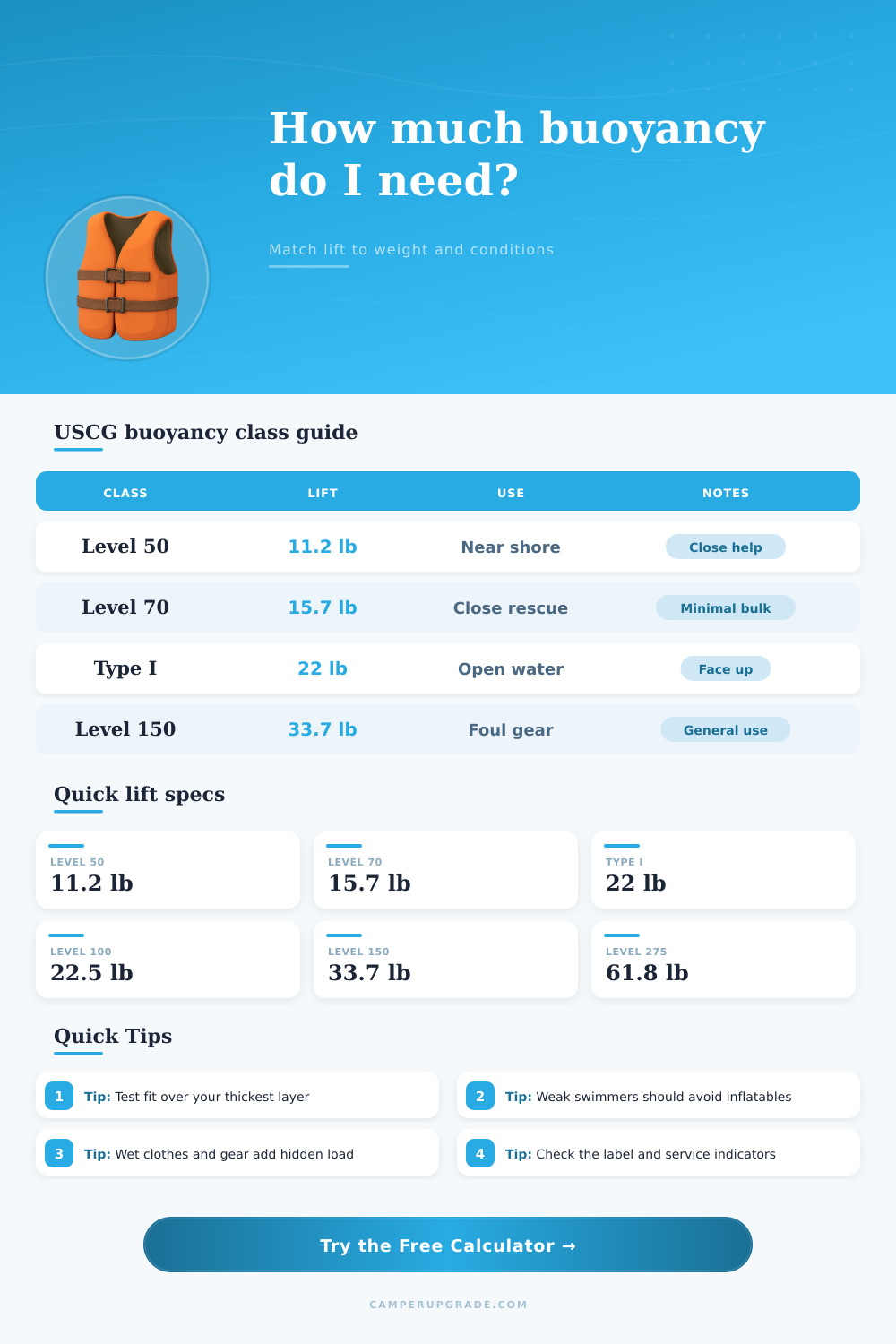
| Class | Min lift | Best use | Notes |
|---|---|---|---|
| Level 50 | 11.2 lb | Near shore | Close help |
| Level 70 | 15.7 lb | Short rescue | Low bulk |
| Type I | 22 lb | Open water | Face up |
| Level 150 | 33.7 lb | General use | Foul gear |
🌊Water and Activity Factors
| Scenario | Factor | Bonus | Use |
|---|---|---|---|
| Sheltered fresh | 0.95x | 0 lb | Easy calm |
| Coastal salt | 1.06x | 1.0 lb | Open chop |
| Cold chop | 1.14x | 2.5 lb | Long wait |
| Offshore swell | 1.28x | 4.5 lb | Extreme use |
🏊Swimmer and Fit Factors
| Profile | Factor | Fit note | PFD lean |
|---|---|---|---|
| Strong swimmer | 0.11x | Snug | Foam ok |
| Average swimmer | 0.13x | Normal | Hybrid ok |
| Weak swimmer | 0.16x | Bulky | Foam first |
| Non-swimmer | 0.19x | Loose | Foam only |
📦Clothing and Gear Penalties
| Item | Weight | Wet load | Notes |
|---|---|---|---|
| Tee and shorts | 2 lb | 1.3 lb | Warm day |
| Work layers | 6 lb | 3.9 lb | Wet hold |
| Deck gear | 4 lb | 3.2 lb | Tools |
| Winter suit | 12 lb | 7.8 lb | Cold load |
Buoyancy are the force that allows a person to float in water, and buoyancy is a critical factor to consider for safety if a person should fall into water. A life jacket provide buoyancy to a person who wears it, and that life jacket must provide enough buoyancy to keep that persons airway clear of the water. If a life jacket dont provide enough buoyancy, a person may struggle to keep there face above waves.
Thus, a person must consider the different factor related to water and weight when selecting a life jacket. The amount of buoyancy that a person in the water require depend upon the total weight of that person while in the water. A persons total weight while in the water is the weight of the persons body alone, as well as the weight of all of the persons clothing and gear.
How to Choose a Life Jacket
For instance, wet clothing like boots, pants, and jackets will add to the total weight of that person while in the water. Thus, a person must account for the weight of wet clothing. Additionally, gear like radios, tools, or a life raft will add to the total weight of that person while in the water, requiring the life jacket to provide more buoyancy to offset that additional weight.
A persons swimming ability while in the water will change the buoyancy requirement of that person. Strong swimmer are able to easily move through the water, whereas non-swimmers are not. Thus, strong swimmers may require less buoyancy then a non-swimmer.
Additionally, a person may become tired if they have to wait for rescue while wearing there life jacket. If a person becomes tired, they may not have the strength to remain afloat on their own. Therefore, their life jacket must provide enough buoyancy to keep them afloat if they are tired.
Life jackets are categorize according to the amount of buoyancy that they will provide to the individual wearing the life jacket. For instance, some life jackets are design to be used near the shore, and those life jackets may allow for easy movement by the wearer. Other life jackets are designed to be used in the open water, and those life jackets will provide more buoyancy to enable the life jacket to turn an unconscious person face up in the water.
Additionally, foam life jackets will provide constant buoyancy due to the solid nature of the foam, while inflatable life jackets will only provide buoyancy if the inflatable life jacket is activated. Thus, weak swimmers should of use foam life jackets rather than an inflatable life jackets. The environment in which a person is swimming will also affect the amount of buoyancy required by that person while wearing a life jacket.
For instance, saltwater is denser than freshwater, meaning that a person will experience more buoyancy in saltwater than they will in freshwater. Thus, a person who is swimming in freshwater will require a life jacket with more buoyancy than a person who is swimming in saltwater. Additionally, choppy water will create waves that may turn a person face down in the water, requiring more buoyancy from the life jacket to keep the persons face above the water.
Finally, it is important to ensure that a life jacket fits the wearer correctly; otherwise, the life jacket will not be able to function correctly. A life jacket should be worn over the clothing that the person will wear while in the water. If a person wears thick clothing, they will require a larger life jacket.
Additionally, a life jacket that is too large will allow water to enter between the person and the life jacket, increasing the wearers weight. Thus, the person should test the life jacket to ensure that it will fit the wearer properly, such as when raising their arms. Finally, inflatable life jackets should also be periodically check to ensure that they are properly maintained and ready for use.