Lentil Camp Cook Water Calculator
Estimate cooking water, reserve water, simmer time, pot volume, and cooked yield for lentils at camp.
Detailed water breakdown
| Lentil type | Base water per 1 cup dry | Usual covered simmer | Cooked yield per cup dry | Camp note |
|---|---|---|---|---|
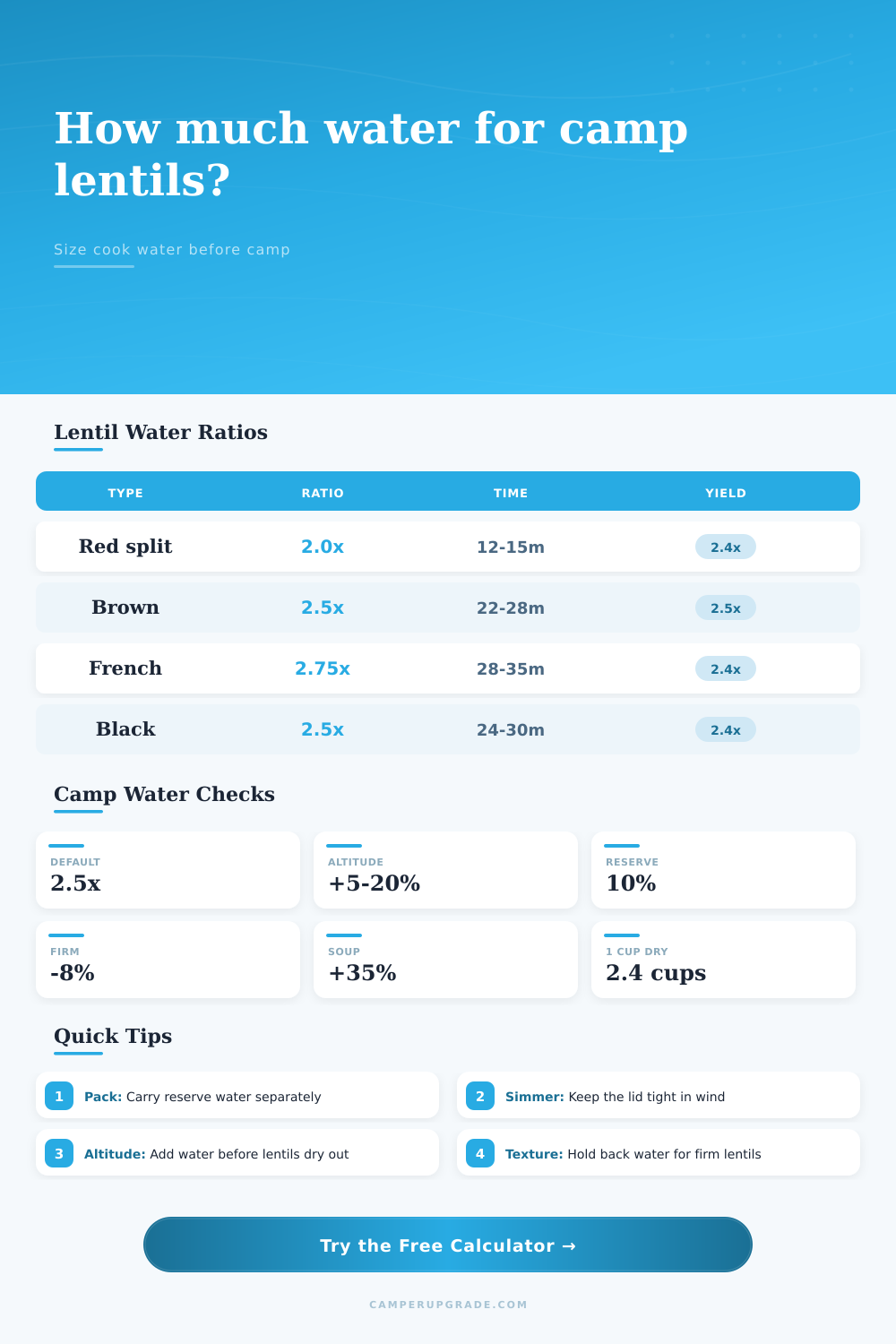
| Red split lentils | 2.0 cups / 480 ml | 12-15 minutes | 2.3-2.5 cups | Breaks down fast; best for dal and thick soup. |
| Brown whole lentils | 2.5 cups / 600 ml | 22-28 minutes | 2.4-2.6 cups | Reliable camp default for stew, bowls, and chili bases. |
| Green whole lentils | 2.5 cups / 600 ml | 24-30 minutes | 2.3-2.5 cups | Holds shape better than brown lentils. |
| French or Puy lentils | 2.75 cups / 660 ml | 28-35 minutes | 2.3-2.4 cups | Needs more water and time for a firm bite. |
| Black beluga lentils | 2.5 cups / 600 ml | 24-30 minutes | 2.3-2.5 cups | Good for compact bowls; avoid over-stirring. |
| Yellow split lentils | 2.25 cups / 540 ml | 18-24 minutes | 2.5-2.8 cups | Absorbs quickly and thickens as it rests. |
| Whole masoor lentils | 2.5 cups / 600 ml | 25-32 minutes | 2.4-2.6 cups | Soaking helps shorten trail simmer time. |
| Canned drained lentils | 0.35 cup / 85 ml | 5-8 minutes | Ready-to-heat | Add water only for reheating, sauce, or soup looseness. |
| Setting | Water factor | Time factor | Best use | Calculation detail |
|---|---|---|---|---|
| Covered camp stove pot | 1.00x | 1.00x | Default camp meals | Uses the base ratio for each lentil. |
| Wide backpacking pot | 1.08x | 1.02x | Small stoves and fast boils | Wide surface loses more steam. |
| Pressure cooker | 0.72x | 0.45x | Van kitchens and RVs | Less evaporation, faster softening. |
| Thermal hold | 1.12x | 1.20x | Fuel saving after boil | Extra water supports passive carryover cooking. |
| Loose soup or stew pot | 1.30x | 1.05x | Brothy meals | Includes liquid meant to remain in the bowl. |
| Shallow skillet simmer | 1.18x | 1.08x | Small one-burner setups | Evaporates quickly and needs more watching. |
| Input | Choice | Water change | Time change | Why it matters |
|---|---|---|---|---|
| Altitude | 0-2,000 ft | 0% | 0% | Normal boil temperature for camp cooking. |
| Altitude | 2,000-5,000 ft | +5% | +8% | Lower boil temperature slows hydration. |
| Altitude | 5,000-8,000 ft | +12% | +18% | Longer simmer means more evaporation. |
| Altitude | 8,000+ ft | +20% | +30% | Keep reserve hot and add before the pot dries. |
| Soak | Quick 30 minute soak | -3% | -8% | Small reduction for split or whole lentils. |
| Soak | Trail 2 hour soak | -6% | -15% | Useful for firm brown, green, and black lentils. |
| Soak | Overnight soak | -10% | -25% | Best for whole masoor or cold-soaked starts. |
| Lid | Uncovered or windy pot | +12% to +18% | +3% to +6% | Steam loss changes water more than timing. |
| Camp meal | Dry lentils | Starting water | Reserve water | Expected yield |
|---|---|---|---|---|
| Solo red dal mug | 0.5 cup / 80 g | 1.0 cup / 240 ml | 0.1 cup / 25 ml | 1.2 cups cooked |
| Two-person brown stew | 1.0 cup / 160 g | 2.5 cups / 600 ml | 0.25 cup / 60 ml | 2.5 cups cooked |
| Family green lentil pot | 2.0 cups / 320 g | 5.0 cups / 1.2 L | 0.5 cup / 120 ml | 4.8 cups cooked |
| French lentil salad base | 1.5 cups / 240 g | 4.1 cups / 990 ml | 0.4 cup / 100 ml | 3.5 cups cooked |
| Yellow split soup night | 1.5 cups / 240 g | 3.4 cups / 810 ml | 0.3 cup / 80 ml | 4.0 cups cooked |
| Rice-lentil one-pot | 1.0 cup / 160 g | 3.2 cups / 770 ml | 0.3 cup / 75 ml | 3.0 cups meal base |
| Total starting contents | Minimum pot size | Comfortable pot size | Water bottle equivalent | Use case |
|---|---|---|---|---|
| 1.5 cups / 360 ml | 0.6 L | 0.75 L | Small mug bottle | Solo side serving |
| 3 cups / 720 ml | 1.0 L | 1.2 L | One 1 L bottle | Two-person meal base |
| 5 cups / 1.2 L | 1.7 L | 2.0 L | One large bottle plus reserve | Small family pot |
| 7 cups / 1.7 L | 2.3 L | 2.8 L | Two 1 L bottles | Group stew or soup |
| 10 cups / 2.4 L | 3.2 L | 4.0 L | Hydration bladder range | Basecamp batch cooking |
When we plan a camping meal, we tend to guess at how hungry we’ll be. Dried Lentils are a good staple food, they’re nutritious and light-weight. But on the trail, we carry only so much water; it’s heavy. On the other hand, not enough water lead to gritty meals in the high country, while too much means extra weight and half-eaten soup.
In that case, equation beats recipe. With this tool, you solve that conundrum before you even leave trailhead. Most home cooks ignore water because tap water is free and abundant. Every ounce matter on the trail. Choose your lentil type and cooking method, and the calculator will do math for you. No more guesses required: How much will evaporate? What if I’m at high altitude? Save yourself the guesswork.
How to Use the Water Calculator
Yes, ratios matter, but “two-to-one” isn’t the end all, be all. For example, a simple two-to-one ratio work for rice cooked in a pressure cooker. It does not work as well when simmering brown lentils in a wide pot exposed to wind. Half of your precious liquid could vanish before those starches has time to swell up.
Those inputs are reflections of reality: The harder and darker the lentil (firm but not broken-down), the more water you’ll start with; red split will take less. With your pot, consider a wider shape, which has more surface area; steam will escape quicker. That’s a slight input, but result is huge. Twenty minutes? Yes, double time in that shallow pan.
Camp cooking plans are greatly impacted by altitude. As altitude rises, the water temperature at which it boils decreases. That’s right, altitude causes your lentils to take longer to cook. It also cause more water to be lost. Therefore, the calculator provide an additional percentage buffer according to the elevation band.
So what does that mean? How do I know if I can trust the output? Why does it matter? At 5,000 feet, air gets thinner. The water boils but not with such force. And the simmer lingers on. The longer it cooks, the more water evaporates from pot.
The amount of water needed changes a lot different than the texture. A firm lentil for a salad need less liquid than a soft stew base. Changing the texture change which tool you use. That’s good news, because a lot of campers overcook their food out of precaution. If you know how much water to start with, there’s no need to overcook it. Aim for al dente so you have something that holds up in a cold-weather salad. No more thick porridge ever again.
Keep a water reserve. This is important. Water for what we need versus what we may need. A little bit reserved, the calculator advises. Separated, apart from big pot. It is hot. So when I realize, oh yeah, this dish needs more water, I don’t have to dump cold on boiling lentils. Adding cold water shocks the cooking process. If I do, some of the beans will be tough, others completely dissolve. By reserving the water, there’s thermal momentum: hot, so keep it hot.
On the page, there are reference tables that break out the ratios based off the type of lentil. There is also a table with estimates of how long each will take to cook, and what the base water amount will be. The table is useful if you just want a quick check instead of running the whole calculation. For example, red split lentils are good for a quick soup or as a meal all on their own, since they take less water and don’t take very long to cook. Beluga black lentil stay intact realy nicely but require a steady simmer.
Camp cooking is a balancing act; some variables are easy to nail down while others aren’t. You won’t know the altitude or the wind until you get there. What you do have control over is the water you bring and how you use it. The calculator provides a starting estimate for expected conditions. It transforms a guessing game into a plan. When the sun goes down and the cold creeps in, you don’t want to be waiting on dinner with nothing but wasted water. You should of begun with the numbers, account for the wind, and carry spare water nearby. When those lentil soften and the pot is full, you’ll thank your stomach.