Lantern Fuel Cost per Hour Calculator
Estimate lantern operating cost from fuel type, burn rate, mantle or LED mode, brightness setting, container size and cost, hours per night, trip nights, and group lantern count.
Calculation breakdown
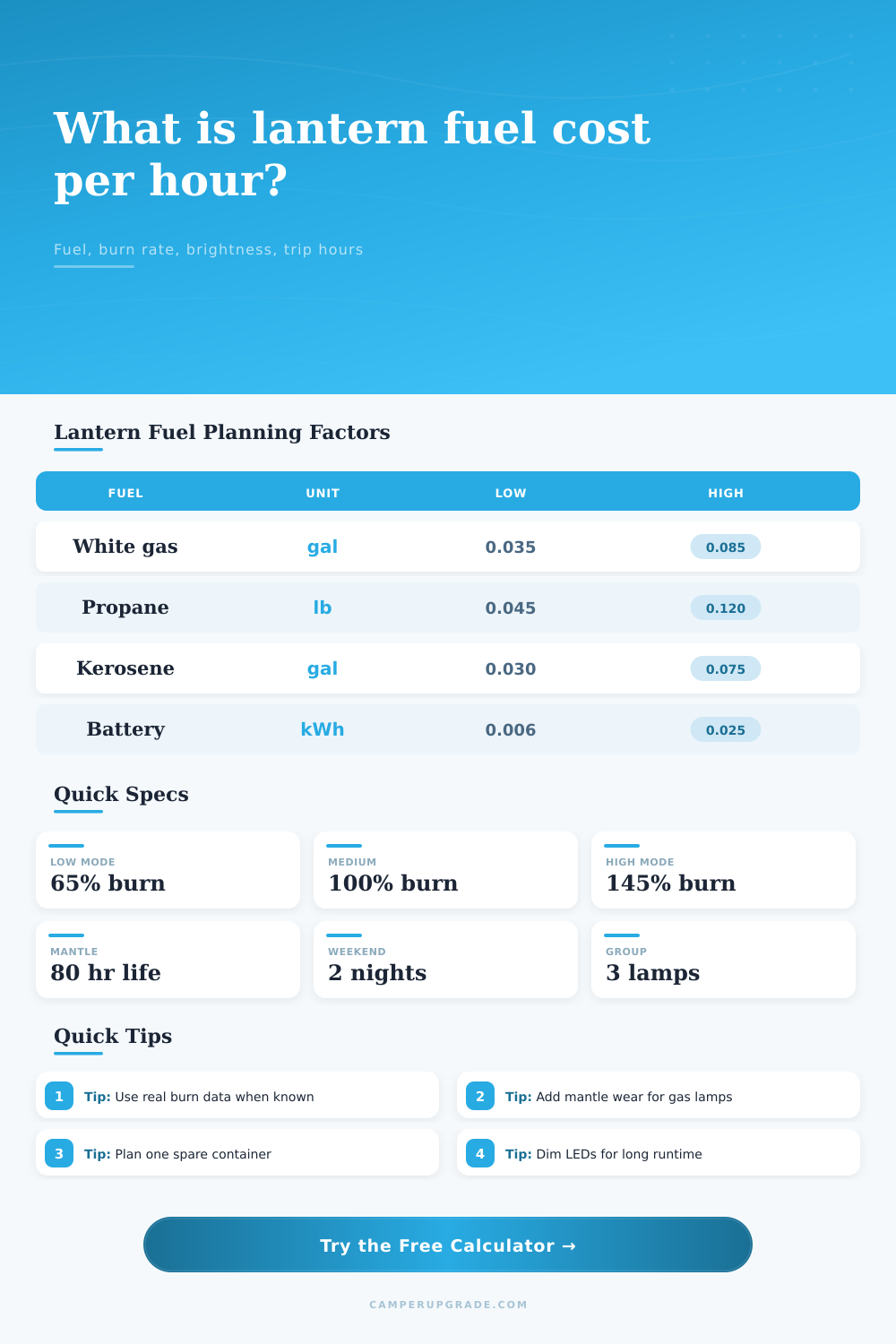
| Lantern fuel | Planning unit | Low to medium burn | High-output burn |
|---|---|---|---|
| Propane mantle lantern | lb of propane | 0.045 to 0.083 lb/hr | 0.10 to 0.13 lb/hr for very bright use. |
| White gas dual-mantle lantern | gallons of camp fuel | 0.035 to 0.060 gal/hr | 0.070 to 0.090 gal/hr when run wide open. |
| Kerosene pressure lantern | gallons of kerosene | 0.030 to 0.050 gal/hr | 0.060 to 0.080 gal/hr for large lanterns. |
| Rechargeable LED lantern | kWh from charger or pack | 0.006 to 0.014 kWh/hr | 0.018 to 0.030 kWh/hr at maximum brightness. |
| Container | Example size | Typical price | Hours at medium burn |
|---|---|---|---|
| Disposable propane bottle | 1.0 lb | $5 to $9 | About 12 hours at 0.083 lb/hr. |
| Camp fuel can | 1.0 gal | $12 to $22 | About 17 hours at 0.060 gal/hr. |
| Kerosene jug | 1.0 gal | $8 to $16 | About 22 hours at 0.045 gal/hr. |
| Recharge allowance | 0.5 kWh | $0.08 to $0.30 | About 42 hours at 0.012 kWh/hr. |
| Brightness setting | Multiplier | Best use | Planning effect |
|---|---|---|---|
| Low | 0.65x | Path marker or quiet table light | Extends fuel and mantle life for long evenings. |
| Medium-low | 0.82x | Dinner, card table, tent vestibule | Good compromise for group comfort and runtime. |
| Medium | 1.00x | Normal camp kitchen or picnic table | Uses the rated burn rate exactly as entered. |
| High | 1.45x | Cooking cleanup or task light | Raises fuel cost and can shorten mantle life. |
| Scenario | Lanterns | Hours and nights | Fuel planning note |
|---|---|---|---|
| Solo weekend | 1 lantern | 4 hr/night for 2 nights | A 1 lb propane bottle usually covers the plan with reserve. |
| Family base camp | 2 lanterns | 5 hr/night for 3 nights | Two medium propane lanterns may need three small bottles. |
| Scout patrol | 4 lanterns | 6 hr/night for 4 nights | Group lighting makes mantle wear a visible line item. |
| LED festival camp | 6 lanterns | 7 hr/night for 3 nights | Battery kWh stays low, but pack count depends on charging access. |
Propane
Simple bottle mathGood for car camping and group tables because 1 lb cylinders are easy to count, but cold weather and high brightness can raise bottle count.
White Gas
Refillable fuel canOften strong for bright mantle lanterns. The calculator works best when you enter the actual ounces or gallons burned per hour.
Kerosene
Long steady burnUseful for base camps where low to medium output runs for many hours. Include mantle or generator parts if your model uses them.
LED
Lowest hourly fuelFuel cost is replaced by recharge energy or battery pack overhead. Brightness changes runtime sharply on small battery lanterns.
Fuel Calculator: You buy a lantern that promises hours of burning time. The label on the fuel bottle are unreadable. There’s a group of friends who refuse to eat in the dark. There’s soup on the stove which must remains warm. Everyone assume that any fuel can is just like every other. Not true.
Beyond the money spent at checkout, there is other costs. These include lost efficiency and wear-and-tear. There is also the cost of human nature which is tendency to turn it up when clouds roll in.
Why You Need a Fuel Calculator
Once you know how fast you burn through fuel and what type it is, the calculator do the math for you. It saves you from trying to guess whether or not you’ll have enough for the journey.
The second factor that trips people up are the burn rate. What’s listed as a medium burn on a manufacturer isn’t what most campers does with their lanterns. It is low for mood, medium for supper time and high when looking for an ice cream bar. That determines your total gas usage.
The beauty of the tool is it lets you play around with a brightness multiplier to account for this. Want to cook? Well now you has to add more. Now your reserve buffer are depleted faster. This is important when you are way out there and supplies is limited.
Folks also forget about hardware wear. Unlike liquid fuel, mantles don’t evaporate but they do have a limited lifespan. Each light of a kerosene or white gas lantern reduce the useful life of your fabric mesh. That cost appear on the hour meter as well. It compels you to consider the actual price of your light.
For those running LEDs, it equals battery refills and/or battery cycles. If you neglect these overheads, your budget looks better then it really is. You might be shocked at how much replacements will add up in only a few weekends.
The math become more complicated when you add group dynamics. A single lantern is manageable, but four lanterns in one group create more waste heat and more fuel usage. As the table above illustrates, the size of the container increase based off the number of users. If you adjust the brightness setting as well, you can’t simply double up on fuel because you doubled the number of lanterns. Total fuel draw matter. It’s a planning puzzle that transforms what was meant to be a simple bottle purchase.
There’s another cost: cold. As temps drop, propane’s vapor pressure decreases. This means the lantern must work harder to draw in fuel or it will use it up faster. Kerosene and white gas, meanwhile, aren’t as affected by cold so they stay popular among winter campers. To compensate, the tool doesn’t model freezing physics, but it allows you to enter a buffer percentage. Fifteen to twenty percent isn’t paranoid; it’s insurance when you know that reality naturaly matches what the manual says.
It comes down to fuel selection: do you want maximum brightness or something else? If convenience matters most, propane is a good choice. The bottles aren’t too expensive and are found everywhere. Also, you don’t need to worry about burning hot to save money which would drive up the hourly cost quickly.
If price per hour is your main concern, kerosene’s got you covered. It takes longer to ignite, so you have to crank the heater to get it lit. However, the long-burning payoff will make it worth-while.
For those looking at LED, here’s why: if you can recharge it, it’ll be cheap to operate. When the battery chemistry quits, so does the light…silently.
So there isn’t one best fuel; just the fuel appropriate for your budget, your night and how much fiddling around you’re willing to do. After all, light is a resource as finite as food and water. When measured by the hourly cost, you find yourself managing it different.
That lantern is no longer a source of light; now it’s a device. You stoke it bright when work needs doing but dial down the fire for talking. Instead of carrying enough bottles to last just in case, you bring only as many as you should of figured out you’d need.
Soup warms, the reading lamp illuminates, and on the way back to the vehicle you still have half-a-tank remaining. That’s what a properly lit journey looks like.