Kindling to Log Ratio Calculator
Estimate how much tinder, fine kindling, pencil sticks, and larger starter wood you need to reliably light campfire logs.
⚡Real fire-start presets
🔥Fire load settings
🧱Kindling material comparison
📘Reference tables
| Log wood | Approx dry density | Ignition behavior | Starter adjustment |
|---|---|---|---|
| Oak or dense hardwood | 45 lb/ft³ / 720 kg/m³ | High heat after it catches, slow first face ignition | Add 20% kindling |
| Maple or birch hardwood | 40 lb/ft³ / 640 kg/m³ | Balanced heat and ignition once split dry | Add 10% kindling |
| Ash or mixed hardwood | 36 lb/ft³ / 575 kg/m³ | Reliable campwood with moderate starter need | Baseline |
| Pine or fir softwood | 28 lb/ft³ / 450 kg/m³ | Easy ignition, faster burn, more flame early | Reduce 10% |
| Cedar or spruce softwood | 24 lb/ft³ / 385 kg/m³ | Very fast ignition, short coal life | Reduce 15% |
| Compressed fire log | 55 lb/ft³ / 880 kg/m³ | Needs sustained flame on the starter edge | Add 30% |
| Moisture level | Typical reading | Kindling multiplier | Practical signal |
|---|---|---|---|
| Kiln dry | 8-12% | 0.85x | Sharp cracks, light ends, no hiss |
| Seasoned | 13-18% | 1.00x | Good firewood range for camp use |
| Borderline | 19-24% | 1.35x | Slight hiss, duller sound, slower edges |
| Damp outside | 25-32% | 1.85x | Wet bark or surface rain, needs longer flame |
| Wet or green | 33%+ | 2.60x | Steam, heavy feel, weak coal formation |
| Starter size | Diameter guide | Role in stack | Share of kindling |
|---|---|---|---|
| Tinder and shavings | Paper-thin to 1/8 in | Accepts match, spark, or cube flame | 8-15% |
| Fine sticks | 1/8-1/4 in | Builds the first sustained flame bed | 25-40% |
| Pencil sticks | 1/4-1/2 in | Bridges fine flame to thumb-size pieces | 25-35% |
| Thumb sticks | 1/2-1 in | Heats the first log faces long enough | 20-30% |
| Small splits | 1-2 in | Optional ramp for damp or dense logs | As reserve |
| Common setup | Main fuel load | Starter ratio | Kindling target |
|---|---|---|---|
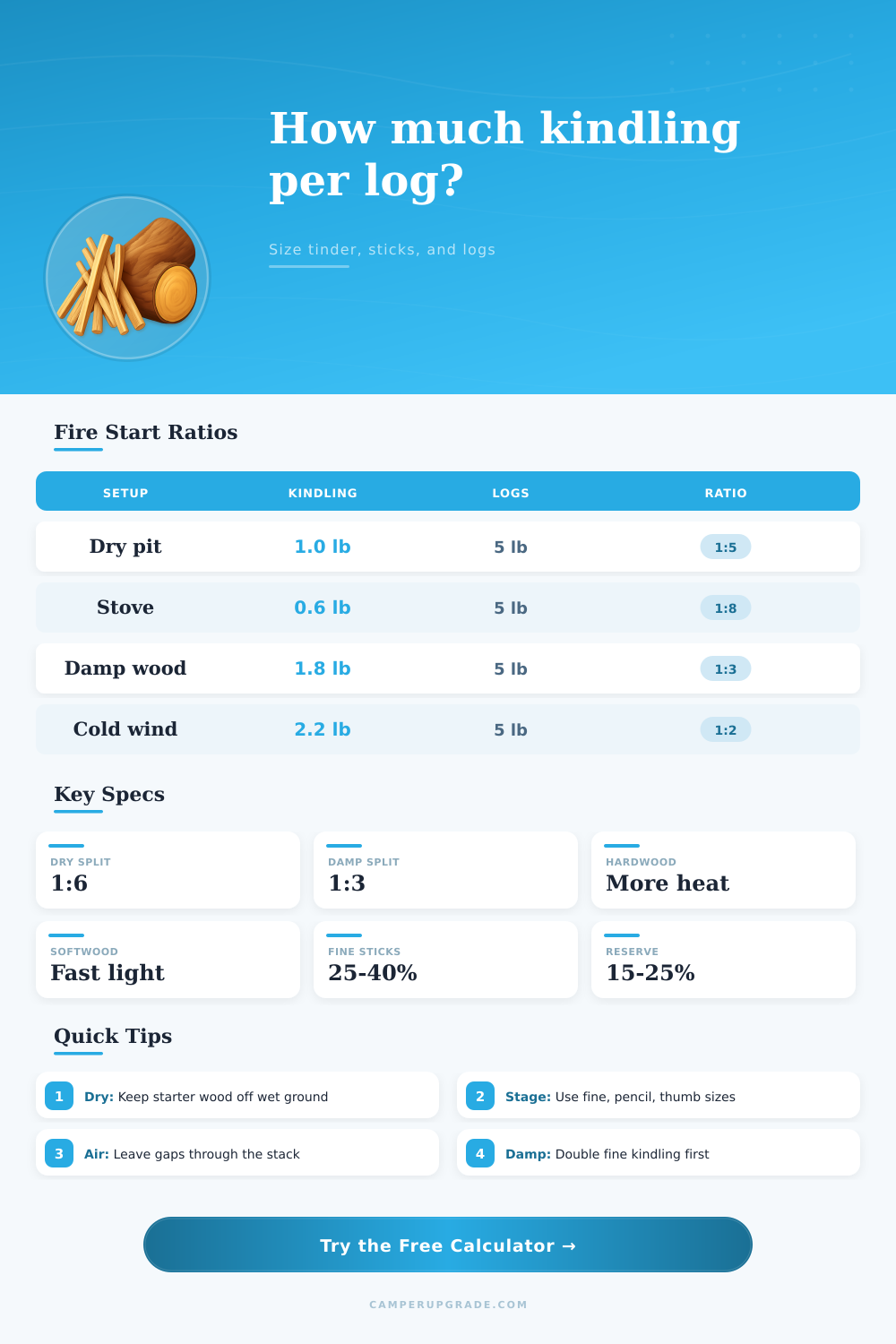
| Solo RV fire ring | 3 logs, 10-14 lb | 1:5 to 1:6 | 2-3 handful bundles |
| Family campsite fire | 5 logs, 18-28 lb | 1:4 to 1:5 | 4-6 handful bundles |
| Wood stove cold start | 2 splits, 8-14 lb | 1:7 to 1:9 | 1-2 compact bundles |
| Damp morning relight | 3 logs, 12-20 lb | 1:2.5 to 1:4 | 4-7 loose bundles |
| Cooking coal starter | 4 logs, 14-24 lb | 1:4 to 1:6 | 3-5 staged bundles |
🛠Calculation tips
You’ve got it now: you’re hot with a Tinder Cube, you’ve transferred that warmth to some other fuel; now you want to apply it to big fire. And this is where things can realy go wrong. You’ve got a tiny nest of dry shavings or birch bark glowing happily in one hand, and a perfect flame dancing right there in your palm. Then you take a step back, throw down the heavy oak logs you dragged over the campsite (and watch them snuff themselves). Too big! No air! The heat has nowhere to go but out into the night air rather then into the fuel.
What went wrong? Nothing. Not you. It wasn’t a matter of skill. It was a matter of ratio. People bring far too little intermediate fuel and far too much log. They then assume that once the spark catches, everything take care of itself by magic. Wood doesn’t burn by magic. Wood burns by heat transfer.
How to Build a Better Campfire
To solve that problem, the calculator on this page measure the gap between the little spark that starts it all and that giant pile of actual fuel. And it does so in ways that might sound insignificant, but alter physics of the ignition process. Take the moisture content parameter, for example. Yes, we know: Wet wood is hard to burn. But really, it’s an energy-budgeting thing. A single percent of moisture beyond what’s considered “seasoned” demand a lot of heat just to get the moisture out, before any of the wood will even start to break down (pyrolyze) into flaming stuff. So if you’re starting with moist logs, it’s not just a matter of having extra kindling; it’s a question of supplying a greater amount of small sticks capable of staying hot long enough to bake off some of the moisture from their surfaces. This tool factors that in by recalculating the needed amount of starter material depending on how much effort must be put toward evaporation rather than burning.
Moisture level is only part of it; there’s also a big difference in wood types,” he says. Hardwood is denser than softwood (oak or maple versus pine or cedar). This means it has more energy and burns hotter over time, but it make the wood harder to get going. Its tighter grain structure resists fire at first, requiring continued heating before it ignites. On the flip side, softer woods is easy to light up, since their fast-burning nature requires less heat at the start to get the flame going, which then heats up other stuff around it. The tool comes loaded with data on how different species behave. If you choose a very dense hardwood, the system adds more estimated starter material. This is because these logs needs heat for a longer time before they start contributing their own.
Airflow is the silent variable that ruins more fires than bad wood. Your kindling and logs could be perfectly ratioed on paper, but without any oxygen reaching the middle of the pile they’ll suffocate anyway. The fire lay styles entered into the calculator take the guesswork out by giving you an estimate of how much space is left for airflow within your structure. With a teepee structure, the heat rise up the middle, pre-heating those logs stacked above. A grid-style log cabin is stable enough, but if it’s built too tall before the base has gotten fully hot then it will choke the air. Knowing these structural variations helps you adjust your expectations. In a windy situation, you’ll want more kindling on hand. Even though the wind doesn’t blow out flames, it steals heat from the wood’s surface too fast for the fire to keep up.
The second problem is that many people just carry two sizes of fuel, thinking “I’ve got my logs, and I’ve got my tinder.” That’s a thermal gap, and there’s no way around it. Fire building involves using different sizes of material: Tinder catches, yes. But then you want a bunch of fine sticks so you can build up heat in them before moving on. Then you want pencil-sized stuff to sit on top of those and build up more heat. Then you want thumb-sized stuff to last long enough to char your first log faces. And then you want the main fuel. If you break this down into real-world bundles (the calculator does this), you get an idea of how many handfuls of each size class you’re going to need. It doesn’t let you grab at random armfuls of twigs and hope for the best.
The secret is in getting the starter right, which transforms it from a chore into a ritual. If you get the proportions right, there’s a predictable chain reaction: the logs start glowing just when the kindling burns down. You don’t need to fan or panic, or add wet paper or lighter fluid in a desperate attempt to save a dying ember. Because you gave the wood time to work up a head of steam, and showed respect for the laws of heat transfer (it lights on its own terms). That’s the difference between a roaring campfire and one that struggles.