Kayak Loading Trim Calculator
Estimate kayak load balance from paddler position, bow bags, stern bags, deck gear, water, hull capacity, and freeboard reserve before you launch.
🛶Kayak and Load Presets
⚙Hull, Paddler, and Gear Inputs
📊Quick Spec Grid
📘Kayak Loading Reference Tables
| Preset | Typical Load | Trim Concern |
|---|---|---|
| Recreational day | 10 to 25 lb gear | Paddler position dominates |
| Touring weekend | 45 to 90 lb gear | Hatch split matters |
| Fishing sit-on-top | Crate plus tackle | Stern-heavy setup |
| Expedition sea kayak | Food, water, shelter | Capacity reserve |
| Trim Offset | Meaning | Adjustment |
|---|---|---|
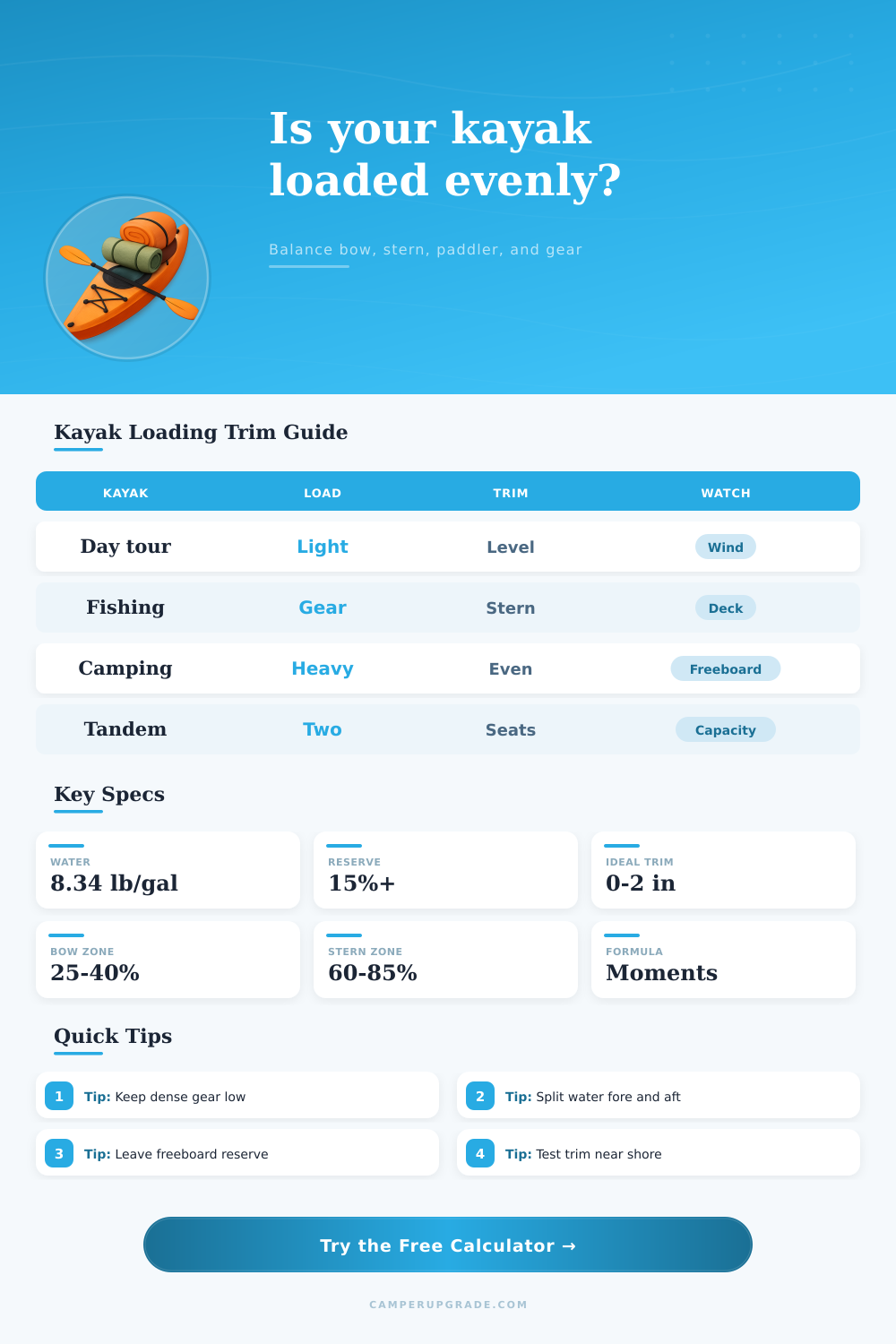
| 0 to 2 in | Near neutral | Fine for most trips |
| 2 to 5 in bow | Tracks more, wetter bow | Move gear aft |
| 2 to 5 in stern | Bow may wander | Move gear forward |
| Over 5 in | Noticeable imbalance | Repack before launch |
| Freeboard | Planning Read | Use Case |
|---|---|---|
| 8 in or more | Comfortable margin | Calm to moderate water |
| 6 to 8 in | Usable but watch waves | Protected water |
| 4 to 6 in | Low margin | Short calm outings only |
| Under 4 in | Too loaded for planning | Reduce load |
| Zone | Best Items | Reason |
|---|---|---|
| Bow hatch | Soft light bags | Prevents bow diving |
| Near seat | Water, food, stove | Lowest trim leverage |
| Stern hatch | Bulky camping gear | Uses volume well |
| Deck | Only needed items | Windage and stability |
💡Loading Tips
A loaded kayak behaves different in the water than an unloaded kayak behaves on land. Furthermore, the loaded kayak will behave differently in the water than the unloaded kayak due to the way that the kayak interacts with the waves and the wind. When a kayak is loaded, the bow may plow into the water or the stern may wander from the path that the kayaker desires for the kayak.
Each of these issue are due to the placement of the loaded weight of the kayak. The placement of that loaded weight is important because the placement of that weight will impact the trim of the kayak. The trim of the kayak is the way in which the kayak balance between it’s bow and its stern.
How to Balance Your Kayak
Calculator Dimensions
Each of the dimension of the kayak, such as the hull length and the hull beam, will impact the amount of weight that the kayak must sink before its freeboard disappear. Freeboard is the distance between the waterline and the top of the kayak hull. Freeboard is necessary for providing a safety margin against water from waves.
A kayak with a longer length and narrower hull beam will exhibit trim changes more quickly than a kayak that is wider. The long and narrow kayak will exhibit trim changes quickly because the weight is not distribute over a large area of the hull. Kayak Capacity
Kayaks will have ratings for the amount of weight that the kayak can hold.
These capacity rating will provide a starting point for the total weight of the kayak and its occupants. However, the capacity ratings are based upon ideal condition. Most kayakers will not want to come close to the maximum capacity of their kayak.
This is due to the additional weight of the water and the paddler’s wet clothing. The calculator provides the percentage of freeboard that is built into the calculator as a safety margin for these extra load of the kayak. Thus, the percentage of freeboard that is built into the calculator allows for the kayak to have a margin of safety should all of the kayaker’s cargo be load into the kayak.
Kayak Stability
One of the factor that will impact the stability of the kayak is the weight of the paddler that is rowing the kayak. The paddler may move the weight of the paddler while rowing the kayak. Any dense items, such as food and water bottle, should be placed near the seat of the kayak.
Placing the dense items near the kayak seat will allow the paddler to avoid move those items to compensate for the trim of the kayak. Items that are placed in either the bow or stern compartment of the kayak will be further from the midpoint of the kayak. Thus, these items will have a dramatic impact upon the trim of the kayak.
The trim of the kayak can be calculated based off the difference in the weight of the items that are placed in the bow and stern compartments of the kayak. A small trim offset is normal for kayaks. However, a large trim offset will impact the kayak in relation to the wind, and the kayak’s handling in following sea.
Water Weight
Water is a heavy weight, and it is a movable weight within the kayak. Thus, it is possible to split the water into two different container for fine-tuning of the kayak’s trim. However, items that are placed on the kayak’s deck will raise the kayak’s point of gravity.
These items should only be placed on the kayak’s deck if they are needed to complete the tasks that will be performed while on the water during the day. Thus, placing items on the kayak’s deck should be avoided if maintaining a low point of gravity of the kayak is the goal. Kayak Trim Calculator
Each of the measurements of the kayak’s hull and each of the weights of the kayaker and their item will impact the trim of the kayak.
The calculator help to remove the guesswork of the kayaker by calculating these variable. Thus, the kayak trim calculator allows the kayaker to understand how their kayak will sit in the water with their given amount of cargo. Furthermore, the kayakers can test the kayak in the same location where they plan to launch the kayak into the water.
Thus, it is important that the kayak be test prior to beginning a kayaking trip. Kayak Mistakes
Some of the mistake that many kayakers make include placing heavy items in the stern compartment of the kayak. This is due to the hatch that is located at the stern of the kayak.
Additionally, many kayakers often fill each compartment of the kayak with the maximum amount of the item that that compartment can contain. This leaves no freeboard for kayakers in case of wave or rescue drills. The reference tables provided on this page can help kayakers understand the typical amount of weight that each compartment should contain to keep the kayak within normal trim parameters.
Kayak Trim Adjustments
Small adjustment can be made to the items that are within the kayak to fix the trim of the kayak. For instance, one could move a dense bag of items within the kayak by a small distance, or move a water bladder closer to or further from the mid-point of the kayak. Because the kayak trim calculator instantly updates itself when an adjustment is made to any input variable, different arrangement of the kayaker’s gear can be tested while still on the dock.
Thus, the kayaker can find the best balance for their kayak prior to launching into the water with all of there gear. Kayak Trim Benefits
When the kayak is trim correctly, it will be easier for the kayaker to kayak without strain. The hull of the kayak will be in the position that was design for the kayak.
Additionally, the paddler will not have to constantly adjust the kayak due to improper trim. Instead, the kayaker can focus upon rowing the kayak forward. Furthermore, when properly trimmed, the kayak will exhibit a visible margin of error within the freeboard.
Thus, the paddler will feel confident in their kayak while on the water. Finally, it is important for kayakers to take time to measure and adjust their gear for the kayak. Thus, kayakers of all experience levels should take time to adjust the gear prior to launching the kayak.