Kayak Load Trim Balance Calculator
Estimate fore-aft trim, bow and stern load share, capacity use, freeboard reserve, and the gear move needed to balance day touring, camping, fishing, and river kayak loads.
🛶Kayak Load Presets
Your Kayak Trim Snapshot
📝Kayak, Paddler, And Load Inputs
📊Load Balance Spec Grid
📘Kayak Trim Reference Tables
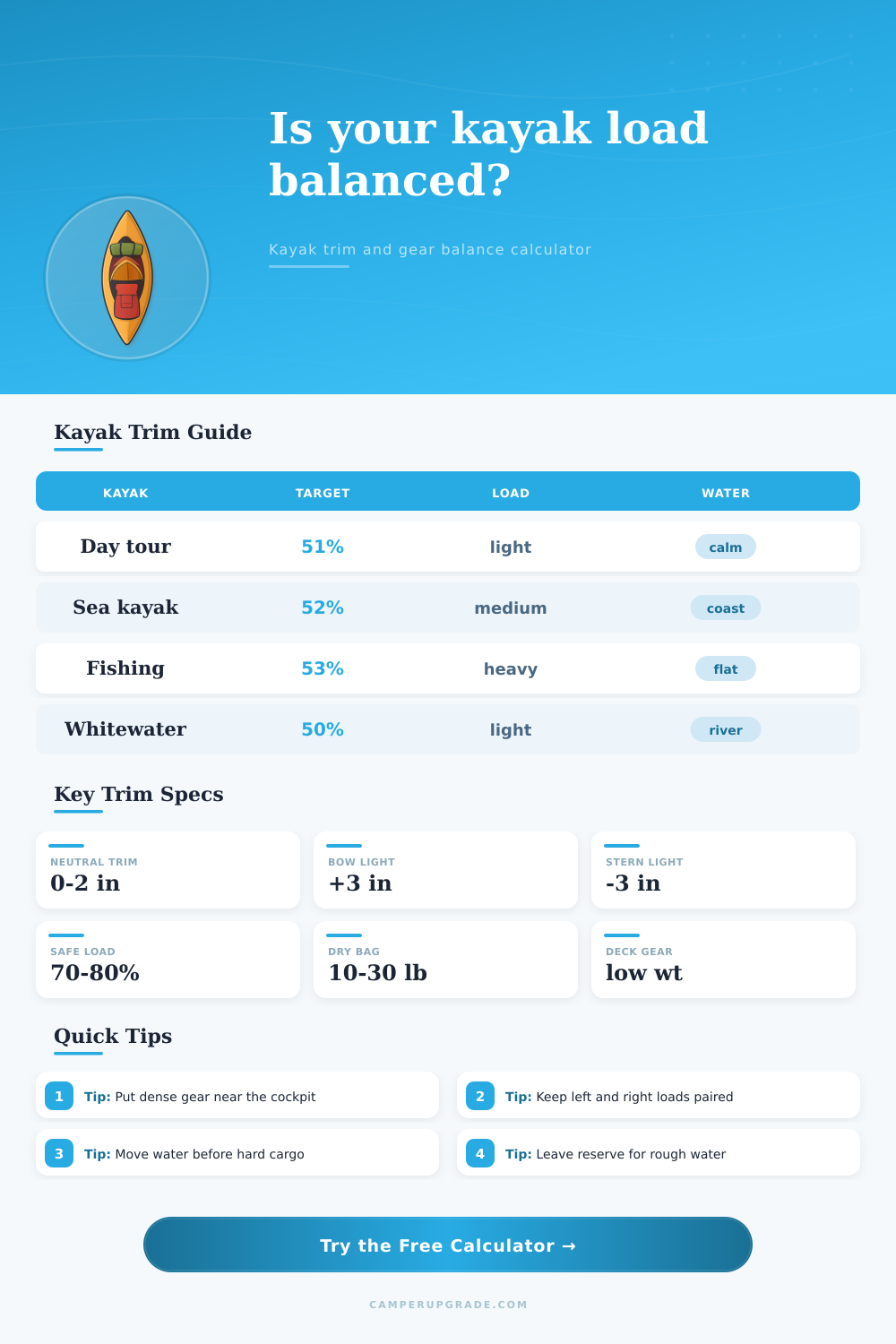
| Kayak profile | Target load center | Useful trim | Reserve guide |
|---|---|---|---|
| Recreational sit-inside | 51% from bow | Nearly level, small stern bias | 20% unused capacity |
| Touring or sea kayak | 52% from bow | Neutral to slightly stern-set | 22% unused capacity |
| Fishing sit-on-top | 53% from bow | Stern stable, bow not skipping | 25% unused capacity |
| Whitewater self-support | 50% from bow | Centered for boofs and pivots | 25% unused capacity |
| Tandem paddled solo | 52.5% from bow | Use ballast to sink the bow | 20% unused capacity |
| Packable or inflatable | 50.5% from bow | Keep dense items near center | 30% unused capacity |
| Load zone | Typical station | Best cargo | Trim effect |
|---|---|---|---|
| Bow tip and forward hatch | 10% to 35% | Light bulky dry bags, spare layers | Drops bow and reduces weathercocking |
| Front bulkhead area | 35% to 48% | Water, food, repair kit | Corrects stern-heavy camping loads |
| Cockpit and day hatch | 48% to 60% | Dense items, snacks, pump | Adds load with little trim change |
| Stern hatch | 62% to 88% | Tent, stove, clothing, crate | Raises bow if overpacked aft |
| Deck load | 40% to 70% | Only low, secured essentials | Small trim effect but raises windage |
| Water condition | Trim window | Balance priority | Capacity reserve |
|---|---|---|---|
| Flatwater or calm lake | 3 in either way | Comfortable tracking and turning | 15% to 20% |
| Wind chop or quartering wind | 2.5 in either way | Reduce bow wander and stern squat | 20% to 25% |
| Coastal swell or crossings | 2 in either way | Keep hatches high and predictable | 25% or more |
| River current and eddies | 2 in either way | Centered load for quick pivots | 25% or more |
| Surf launch or landing | 1.5 in either way | Control pearling and broaching | 30% or more |
| Common load plan | Gear weight | Center target | Practical adjustment |
|---|---|---|---|
| Day tour with lunch | 10 to 20 lb | Near seat station | Put water and kit behind knees or day hatch |
| One-night touring camp | 35 to 60 lb | 51% to 53% | Split food and water forward before tent aft |
| Fishing crate and rods | 25 to 70 lb | 52% to 54% | Counter crate weight with bow water |
| River self-support | 25 to 55 lb | 49% to 51% | Keep heavy dry bags close to cockpit |
| Long expedition | 70 to 120 lb | 51% to 53% | Pack by moment, then check hatch clearance |
💡Trim Calculation Notes
There’s a certain kind of panic that sets in while paddling out on a big lake when you realize that the water is creeping up toward your cockpit faster then expected. At first it squats just a bit at the stern, then there’s some obvious drag. Before you notice it, you’re feeling the resistance… Every stroke seem slow and heavy. Most times that’s your load trim issue; either you’ve got too much weight to the rear or not enough to the front to maintain the bow up on top of the water.
Ounces of shifted gear make all the difference between a struggle and a glide by changing how many inches of the boat sits above the water. To understand trim is to realize that basically, it’s the angle that your boat floats relative to its length. Too much trim on the stern makes the boat sit too flat. This means it will fight your steering whenever you try to turn. This is otherwise known as weathercocking into the wind.
How to Balance Your Kayak
Too much trim on the bow (pearling) means it digs into waves, or worse, plows through chop with too much drag. You find the best way to manage how weight distribution affect your kayak’s interaction with water by trimming out. Not floating. It move efficiently and predictably.
Once you know what’s going on inside the hull, the tool above does the math for you, no guesswork necessary about where center of gravity really is. But what about inputs? Inputs are the leverage points on your hull. The inputs matter more than most paddlers realize because they define the leverage point on your hull.
Think of it like this: entering your seat station percentage tells the system how far forward or back your heaviest mass (you) sits from the bow of the kayak. Most tour kayaks is designed to sit somewhere near 52% from the bow, meaning they have some slight aft bias for improved tracking. Fishing kayaks tend to sit flatter and wider, so they may seek a bit farther back to maintain a dry rod holder.
Inputting weight in your deck loads or even bags in the stern and/or bow hatches tell the system moments that draw the boat in certain ways. Those moments is calculated against your overall load to determine whether they cancel each other out or create a net lean.
Trim also becomes very different depending on water conditions. What’s comfortabley and barely noticeable with a couple inches of offset on a quiet river can be treacherous when you’re dealing with cross winds or big swells pounding the low side of the boat. The table on the page do a good job outlining this with narrow trim windows needed for rougher water.
That’s why reserve capacity is so important. When you leave yourself some room in your hull, it give you a buffer from something like water ingress or an unexpected shift of weight. Going all-out at a hundred percent means there’s nowhere to go but down.
One common error among many new paddlers is packing their heaviest gear (tool kit), water jugs, into the most convenient hatch instead of the most strategic hatch. If there’s a five-pound discrepancy in weight between left and right, it will cause a constant heel, tiring your core muscles over time. This side-to-side imbalance, while every bit as important to stability as fore-aft balance, is something the calculator check for.
Liquids are easily shifted without unpacking dry bags; moving water ballast forward or aft is the simplest way to adjust trim. It let you set boat’s balance before launching. Boats with adjustable seats will allow you to adjust your seating position to fit the weight of gear. If you’re packing too much in the rear of the boat, you can slide your seat forward a couple inches to offset the stern weight. This moves your leverage point and may work better than repacking everything.
Done right, this is more of a mechanical fix rather then having to buy something else. You should of adjusted it before launch. Balance and buoyancy are constants no matter what trip you take; knowing their trade-offs will help you make adjustments on the fly, whether it’s a day of fishing or an overnight adventure.
Neutral stability is ideal so it floats level when you’re done, with just a little freeboard to get through whatever comes next. Want the bow up for chop, but down enough to keep it from getting out of hand. Some of those details are felt in the water. Some take practice. But all can be planned for on dry land to take the guesswork out.
Planning for balance means that no matter what is stashed inside, your energy will go where it needs to, forward motion, not into a fight against the kayak’s natural desire to squat or list. The secret is knowing what they mean when they say this. Even if you’ve got a lot of weight in the boat, if it’s trimmed right, it’ll feel like an extension of yourself, light and responsive.