Kayak Cockpit Size Calculator
Compare paddler height, hip width, inseam, foot size, shoes, cockpit dimensions, deck height, thigh brace clearance, and spray skirt size to estimate kayak fit.
🛶Kayak Fit Presets
⚙Paddler And Cockpit Inputs
📏Cockpit Spec Grid
📋Reference Tables
| Kayak type | Length | Width | Fit target |
|---|---|---|---|
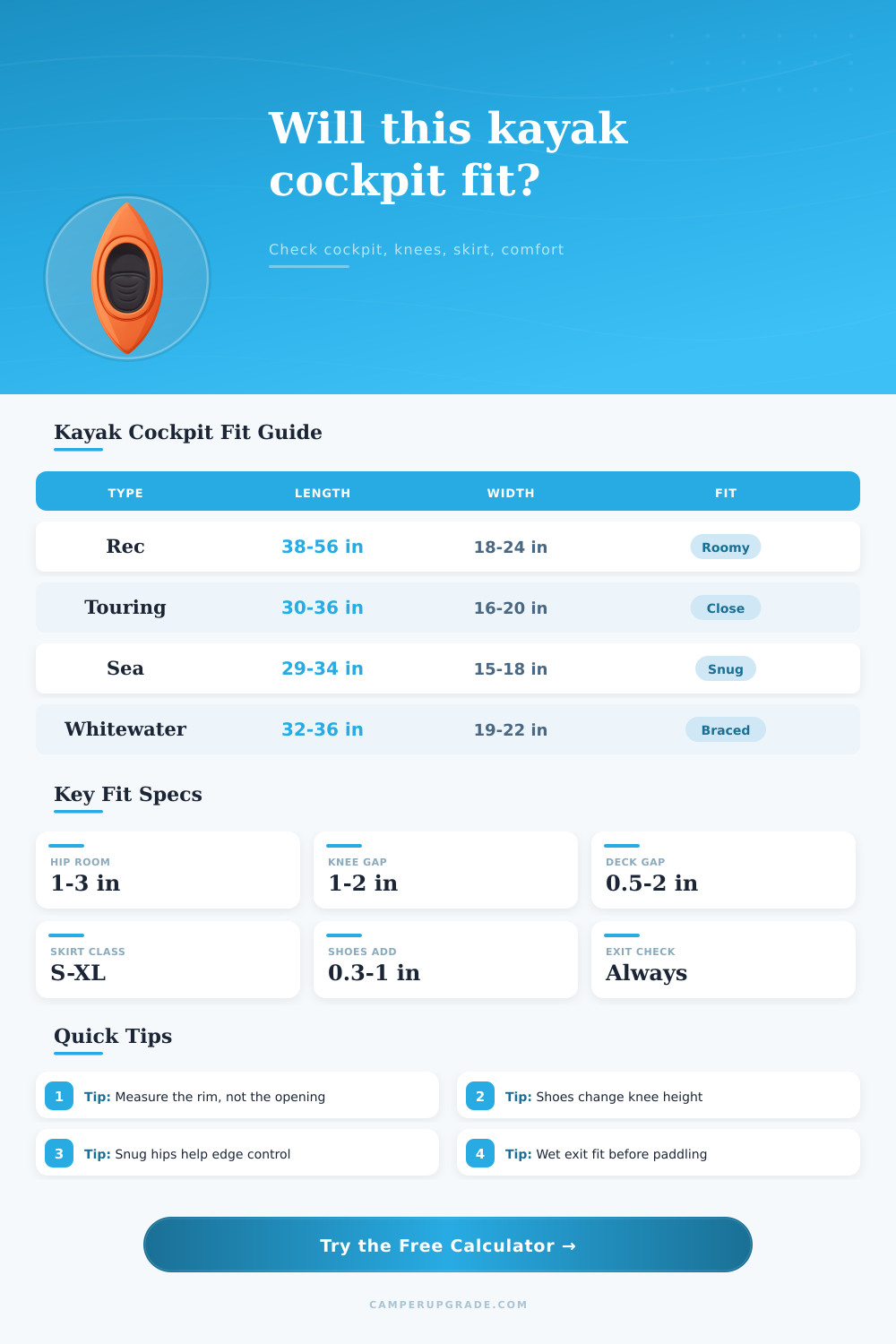
| Recreational sit-inside | 38-56 in | 18-24 in | Easy entry, roomy hips |
| Day touring | 34-40 in | 17-21 in | Comfort with moderate control |
| Sea kayak | 29-35 in | 15-19 in | Close thigh and hip contact |
| Whitewater creek | 32-36 in | 19-22 in | Braced knees and fast exit |
| Performance low deck | 28-33 in | 15-18 in | Snug control, low shoe bulk |
| Skirt class | Rim length | Rim width | Common use |
|---|---|---|---|
| XS | 26-30 in | 14-17 in | Small sea or Greenland cockpit |
| S | 29-33 in | 15-18 in | Compact touring cockpit |
| M | 32-36 in | 17-20 in | Touring and many whitewater boats |
| L | 35-39 in | 19-22 in | Large touring or creek cockpit |
| XL | 38-45 in | 21-24 in | Large rec or fishing cockpit |
| XXL | 45-56 in | 22-26 in | Oversize recreational cockpit |
| Measurement | How to take it | Good margin | Warning sign |
|---|---|---|---|
| Hip width | Sit flat, measure side to side | 1-3 in total room | Pinching or sliding |
| Inseam | Crotch to floor in paddling shoes | Feet reach pegs | Knees forced high |
| Deck height | Inside deck near knees | 0.5-2 in above knee | Numb legs or jammed toes |
| Thigh brace | Room under brace contact point | Light contact | No release path |
| Rim size | Outer coaming length and width | Matches skirt class | Skirt pops or cannot stretch |
| Fit result | Margin | Likely feel | Action |
|---|---|---|---|
| Tight | Under 0 in | Pressure or hard exit risk | Try more deck, width, or thinner shoes |
| Snug | 0-1 in | Precise control | Best for skilled touring or whitewater |
| Balanced | 1-3 in | Comfort plus control | Good all-around target |
| Roomy | 3-6 in | Easy entry and relaxed knees | Add hip pads if control feels loose |
| Loose | Over 6 in | Low boat contact | Choose smaller cockpit for edging control |
Cockpit and spray skirt labels are not fully standardized. Use measured rim length and width when comparing boats, skirts, and brand charts.
💡Fit Tips
Choosing a kayak depend on whether the kayak will fit the body of the person who will use it. The size of the cockpit of a kayak is important to consider because the size of the cockpit will impact the way that a person enters the kayak, controls the kayak, and how comfortable the persons knee will feel while wearing clothes. While many people will only find out if the kayak will fit their body while sitting within the kayak, there are specific measurement that can be used to determine if a kayak will fit a person prior to going to the water to test the kayak for function.
The measurements of a person that must be used to determine if a kayak will fit a person are the measurement of the hips and legs of the person. You must measure the width of a person’s hips while they are sitting because the width of a person’s hips will determine how much room that they will have on the sides of there body. The inseam and foot length of a person must be combined to determine how high a persons knees will rise while within the kayak.
How to Choose a Kayak That Fits Your Body
The deck height of the kayak at a persons knees measured from within the kayak will determine if a persons knees will have clearance while wearing shoes. Finally, a person must measure the thickness of their calves relative to the kayaks thigh braces because a person must make contact with those thigh braces to operate the kayak effective. Each of these measurements interact with the cockpit rim of the kayak, which allows for the creation of a calculator that incorporate each of these measurements along with the length and width of the kayak.
The shape of the cockpit also impacts which type of spray skirts will be required to fit over the cockpit rim of that kayak. The length and the width of the cockpit rim will determine a class label for the kayak, which will indicate which commercial spray skirts will fit that kayak model. Should the spray skirt that is purchased for the kayak not match with the calculated class for the rim, the seal of the spray skirt may not be reliable; the skirt may be too small for the person to perform a wet exit from the kayak, or the skirt may be too large to prevent water from entering the kayak while the person paddles the kayak.
Depending upon the type of kayak that is to be used, there are different requirement for each of the body measurements of the kayaker. For example, kayaks that are used for more recreational purposes will have large cockpits that allow the kayaker to easily enter the kayak and have less pressure on their hips and knees. Touring and kayaks used for sea trips have smaller cockpits to allow the kayaker to have more contact with the kayak, which provides more control and improves the kayakers ability to recover from rolling the kayak.
Kayaks that are used for navigating narrow streams of water are constructed to have enough space for the kayaker to operate the kayak effective, yet provide enough space for the kayaker to perform a wet exit from the kayak after it may have capsized. Finally, kayaks used for fishing have more room within the cockpit for the kayaker, as they may be within the kayak for many hours and may be wearing extra clothing. Each of these types of kayaks have different margins for measurements within the cockpit, which impact the design of the cockpit.
The thickness of a persons shoe may also be a measurement that is overlooked when considering kayak fit. The thickness of a persons shoe can impact the clearance of the persons toes and knees within the kayak; the more thickness that is introduced with neoprene or rubber inserts, the more a persons toes and knees will rise from the deck of the kayak. Thus, a person may need more clearance for their toes and knees within the kayak if they are fishing in cold water.
To account for this, the kayak cockpit clearance calculator for the kayaker will include a field for the thickness of a persons shoes. This field will subtract the thickness of a persons shoes from the clearance for that persons knees within the kayak, which will allow the kayaker to understand the clearance that their knees will have within the kayak prior to putting on their shoes. While there is no calculator that can completely take the place of testing the kayak that a person is considering purchasing, the calculator may help the person to recognize any problem with the kayak that may not be immediately visible in the photographs of the kayak.
For instance, if the calculator reveals that a person will have negative clearance within their kayak, that means that the kayak will feel too tight for that person when they start to move within the kayak. The same measurements that are used to calculate the fit of a person within a kayak will allow a kayaker to understand if the kayak will be functional for that kayaker; however, the individual should of still perform a wet exit onto flat water prior to purchasing the kayak. Each of the reference tables within the calculator will provide information regarding the sizes of rim and spray skirts, which will allow the kayaker to compare those values between different kayak brand.
Each of these measurements can help to find the perfect kayak for a person whose body feature certain attributes. By ensuring that the hip room within the kayak, the knee clearance, and the fit of the spray skirt are all within an appropriate range, the kayak will feel as if it is an extension of the body of the kayaker while within the kayak. Through finding a kayak that appropriately fits the body of the kayaker, a person will develop a preference for that kayak over one that they may only tolerate.