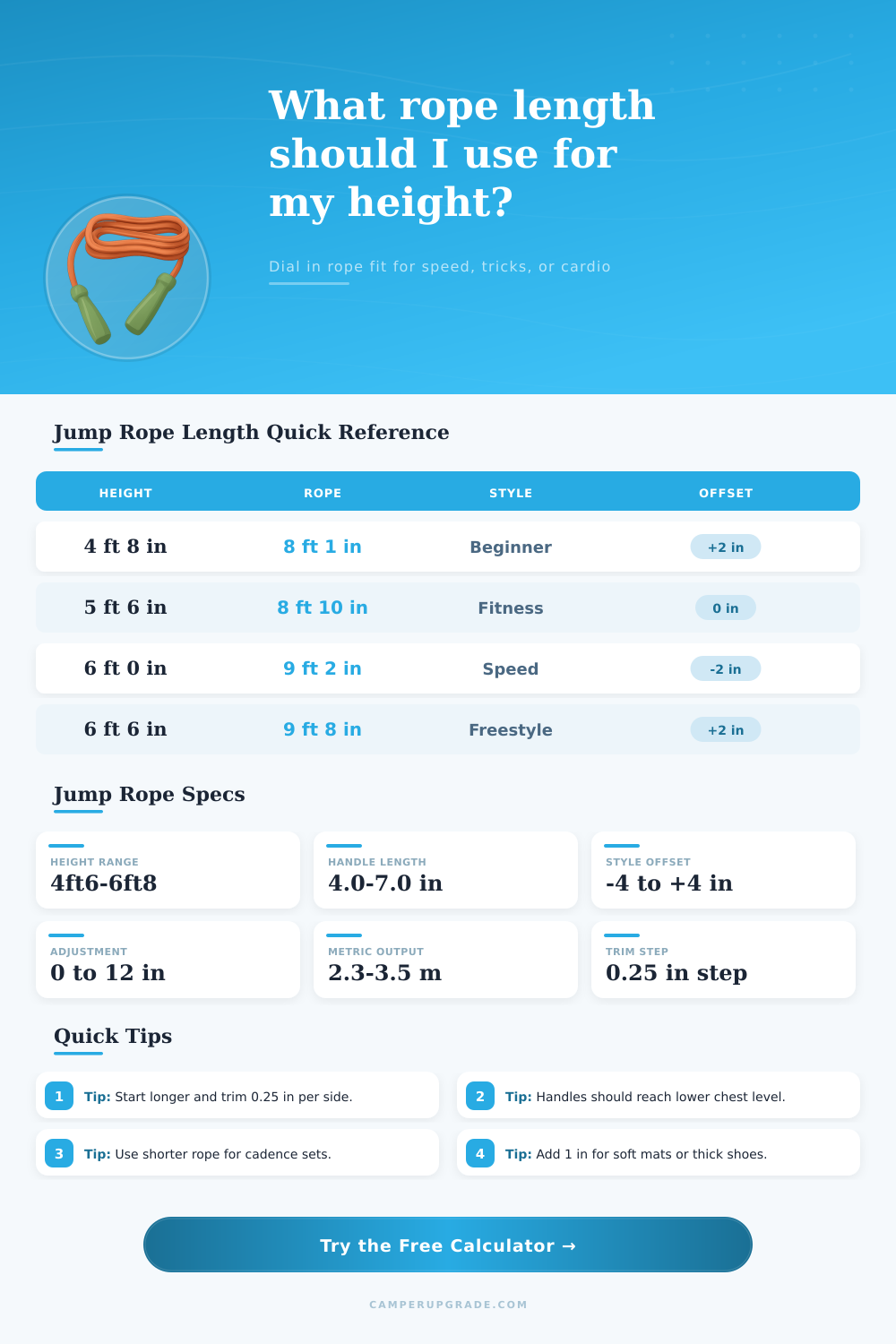
Jumping Rope Length Calculator
Estimate rope fit from athlete height, style, handle size, and training surface for reliable cadence and clean turnovers.
🏋️Athlete Presets
⚙Rope Sizing Inputs
📊Rope Length Spec Grid
🧵Rope Material Response Grid
📘Jump Rope Reference Tables
| Athlete Height | Starter Rope | Metric Starter | Typical User |
|---|---|---|---|
| 4 ft 6 in to 4 ft 10 in | 8 ft 0 in | 2.44 m | Youth beginner |
| 4 ft 11 in to 5 ft 3 in | 8 ft 4 in | 2.54 m | Cardio entry level |
| 5 ft 4 in to 5 ft 8 in | 8 ft 8 in | 2.64 m | General fitness |
| 5 ft 9 in to 6 ft 1 in | 9 ft 2 in | 2.79 m | Mixed style athlete |
| 6 ft 2 in to 6 ft 5 in | 9 ft 6 in | 2.90 m | Longer stride jumper |
| 6 ft 6 in to 6 ft 8 in | 9 ft 10 in | 3.00 m | Tall athlete baseline |
| Style Mode | Length Offset | Target Feel | Cadence Range |
|---|---|---|---|
| General Fitness | 0 in | Balanced clearance | 120 to 150 rpm |
| Speed Intervals | -3 in | Fast turnover | 150 to 190 rpm |
| Double Under | -2 in | Tight arc control | 130 to 170 rpm |
| Boxing Footwork | -1 in | Quick rhythm change | 130 to 165 rpm |
| Freestyle Skills | +2 in | Extra swing room | 110 to 145 rpm |
| Endurance Sets | +1 in | Lower trip risk | 100 to 135 rpm |
| Handle Length | Total Rope | Cable Cut | Per Side Deduction |
|---|---|---|---|
| 4.5 in handles | 9 ft 0 in | 8 ft 3 in | 4.5 in per side |
| 5.0 in handles | 9 ft 0 in | 8 ft 2 in | 5.0 in per side |
| 5.5 in handles | 9 ft 0 in | 8 ft 1 in | 5.5 in per side |
| 6.0 in handles | 9 ft 0 in | 8 ft 0 in | 6.0 in per side |
| 6.5 in handles | 9 ft 0 in | 7 ft 11 in | 6.5 in per side |
| 7.0 in handles | 9 ft 0 in | 7 ft 10 in | 7.0 in per side |
| Scenario | Height | Recommended Rope | Adjustment Note |
|---|---|---|---|
| Youth beginner | 4 ft 8 in | 8 ft 1 in | Keep +2 in while learning |
| Gym cardio | 5 ft 4 in | 8 ft 8 in | Neutral setup for consistency |
| Boxing session | 5 ft 8 in | 8 ft 9 in | Trim slightly for rhythm drills |
| Speed ladder | 6 ft 0 in | 9 ft 0 in | Use tighter arc for turnover |
| Freestyle flow | 5 ft 10 in | 9 ft 4 in | Add room for side swings |
| Tall athlete | 6 ft 6 in | 9 ft 8 in | Keep apex near lower chest |
Finding teh correct length for a jump rope is a necessary step in the process of jump with efficiency and effectiveness. Finding the correct length for a jump rope will ensure that an individual can maintain a consistant jumping rhythm. If the length of a jump rope is too short, it will drag against the floor and trip an individual as they jumps.
On the other hand, if a jump rope is too long, it will swing too widely during jumping, making it difficult to maintain a fast jumping pace. To determine the proper length for a jump rope, an individual must take into consideration there height, jumping style, and jumping surface. The height of an individual is the primary determining factor for the length of the jump rope.
How to Find the Right Jump Rope Length
Many individuals finds their jump rope length by standing on the middle of the jump rope and adjusting the handles so that they are at the level of an individual’s armpits or chest. Taller individuals require jump ropes that are longer than shorter individual. In addition to an individual’s height, the inseam length of an individual may also factor into the measurement of the proper length of a jump rope.
An individual with a longer inseam may require jump rope handles that are lower to the ground than an individual with a short inseam length. The jumping style that is perform will also influence the length of the jump rope that is required. For instance, individuals who perform speed jumping require shorter jump ropes than those who jump in freestyle.
This is because the freestyle jumping style allow for tricks and side jumps that require the jump rope to have extra slack. Jumping for endurance use a balanced jump rope that minimize the risk of tripping when jumping for extended periods. An individual’s skill level also impact how jump ropes are measured.
Beginners require jump ropes that are longer than elite jump rope athletes. This is because beginners will trip more with shorter jump ropes. Conversely, elite jump rope athletes can handle shorter jump ropes when perform tricks like double unders.
The jumping handles for jump ropes also play a role in the length of the jump rope. Jump ropes with longer jumping handles will require an individual to trim the jump rope to account for the length of the handle. Shorter jumping handles will require an individual to purchase a jump rope with a shorter length.
The jumping surface for an individual will also influence the length of the jump rope. If an individual jumps on a foam mat, an inch should be added to the length of the jump rope. This is because foam mats will absorb the jump of an individual.
An individual jumping on concrete may want to use a jump rope with a tight range of motion. The material of a jump rope will also impact its length. Jump ropes with wire jump ropes will require shorter jump rope lengths than those that utilize weighted jumping ropes.
To determine the length of the jump rope that will work best for an individual, the individual should stand on the middle of the jump rope and adjust the jump rope handles to be near the nipples for jumps that require speed, or the handles should be near the chest for individuals who wish to maximize their jumping endurance. If an individual jumps with the jump rope and the rope hits their heel, the jump rope is too short and needs to be cut. If the jump rope hits the ground too soon or too frequently, it is too long for the individual to jump with.
Jumps ropes should be trimmed in quarter inch increments so that an individual does not accidentally cut the jump rope too short. Small adjustments to the length of a jump rope should be performed by cutting the rope in quarter inch increments and testing it after each cut to ensure that the jump rope is not trimmed too much. If an individual overtrims a jump rope, it may become too short to be of much use to that individual.
In this case, the individual would of had to purchase a new jump rope. An individual should always purchase a jump rope that is longer than they require because it is easier to shorten a jump rope than to lengthen it. If an individual feels that they are not sure of the length of the jump rope required for them, they should jump fifty time with the jump rope to test it for effectiveness.
Only after confirming that the jump rope is of the incorrect length should an individual adjust the length of the jump rope. Following this process will ensure that an individual’s jump rope will be of the correct length for the individual’s jumping needs.