Jerky Yield Calculator
Estimate finished jerky weight, yield percentage, servings, dehydrator trays, and batch count from raw meat weight, trim, marinade change, moisture loss, cut thickness, and packaging loss.
Jerky batch estimate
Your finished jerky estimate will appear here.
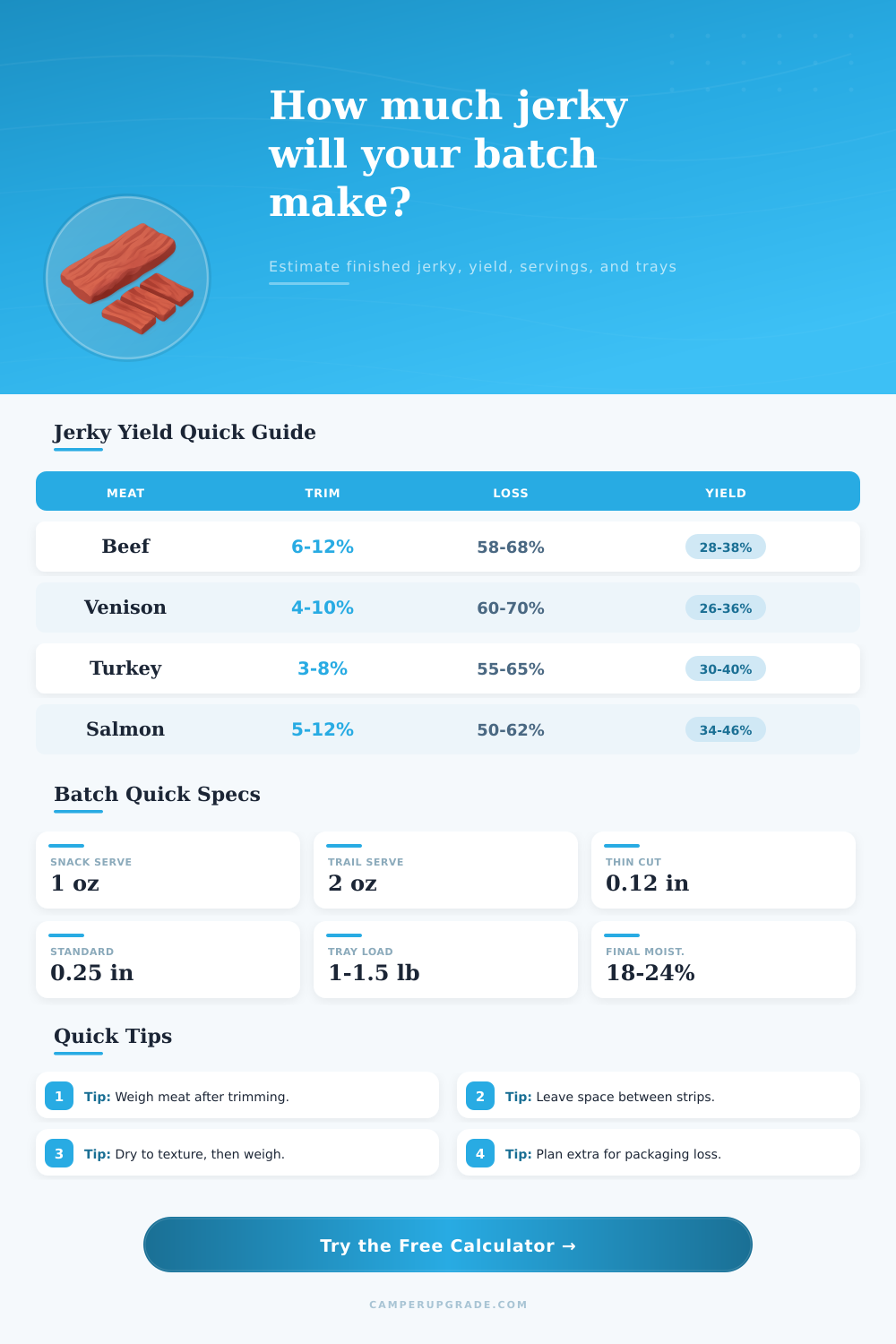
| Meat type | Typical trim | Drying loss from marinated weight | Finished yield from raw | Batch note |
|---|---|---|---|---|
| Beef round or flank | 6% to 12% | 58% to 68% | 28% to 38% | Lean, predictable, easy to slice evenly. |
| Venison or game | 4% to 10% | 60% to 70% | 26% to 36% | Very lean meat often dries lighter and firmer. |
| Turkey breast | 3% to 8% | 55% to 65% | 30% to 40% | Lower trim but a softer texture when left moist. |
| Salmon strips | 5% to 12% | 50% to 62% | 34% to 46% | Higher fat and moisture can finish heavier. |
| Elk or bison | 4% to 9% | 60% to 70% | 26% to 36% | Lean game-style batch for trail packing. |
| Lean pork loin | 8% to 16% | 56% to 66% | 28% to 38% | Trim surface fat closely before marinating. |
| Raw meat weight | Low yield 28% | Typical yield 34% | High yield 40% | 1 oz servings |
|---|---|---|---|---|
| 2 lb / 0.9 kg | 0.56 lb | 0.68 lb | 0.80 lb | 9 to 13 |
| 5 lb / 2.3 kg | 1.40 lb | 1.70 lb | 2.00 lb | 22 to 32 |
| 8 lb / 3.6 kg | 2.24 lb | 2.72 lb | 3.20 lb | 36 to 51 |
| 10 lb / 4.5 kg | 2.80 lb | 3.40 lb | 4.00 lb | 45 to 64 |
| 15 lb / 6.8 kg | 4.20 lb | 5.10 lb | 6.00 lb | 67 to 96 |
| 20 lb / 9.1 kg | 5.60 lb | 6.80 lb | 8.00 lb | 90 to 128 |
| Cut thickness | Thickness in mm | Moisture loss tendency | Tray loading cue |
|---|---|---|---|
| 1/8 in thin | 3 mm | Higher loss, lighter finished strips | Can fit more strips, avoid overlap. |
| 3/16 in medium | 5 mm | Balanced drying and chew | Good general dehydrator load. |
| 1/4 in standard | 6 mm | Classic jerky yield and texture | Leave air gaps between pieces. |
| 3/8 in thick | 10 mm | May finish heavier if left flexible | Use lighter tray loads and rotate. |
| Dehydrator setup | Raw load per tray | Five-tray raw capacity | When to reduce load |
|---|---|---|---|
| Compact round trays | 0.75 to 1.0 lb | 3.75 to 5 lb | Wet marinade, thick slices, crowded center. |
| Standard home trays | 1.0 to 1.4 lb | 5 to 7 lb | Sticky glaze or uneven strip width. |
| Large square trays | 1.4 to 2.0 lb | 7 to 10 lb | Low airflow corners or very lean game. |
| Cabinet dehydrator racks | 2.0 to 3.0 lb | 10 to 15 lb | Thick strips that need extra spacing. |
Yield ranges are planning estimates. Actual jerky weight depends on slice thickness, meat leanness, marinade solids, airflow, drying endpoint, and how much crumb or edge trim is kept.
Making jerky at home will result in the jerky having a lower weight than the initial weight of the raw meat that you started with. The raw meat will lose weight at several stages of the jerky making process. Each of the factor that contribute to the reduction of the weight of the jerky can be accounted for in the planning of the jerky making process.
In planning for the jerky making process, then, you must account for the fact that the final weight of the jerky will be lower than the weight of the jerky that you purchases from the store. One of the major loss of the weight of the jerky is the loss of trim loss that occurs prior to the drying of the meat. Many individuals does not account for trim loss in they estimation of how much jerky they can produce from a given pound of raw meat.
Why Homemade Jerky Loses Weight
It is necessary to remove the fat, silverskin, and the ragged edge of the raw meat prior to drying the meat strips in order to ensure that the resulting jerky is of high quality. However, this removal of fat and silverskin will reduce the weight of the jerky that is produce. It is necessary to account for this loss of weight prior to the drying of the meat.
If you dont account for trim loss, you will find that you have less jerky then you had planned to produce. The weight of the jerky can also be affected by the use of marinade. The marinade add weight to the raw meat while it is marinated in the marinade.
However, when you remove the marinade from the raw meat, the marinated meat will lose some of that added weight. While the loss of weight of the jerky due to the draining of marinade is usually small, it is still a loss of weight of the jerky that must be accounted for. The weight of the marinated jerky will be the weight that you start with during the dehydration process.
Another major loss of weight of the jerky is due to the dehydration process. During dehydration, the water from the jerky strips are lost. The amount of water that is lost from the jerky strips result in the jerky losing between fifty-five and seventy percent of its initial weight.
The amount of weight that is lost during dehydration depends upon the thickness of the jerky strips that is made, the amount of airflow within the dehydrator, and the moisture level that you want in the jerky strips that are produced. The longer that you allow the jerky strips to dry in the dehydrator, the more water that will leave the jerky strips, resulting in a lower weight of jerky strips. Finally, there is a loss of weight due to packaging loss.
Some jerky may fall in the packaging process, or some jerky strips may stick to the rack within the dehydrator. While the amount of jerky that is lost during packaging is usually minimal, such loss of weight need to be accounted for. The weight of the jerky that ends up in the container will be less then the weight of the jerky that dried in the dehydrator.
There are several factors that will impact the weight of the final jerky that is produced. Each factor will impact the weight of the jerky differently. For instance, the humidity of your kitchen will impact the drying time of the jerky.
The type of meat that you use can impact the amount of water that the meat will lose during the dehydration process. Venison will lose more weight during dehydration then beef jerky, for instance, and fish jerky will dry at a different rate than beef jerky. Each of these factor will impact the weight of jerky that is produced.
It is best to weigh the jerky at each stage of the jerky making process. Weigh the raw jerky, the trimmed jerky, the marinated jerky, and the finished jerky. Not only will you recognize how much jerky you produce with each batch of raw jerky, but you can use that information to produce the amount of jerky that you would like to produce in the future.